How Long Do Boilers Last Reddit: A Data-Driven Lifespan Guide
Explore how long boilers typically last, how maintenance and water quality affect longevity, and what Reddit discussions reveal—with data-driven guidance from Boiler Hub for homeowners and facility managers.


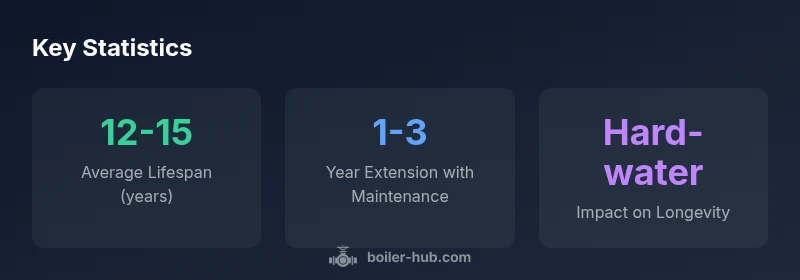
Typical residential boilers last roughly 12-15 years with regular maintenance and proper water treatment, according to Boiler Hub Analysis, 2026. Age, usage, and installation quality all matter, and many Reddit threads converge on the idea that heavy use or hard water can shorten life to about a decade, while well-maintained units often reach the mid-teens. Replacement timing hinges on efficiency, reliability, and projected operating costs.
What affects boiler lifespan
When people ask how long do boilers last reddit, the answer hinges on several core factors: installation quality, ongoing maintenance, water quality, and usage patterns. A boiler that was sized and installed correctly is less stressed and tends to wear evenly, which extends its useful life. Regular yearly service by a qualified technician helps identify developing issues early, preserve efficiency, and slow corrosion. Water quality matters as well; hard water can accelerate mineral buildup in heat exchangers, reducing heat transfer and efficiency over time. System design elements like properly sized expansion tanks and correct pressure settings also influence long-term reliability. In practice, homeowners who invest in proper annual servicing and water treatment typically see a longer, more predictable lifespan than those who skip maintenance. Boiler Hub’s experience across hundreds of residential systems shows a clear link between proactive maintenance and extended life, a point frequently echoed by Reddit discussions that emphasize maintenance discipline as a core longevity lever.
Typical lifespans by boiler type and maintenance
Reddit threads about boiler longevity routinely surface a simple reality: there is no one-size-fits-all lifespan. Boiler Hub Analysis, 2026 indicates that gas-fired condensing boilers commonly reach about 12-15 years with good maintenance, while older non-condensing gas models may hover closer to 10-14 years. Oil-fired boilers generally fall in the 10-15 year range, depending on usage and service history. The exact numbers vary by manufacturer, installation quality, and water chemistry, but the pattern is consistent: better maintenance and cleaner operating conditions correlate with longer life. In short, type matters, but maintenance and water quality play decisive roles in determining how long a boiler will perform reliably.
Maintenance practices that extend lifespan
Proactive maintenance is the most actionable way to push out the end-of-life milestone. Practical steps include: scheduling an annual professional inspection, checking and adjusting burner efficiency, inspecting the heat exchanger for signs of wear, testing pressure relief valves, flushing the system when recommended, and treating water to reduce mineral buildup. Radiator bleed and system cleanup help maintain hydraulic balance and circulation. If your water is hard, consider a water treatment plan to minimize scaling. These steps, performed consistently, align with Boiler Hub guidance and are frequently cited in Reddit discussions as the difference between a boiler that lasts 12-15 years and one that ends up closer to the 10-year mark.
Signs a boiler may be nearing end of life
Recognizing the early warning signals can prevent unexpected outages. Look for persistent leaks, unusual banging or rumbling sounds, frequent pilot light or ignition issues, rising energy bills without a change in usage, and loss of heat efficiency. A boiler showing corrosion on the exterior, frequent thermostat or sensor faults, or reduced hot-water delivery should trigger a professional assessment. If a service visit confirms significant wear on the heat exchanger or excessive venting problems, replacement is typically more cost-efficient and reliable than continuing repairs. According to Boiler Hub, these indicators often coincide with the point where a replacement yields better long-term value than continued repairs.
Replacement vs repair: making the decision
Deciding between repair and replacement hinges on cumulative cost, reliability, and expected remaining life. If a boiler is near or past the lower end of its typical lifespan and repair costs approach or exceed a substantial fraction of a new unit, replacement becomes sensible. A newer, high-efficiency model can deliver lower operating costs and a faster payback over time. For condomensing vs non-condensing units, refer to current efficiency standards and your fuel type. Boiler Hub recommends evaluating the expected remaining lifespan, energy savings, and potential warranty coverage when weighing options. Reddit discussions often emphasize the value of a modern boiler’s reliability, especially in areas with extreme winter conditions.
Costs, ROI, and timing
Replacement costs vary by region, boiler size, and configuration, but the decision generally balances up-front investment against long-term energy savings and maintenance avoidance. While precise prices aren’t quoted here, many homeowners and facility managers find that a newer unit pays back over several years through improved efficiency and fewer service calls. The exact ROI timeline depends on local energy costs and the specific model selected. Boiler Hub’s guidance emphasizes factoring in both direct costs and indirect benefits, such as quieter operation and better reliability, when planning a swap or an upgrade.
Reddit perspective and practical takeaways
Reddit contributors frequently discuss real-world experiences with boiler lifespan, maintenance routines, and brand reliability. The common thread is pragmatic: prioritize regular maintenance, address mineral buildup, and use high-quality replacement parts when needed. Users who share long-term success stories often credit consistent service, proper water treatment, and timely replacement with high-efficiency models. Boiler Hub synthesizes these anecdotes with engineering knowledge to offer a practical framework: treat lifespan as a variable outcome shaped by maintenance, water chemistry, and installation quality. For managers and homeowners, this means proactive planning and validated service histories are the best predictors of a boiler that lasts through multiple winters.
Practical maintenance checklist for homeowners
To maximize longevity, adopt a simple, repeatable routine: schedule annual professional servicing, inspect for leaks and corrosion around connections, test and calibrate the thermostat and pressure gauge, check venting and flue integrity, flush the system as recommended by your installer, replace worn gaskets promptly, and consider water treatment if you have hard water. Maintain clear access to the boiler area, document service dates, and keep a log of any performance changes. This structured approach aligns with Boiler Hub guidance and is commonly endorsed by Reddit users who report fewer surprises and longer system life when a maintenance calendar is followed.
Typical lifespans and considerations by boiler type
| Model Type | Avg Lifespan | Notes |
|---|---|---|
| Gas-fired condensing | 12-15 years | Higher efficiency, modern tech |
| Gas-fired non-condensing | 10-14 years | Lower efficiency, older units |
| Oil-fired boiler | 10-15 years | Fuel availability and maintenance matter |
Questions & Answers
How long do boilers last on average?
Most boilers last about 12-15 years with regular maintenance; variations occur with type, usage, and water quality.
Most boilers last around a dozen to fifteen years with proper maintenance.
Does maintenance reliably extend boiler lifespan?
Yes. Regular servicing can extend life by about 1-3 years depending on conditions and usage.
Regular maintenance can add a few years to a boiler’s life.
What are early warning signs of failure?
Look for leaks, banging or unusual noises, ignition problems, and rising energy bills. If these occur, call a technician.
Watch for leaks, loud noises, or ignition issues and get it checked.
Repair or replace a near-end-life boiler?
If repairs exceed a substantial fraction of replacement cost or reliability is poor, replacement is typically wiser.
If repairs grow costly or reliability drops, replacing is usually better.
Do newer homes keep boilers longer?
Newer installations often last longer due to updated technology and better installation practices, though maintenance remains essential.
Newer boilers tend to last longer, with good maintenance still crucial.
Does water treatment affect boiler life?
Yes. Water treatment reduces scale and corrosion, contributing to longer boiler life and sustained efficiency.
Water treatment can protect the boiler and extend its life.
“"Lifespan is a function of installation quality, ongoing maintenance, and water quality. Treat your boiler as a system, not a single component."”
Key Points
- Prioritize annual maintenance to extend boiler life.
- Water quality and mineral buildup strongly influence longevity.
- Replacement becomes cost-effective when reliability declines.
- Modern high-efficiency boilers offer long-term energy savings.
- Follow a formal maintenance log and documentation.