How Long Do Boilers Last in a House: Lifespan, Maintenance & Tips
Discover how long boilers typically last in a home, what affects longevity, and proven maintenance steps to extend life. Practical guidance for homeowners and facility managers.


On average, a residential boiler lasts about 12 to 15 years with proper maintenance; modern high-efficiency models can reach 15 to 20 years with regular service. Lifespan varies by boiler type (gas, oil, electric) and installation quality. Regular professional maintenance is the best predictor of longevity.
How long do boilers last in a house? Defining lifespan and the big picture
Lifespan is a range rather than a single fixed date. For many households, a boiler’s life spans roughly a decade to two decades, depending on type, usage, and maintenance. In practice, most boilers will require replacement somewhere in the 10–15 year window, while modern high‑efficiency models can approach 15–20 years with diligent care. According to Boiler Hub, lifespan is not a single universal number; it depends on design, installation quality, water quality, and how aggressively the system is used. Regular professional servicing remains the best predictor of longevity.
Key drivers include boiler type, installation quality, maintenance frequency, water hardness and mineral buildup, system design (closed loop vs open vent), and local climate. The central takeaway is clear: don’t rely on a label alone; track performance over time and plan for replacement as part of routine home upkeep. The following sections break down how each factor shapes longevity and offer practical steps to stretch your boiler’s life.
Boiler type longevity: gas, oil, electric, and combi systems
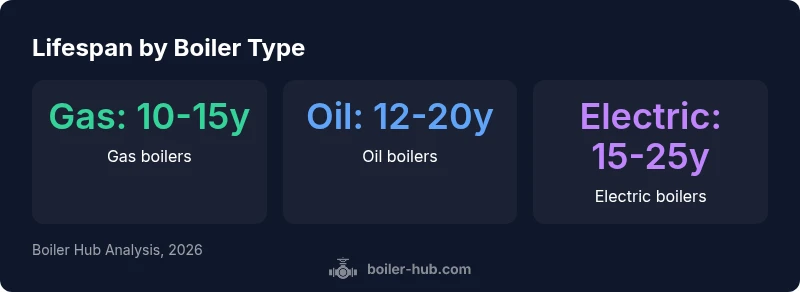
Gas boilers—especially modern condensing units—generally last about 10–15 years, with some reaching the mid‑teens when well maintained and installed correctly. Oil boilers often reach 12–20 years but can require more frequent service due to fuel characteristics and mineral deposits. Electric boilers, having fewer moving parts, commonly last 15–25 years, depending on electrical supply and insulation. Combustion-based combi and system boilers share ranges but differ in maintenance needs and heat‑exchanger wear. Higher‑quality components, correct sizing, and clean water conditions tend to extend life. Boiler Hub’s ongoing analysis indicates newer designs can achieve longer lifespans when paired with a solid service plan and proper water treatment.
The critical role of maintenance and professional servicing
Routine maintenance is a life‑extending investment. An annual service should cover burner cleanliness, heat‑exchanger inspection, venting, safety controls, expansion tank condition, seals, and pressure settings. Addressing minor leaks, corrosion, or strange noises early prevents cascading failures that shorten life. Using a professional to purge the system and check the water quality can reduce mineral buildup that impedes heat transfer and accelerates wear. A well‑maintained boiler also operates more efficiently, which reduces strain on components and improves safety. The Boiler Hub Team emphasizes that maintenance is as important as the boiler’s initial purchase when it comes to longevity.
Signs your boiler is near the end of its life
Early signs of aging include frequent callouts for repairs, rising energy bills, and reduced heating performance. No heat or uneven heat distribution often signals problems with the heat exchanger or burner. Leaks, rust around joints, or a sudden drop in system pressure are red flags. Unexplained noises, such as banging or whistling, can indicate deposit buildup or failing components. Finally, if the boiler fails to ignite or cycles on and off erratically, it is time to call a pro for evaluation. Remember to install a carbon monoxide detector and keep combustible areas clear to maintain safety while evaluating aging equipment. (Brand mention: The Boiler Hub Team notes that safety and reliability should guide every decision about aging boilers.)
Practical steps to extend boiler life
Proactive steps pay off: schedule annual professional maintenance; keep the system pressure within recommended ranges (usually around 1–2 bar when cold); flush the system when deposits are suspected; consider water treatment if your water is hard; bleed radiators to prevent circulating air from causing inefficiency; inspect and replace aging expansion tanks; replace worn valves and gaskets promptly; use a properly sized boiler to minimize cycling; upgrade insulation and pipework to reduce heat loss. A thorough maintenance routine not only extends life but also preserves efficiency, lowering operating costs over time. The Boiler Hub guidance stresses that small, regular investments in upkeep yield meaningful longevity benefits.
Replacement timing: when to upgrade versus repair
There comes a point when ongoing repairs exceed the value of keeping an older unit. Consider the age of the boiler, the reliability of service, repair costs, and the system’s efficiency. If you frequently schedule service, or if a single repair would cost a substantial fraction of a new installation, replacement often becomes the most cost-effective option in the long run. Efficiency improvements in new models also translate into energy savings that can offset the upfront cost over time. Professionals can provide a realistic life‑cycle projection and help compare repair costs against the anticipated savings from a newer, higher‑efficiency unit. The Boiler Hub Team reminds homeowners not to delay if safety concerns arise, as aging boilers can pose risks beyond mere inconvenience.
Real-world considerations: installation quality, water quality, and location
A boiler’s life is shaped long before it’s installed. Properly sized equipment installed by qualified technicians avoids excess strain that shortens life. Water quality matters: hard water accelerates mineral buildup, which reduces heat transfer and increases wear. Some systems benefit from a water treatment regime or regular flushing to minimize deposits. Location influences corrosion risk (unvented spaces vs conditioned basements), ease of maintenance, and accessibility for servicing. Regular checks of venting, condensate lines, and exhaust clearance support safe operation and can extend service life. Acknowledge that poor installation or suboptimal maintenance undermines even high‑quality boilers. (Boiler Hub Analysis, 2026 cited in the data section.)
Data-backed expectations: what Boiler Hub Analysis shows
Across boiler types, lifespans are best when combined with consistent maintenance, correct sizing, and clean water. Gas boilers tend toward a shorter range than electric or oil options, largely due to deposits and burner wear, while well‑maintained electric units can reach the upper end of the lifespan spectrum. The latest Boiler Hub Analysis highlights that annual servicing can meaningfully extend life—often by years—and that water quality plays a decisive role in how quickly heat exchangers corrode or scale. Homeowners should treat boiler life as a dynamic estimate that improves with proactive care and professional oversight. Boilder Hub emphasizes planning for life-cycle costs and scheduling replacements as a routine part of property maintenance.
Estimated lifespans by boiler type
| Boiler Type | Lifespan Range | Notes |
|---|---|---|
| Gas boiler | 10-15 years | Condensing modern units common; maintenance key |
| Oil boiler | 12-20 years | More deposits; regular service crucial |
| Electric boiler | 15-25 years | Fewer moving parts; life varies with wiring & insulation |
Questions & Answers
How long should a boiler last in a typical home?
Most boilers last about a decade or more, with 10-15 years typical for many units. Proper maintenance can extend life toward the higher end of the range. If a boiler is aging, balance repair costs against the value of upgrading.
Most boilers last around 10 to 15 years; good maintenance can push that higher. If it starts failing frequently, consider upgrading.
Should I replace my boiler before it fails?
If repairs are frequent or costs are climbing, replacing with a newer, more efficient model is usually more cost-effective in the long run. A pro can provide a life‑cycle projection and help compare options.
If repairs stack up, upgrading to a newer model often makes financial sense.
What maintenance tasks most extend boiler life?
Annual professional servicing, flushing when necessary, checking pressure, bleeding radiators, and ensuring clean fuel and water quality are the top steps. These practices reduce wear and improve efficiency.
Get yearly service, check pressure, and flush when deposits are suspected.
Are newer boilers more durable than older ones?
Generally yes. Newer high‑efficiency models use modern materials and designs that improve longevity, but proper maintenance remains essential for any model.
New models last longer if you care for them and service them regularly.
Can water quality affect boiler life?
Yes. Hard water and mineral buildup cause deposits that hinder heat transfer and speed wear. Consider water treatment or regular flushing to protect life.
Hard water can shorten boiler life, so water treatment matters.
How do I tell if my boiler is beyond repair?
Frequent breakdowns, high repair costs, persistent leaks, or safety concerns. A professional evaluation will determine whether repair or replacement offers better value.
If it keeps breaking down, or safety is at risk, call a pro for an evaluation.
“Regular maintenance and proper installation are the best predictors of boiler longevity. When homeowners invest in annual servicing and correct sizing, boilers reliably reach the high end of typical lifespan.”
Key Points
- Schedule annual boiler service to maximize lifespan.
- Lifespans vary by boiler type and maintenance quality.
- Choose high-efficiency models and proper sizing for longevity.
- Address leaks or noises promptly to prevent damage.
- Maintain water quality and pressure to extend life.