Can You Increase Boiler Pressure While Running: A Practical Guide
Explore whether you can safely raise boiler pressure while the system is running, with step-by-step safety guidance, common mistakes to avoid, and when to call a professional. Boiler Hub provides evidence-based guidance for homeowners and facility managers.


No—do not increase boiler pressure while the system is running. Pressure adjustments should only be made with the boiler off and cooled, following the manufacturer’s guidance. Attempting to raise pressure while hot can cause safety relief valve release, pipe scalding, or damage to boiler components. If you suspect low pressure, shut down, let the boiler cool, then check the expansion tank and pressure settings.
Can you safely adjust boiler pressure while running
The exact phrase can you increase boiler pressure while running should be avoided during active operation. A boiler’s pressure is tightly tied to its heat, safety devices, and the integrity of piping connections. While it may be tempting to tweak gauges mid-cycle, doing so while the unit is live raises the risk of accidental scalding, valve releases, or a pressure spike that can trigger safety mechanisms. According to Boiler Hub, safe pressure management starts with the boiler being powered down and cooled to a safe temperature, then following the manufacturer’s operating instructions to adjust or top up pressure. This is especially important for older systems that rely on mechanical fill valves rather than electronic controls.
In practice, most boilers are designed to be adjusted only when cold and depressurized. The heat of operation expands fluids and metals, altering readings and making precise adjustment hazardous. For owners and facility managers, the prudent approach is to treat any pressure change as a service action rather than a routine on-cycle adjustment. A misadjusted system not only risks scald injuries but can compromise the boiler’s safety relief valve, temperature controls, and overall longevity.
Why running pressure changes are risky
When a boiler is running, moving parts, pressurized vessels, and hot fluids interact in ways that can surprise even experienced technicians. The primary risks include releasing steam or hot water through relief devices, scald injuries to hands or arms, and unintentional pressure spikes that stress joints and seals. Manufacturers specify that pressure adjustments are to be performed with the unit off to ensure accurate readings and complete de-energization of the control system. Boiler Hub’s guidance emphasizes adhering to the manual’s specified procedures to avoid damaging components or voiding warranties.
Safe practices for pressure checks and adjustments
To maintain safety and system integrity, you should verify all readings against the boiler’s manual, use proper tools, and never bypass safety devices. If the gauge indicates readings outside the manufacturer’s acceptable range, plan a controlled adjustment when the boiler is off. Before any adjustment, gather the required tools, ensure the area around the boiler is dry, and confirm that the expansion vessel and filling loop are in good condition. When in doubt, postpone adjustments until a qualified technician can inspect the system.
Diagnostics before attempting any adjustment
Before attempting any pressure-related actions, perform diagnostic checks: inspect the pressure relief valve for corrosion or leaks, verify the expansion tank is not waterlogged, and confirm the fill valve and hoses are free of kinks. If the system shows signs of leaks, steady temperature rise without heating, or persistent low pressure after cooling, do not attempt to top up pressure on a running system. These steps help you distinguish between a sensor error, a faulty valve, or a more serious fault requiring professional service.
Common myths and safety reminders
Myth: You can “just bump” pressure up a little while running to speed up heating. Reality: this is unsafe and can trigger protective interlocks. Myth: Modern boilers self-balance pressure. Reality: while many systems manage pressure automatically, manual adjustments are sometimes needed after maintenance or a leak. Safety reminder: never disable safety devices, and always wear protective gear if you touch any part of the boiler environment.
What to do next if you’re unsure
If you’re unsure about any measurement, do not proceed. Schedule a service call with a qualified heating technician. Regular maintenance, including annual pressure checks and a comprehensive system review, helps prevent pressure-related failures. The Boiler Hub Team recommends documenting every adjustment and keeping a service log so future technicians can review the history if issues recur.
Tools & Materials
- Pressure gauge or manometer(Used to read the boiler's current pressure when the system is safe to inspect.)
- Filling loop (with hoses)(Used to top up pressure only when the boiler is off, as per manual.)
- Wrench set (adjustable)(For securing fittings if needed during maintenance.)
- Rag or towels(To manage small drips and keep the area clean.)
- Bucket(In case of minor leaks during checks.)
- Safety gloves and eye protection(Personal protection when handling hot surfaces or valves.)
- Boiler manual(Manufacturer-specific guidance for safe pressure ranges and procedures.)
Steps
Estimated time: 45-75 minutes
- 1
Power down and cool the boiler
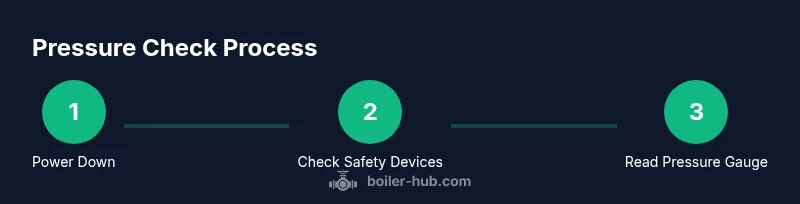
Switch off the boiler at the main control and allow it to cool for at least 30 minutes, ensuring no residual pressure builds. This minimizes burn risk and ensures readings reflect a cold, stable state.
Tip: Use a timer to remind you when the 30-minute wait is up. - 2
Inspect safety devices
Visually check the safety relief valve and vents for signs of leakage or blockage. Do not operate or bypass safety devices.
Tip: Never disable safety mechanisms; they protect you and the system. - 3
Read the current pressure reading
With the boiler off and cooled, locate the pressure gauge and note the reading. Compare it to the manual’s recommended cold-range to determine if an adjustment is needed.
Tip: If the gauge is hard to read, use a flashlight and clean the surface around the dial. - 4
Decide if adjustment is needed after cooling
If pressure is out of range, plan any adjustment only after cooling, using the filling loop per the manual. Do not attempt adjustments on a live system.
Tip: Keep a rag handy for any drips during valve operations. - 5
Top up pressure using the filling loop (off)
Attach the filling loop, open valves slowly, and monitor the gauge. Close valves once the reading is within the manual’s safe range.
Tip: Open valves gradually to avoid sudden pressure spikes. - 6
Power on and test the system
Restore power and run a short cycle to verify stable pressure and check for leaks. If readings drift, switch off and consult a professional.
Tip: If you notice unusual noises or leaks, stop immediately and call a technician.
Questions & Answers
Is it safe to increase boiler pressure while the boiler is running?
No. Pressure adjustments should be performed only when the boiler is off and cooled, following the manual. Running adjustments can trigger safety releases or scalding.
No, you should not adjust boiler pressure while it's running; turn it off and cool it first, then follow the manual or contact a professional.
What is the correct boiler pressure when cold?
Refer to your boiler manual for the safe cold-range. Most systems have a specified low-to-mid range that should be checked after cooling.
Check the manual for the recommended cold-range; do not rely on estimates.
What happens if the pressure is too high?
Excessive pressure can trigger the safety relief valve, cause leaks, or damage components. Do not ignore sudden pressure spikes.
High pressure can vent through safety valves and damage parts; seek professional help.
Can low pressure be corrected without a professional?
Some low-pressure issues can be addressed by topping up using the proper filling loop after the boiler is off. If it recurs, call a pro.
Sometimes you can top up after cooling, but persistent low pressure needs a technician.
When should I call a professional?
If you cannot safely adjust pressure, observe leaks, hear unusual noises, or the gauge remains out of range after cooling, contact a heating professional.
Call a pro if adjustments are unsafe, leaks occur, or readings stay out of range.
Watch Video
Key Points
- Never adjust pressure on a running boiler; safety first.
- Check safety devices and expansion system before any topping up.
- Use the filling loop only when the boiler is off and cooled.
- If in doubt, call a qualified technician.