Troubleshooting: boiler won't stay lit
Learn how to diagnose and fix a boiler that won’t stay lit. Quick checks, common causes, step-by-step fixes, safety tips, and prevention to keep your system running smoothly in 2026.


Boiler won't stay lit is most often caused by a draft, a dirty thermocouple, low gas pressure, a clogged filter, or a faulty flame sensor. Quick fix: reset the boiler, bleed trapped air, verify the gas supply and pressure, inspect the flame sensor and thermocouple, and relight following safety steps. If it still won't stay lit, turn off and call a qualified technician.
What the symptom means for your boiler
When the boiler won't stay lit, it usually signals an ignition or fuel-delivery issue that triggers a safety shutoff. The Boiler Hub team emphasizes that this problem is urgent because a heat source that starts and stops can indicate a developing fault, carbon monoxide risk, or inefficient operation. Look for quick signs: the flame lights briefly and goes out, the burner relights but goes out again, or the boiler cycles on and off rapidly. Understanding the symptom helps you target the right area—ignition, gas supply, or safety controls—without unnecessary disassembly. Throughout this guide, we’ll use practical checks you can perform safely, with clear next steps if the fix requires a professional.
Quick checks you can perform safely
Before diving into detailed diagnostics, start with the basics to rule out simple causes. Ensure the area around the boiler is well-ventilated and free of obstructions. Check that any nearby fans or open windows aren’t creating a draft that disrupts ignition. Confirm the boiler’s power switch is on and that any reset switch has been engaged if your model supports it. If your system has a manual reset button, perform a safe reset according to the user manual. Finally, check the gas supply at the meter and the valve near the boiler to ensure gas is available and fully open. These quick checks can save time and money by catching the easiest fixes first.
Common causes in order of likelihood
The most frequent culprits fall into a few predictable categories. Drafts and ventilation issues near the boiler can disrupt ignition. A dirty flame sensor or thermocouple can prevent sustained ignition even if the burner lights initially. Gas supply or pressure problems, including partially closed valves or low line pressure, are another common factor. Air in the gas line, especially after recent maintenance, can also cause the flame to extinguish quickly. Finally, a faulty pressure switch or control board can misread conditions and shut the burner off too soon. Each cause has a practical, testable fix, which we outline in the step-by-step section.
Diagnostic flow: symptom → diagnosis → solutions
To systematically troubleshoot, follow a simple flow: 1) Confirm power, reset, and ignition behavior. 2) If ignition occurs but flame dies, inspect the flame sensor/thermocouple and gas supply. 3) Check pressure and water levels; adjust if needed and inspect expansion components. 4) Rule out drafts and ventilation. 5) If all tests point to a component failure, replace or service the faulty part. This flow keeps the process orderly and reduces guesswork.
Step-by-step fixes for the most common cause
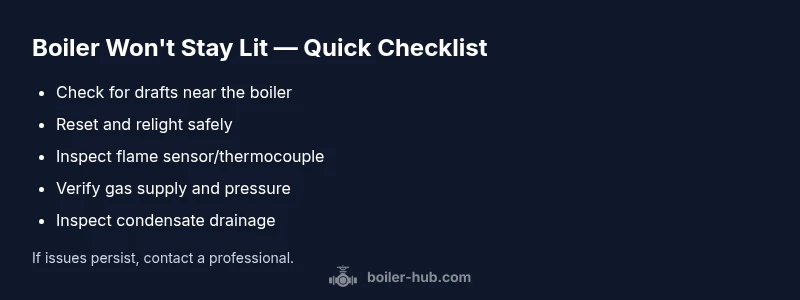
Step 1: Power, reset, and relight. Ensure the boiler is powered, press the reset button if available, and attempt a relight following the manufacturer’s instructions. Step 2: Check for drafts. Close doors/windows or relocate any fans to reduce airflow around the boiler. Step 3: Inspect the flame sensor/thermocouple. If dirty, gently clean the sensor with a soft brush or cloth; if damaged, replacement may be required. Step 4: Verify gas supply. Ensure the gas valve is fully open and there’s no outage or regulator issue; if unsure, contact the utility. Step 5: Test the pressure/controls. Check the pressure gauge (in the green range as a rough guide) and verify that the expansion vessel is functioning; if the readings are off, a professional adjustment may be needed. Step 6: Check for condensate and drainage issues. A blocked condensate line can cause ignition problems on some boilers. Tip: never force parts or bypass safety devices. If the problem persists after these steps, stop and call a qualified technician.
Safety reminders and when to call a pro
Dealing with gas and ignition devices carries safety risks. If you smell gas, hear a hissing sound, or notice soot or staining around the boiler, evacuate and call your gas emergency number. Do not attempt major repairs yourself. Carbon monoxide is odorless and dangerous, so ensure a working CO detector is installed and tested. Regular annual servicing by a qualified technician is the best safeguard against sudden outages. Safety first always.
Steps
Estimated time: 60-90 minutes
- 1
Power and reset
Verify the boiler is powered on. If your model has a reset button, press and hold it for the recommended duration, then attempt a relight following the user manual. This step clears minor control faults and reinitializes ignition safety features.
Tip: Always read the manual for your exact model’s reset procedure. - 2
Check for drafts and ventilation
Move furniture or appliances that might block airflow. Close windows near the boiler and turn off nearby fans temporarily to test if a calmer environment stabilizes ignition.
Tip: A slight breeze near the flue or intake can stop ignition in some units. - 3
Inspect flame sensor and thermocouple
Look for a dirty or oxidized flame sensor; clean gently with a soft brush. If the sensor or thermocouple appears damaged, replacement may be required by a pro.
Tip: Avoid touching electrical components with wet hands. - 4
Verify gas supply
Confirm the gas valve is fully open and there’s no regulator issue. If you sense a gas leak or reduced flow, stop and contact your gas provider.
Tip: Never attempt a repair on gas lines yourself. - 5
Check boiler pressure and expansion components
Ensure the pressure gauge indicates a safe range and inspect the expansion vessel for signs of failure. If readings are off or the vessel is soft or swollen, don’t DIY beyond basic checks.
Tip: Pressure scales vary by model; refer to your manual for exact ranges. - 6
Test for condensate and drainage issues
A blocked condensate line can affect ignition. Inspect the line for blockages and clear as needed, following the manufacturer’s safety instructions.
Tip: If you’re unsure about condensate drainage, call a pro.
Diagnosis: Boiler lights and then goes out shortly after ignition
Possible Causes
- highDrafts or ventilation issues near the boiler
- highDirty flame sensor or thermocouple
- mediumGas supply issue or low pressure
- mediumAir in gas line after maintenance
- lowFaulty pressure switch or control board
Fixes
- easyClose nearby doors/windows and reduce drafts; ensure proper air intake for combustion
- easyReset the boiler and clean or replace the flame sensor/thermocouple if dirty
- mediumCheck gas valve position and ensure sufficient gas supply; contact utility if needed
- easyBleed air from radiators if applicable and confirm gas line integrity
- hardTest or replace the pressure switch/control board as advised by a professional
Questions & Answers
Why does my boiler go out after lighting?
Common causes include drafts, a dirty flame sensor or thermocouple, insufficient gas supply, or a faulty pressure switch. Following a safe diagnostic flow helps identify the exact cause and the appropriate fix.
A boiler going out after lighting is usually due to drafts, ignition sensor issues, or gas supply problems. A step-by-step check will pinpoint the exact cause.
Can I relight it myself if it goes out again?
Yes, if you follow the manufacturer's relight procedure and take safety precautions. If you smell gas or the boiler repeatedly fails, stop and contact a professional.
You can try relighting safely by following the manual, but if gas is present or it keeps failing, call a pro.
What maintenance helps prevent this problem?
Annual servicing, cleaning flame sensors, and checking gas supply lines reduce ignition problems. Keep vents clear and ensure good ventilation to minimize drafts around the unit.
Regular service and keeping vents clear can prevent most ignition issues.
Is a faulty flame sensor dangerous?
A faulty flame sensor can prevent safe ignition and shut off the boiler to prevent gas buildup. It can be replaced by a professional and is not typically dangerous if handled correctly.
Yes, a bad flame sensor should be inspected by a pro to ensure safe operation.
When should I replace the boiler?
If ignition problems persist after professional service or if the boiler is old and inefficient, replacement may be more cost-effective than continued repairs.
If problems persist and efficiency drops, consider replacement after a professional assessment.
Watch Video
Key Points
- Start with the simplest checks (power, reset, drafts).
- Prioritize flame-sensor and gas-supply issues as common culprits.
- Don’t bypass safety devices; call a professional for complex fixes.
- Regular maintenance prevents future outages and improves efficiency.