Boiler Won't Fire Up: Troubleshooting Guide
A practical, urgent troubleshooting guide to diagnose and fix a boiler that won't fire up. Step-by-step checks, diagnostic flow, safety tips, and when to call a pro.


Boiler won't fire up most often due to ignition issues, safety shutoffs, or a power fault. Start with basic checks: ensure power and thermostat are calling for heat, verify gas supply and ignition, and inspect venting for obstructions. If you smell gas or nothing improves, stop and call a licensed technician.
Understanding the problem
When a boiler won’t fire up, the root cause is almost always a disruption in one of the ignition sequence steps: power delivery, heat demand from the thermostat, gas supply, ignition spark or burner lighting, and safety interlocks. Boilers rely on a precise set of conditions to proceed with ignition. Even a small sensor fault or a tripped safety switch can halt the entire process and trigger an error code on the control panel. According to Boiler Hub, home systems most commonly fail due to power issues or ignition/safety faults. Age and maintenance history matter, too; worn igniters, dirty flame sensors, and degraded pressure switches become more likely with time. Understanding these steps helps you distinguish between a simple reset and a component failure. Remember to treat any potential gas odor as a safety emergency and evacuate if detected, then contact gas emergency services. The Boiler Hub Team emphasizes patience and safety as you troubleshoot.
Immediate safety checks you can perform
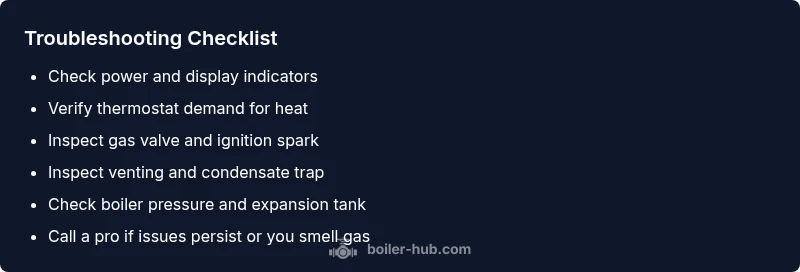
Before you touch any mechanical parts, perform quick, non-destructive safety checks. First, verify the boiler is plugged in (or wired) and that the dedicated breaker is ON. Look for a display, LED, or fault code that indicates power or sensor status. If the power is fine, check the thermostat: ensure it’s calling for heat and, if it’s a wireless model, replace the batteries. Confirm the gas supply valve is fully open and listen for a spark or ignition cue when the boiler attempts to start. If you smell gas at any point, evacuate the area and contact the gas utility immediately. Finally, inspect visible venting for obvious blockages or kinks; blocked exhaust can trigger safety shutoffs. Safety is paramount; if you’re uncertain, pause and call a professional.
How the ignition system works and common faults
A typical gas boiler ignition sequence starts with a heat demand signal, powers the ignition module, opens the gas valve, and then lights the burner via a spark or hot surface igniter. The flame sensor confirms flame presence; if the sensor is dirty or failing, the control will shut down the burner to prevent unburned gas. Common faults include a weak or mis-timed spark, a dirty flame sensor, a clogged vent, or a malfunctioning gas valve. Electrical glitches, faulty control boards, and water conditioning issues can also prevent ignition. Understanding these components helps you narrow down whether the problem is electrical, mechanical, or a safety interlock. If you’re uncomfortable testing any of these parts, or if you notice a gas odor, contact a licensed technician immediately.
Common failure patterns and what they mean
No ignition at all often points to power, gas supply, or a failed ignition module. Intermittent ignition may indicate a flaky thermocouple, dirty flame sensor, or aging ignition components. A constant click without ignition can signal a gas valve issue or delayed signal from the control board. A faint burner flame that dies quickly suggests insufficient gas pressure or a blocked vent. In any case, note any fault codes shown on the boiler display, as these codes guide the next steps. Always consult your boiler’s manual for code definitions and safety recommendations.
What not to touch and when to call a pro
Do not bypass safety interlocks or reset systems repeatedly in an attempt to “force” ignition. If you smell gas, hear hissing sounds, or detect a strong gas odor, evacuate immediately and call the gas emergency number. For electrical faults, ensure the boiler is powered down before inspecting connections, and avoid touching live circuits. If the problem persists after basic checks, contact a licensed heating technician. A professional can verify gas pressure, inspect the venting system, test ignition components, and determine if a part replacement is needed. Regular maintenance can reduce the likelihood of no-fire conditions in the future.
null],
Steps
Estimated time: 45-60 minutes
- 1
Power and safety verification
Begin by ensuring the boiler is connected to power and the breaker is not tripped. Confirm that indicator lights or the display are active. If the power appears fine, document any fault codes shown on the panel before continuing.
Tip: A quick power reset can clear transient faults; do not rush to jam-diagnose without noting codes. - 2
Thermostat demand and heat call
Check that the thermostat is set to a temperature above the room and that it is actually calling for heat. If you have a programmable thermostat, verify the weekend/holiday schedule isn’t preventing heat call. Replace batteries if necessary for wireless units.
Tip: A dead or misconfigured thermostat is a common, easily fixed cause. - 3
Gas supply and ignition signal
Confirm the gas valve is fully open and listen for a spark when the boiler attempts to ignite. If there is no ignition spark or a weak flame, the ignition module or gas valve may need service.
Tip: Do not stand over the burner while testing ignition; keep hands clear of moving parts. - 4
Venting and condensate checks
Inspect the flue or vent pipe for visible obstructions and ensure condensate traps are clear. A blocked vent can cause the safety switch to shut down the boiler.
Tip: Blocked venting is a common safety cause of ignition failure. - 5
Pressure and water level check
Look at the boiler pressure gauge; if pressure is too low, follow manufacturer steps to repressurize gradually. If the expansion tank shows signs of failure, contact a pro.
Tip: Never force-fill beyond recommended pressure range. - 6
Final ignition test and follow-up
Power the system back on and attempt a controlled ignition sequence while observing for a clean flame. Record any codes or behaviors for your technician if the unit still won’t light.
Tip: If ignition failure persists, it’s time to call a professional.
Diagnosis: Boiler won't fire up
Possible Causes
- highPower issue (tripped breaker or blown fuse)
- mediumThermostat setpoint too low or not calling for heat
- highGas supply interrupted or ignition issue
- mediumOverheating or blocked venting triggering safety shutdown
- lowLow water pressure or expansion tank problem
Fixes
- easyVerify power at the outlet, reset the breaker, and check a blown fuse
- easyTest thermostat function and replace batteries if wireless; ensure it’s calling for heat
- mediumCheck gas valve position and listen for ignition spark; if no spark, inspect ignition module
- mediumInspect venting for blockages and clear condensate traps; ensure proper venting path
- mediumCheck boiler pressure gauge and repressurize if needed; inspect expansion tank for air or damage
- hardIf you smell gas, or all else fails, shut off and call a licensed professional
Questions & Answers
Why won't my boiler ignite even when there is power and heat call?
Ignition failure can stem from ignition module faults, dirty flame sensors, or safety interlocks triggering due to venting or pressure problems. Start by confirming the flame signal and sensor cleanliness; if unresolved, a professional should assess gas components and electronics. - Boiler Hub Team
Ignition problems usually involve the ignition module, flame sensor, or safety interlocks. Check the signal and sensor, then call a pro if it stays unresolved.
What should I check first if the boiler won’t fire up?
Begin with power, display/status indicators, and heat demand from the thermostat. If these are in order, proceed to verify gas supply and ignition signals. If you smell gas or see an error code, stop and call a licensed professional. - Boiler Hub Team
First, check power and the thermostat. If it looks good, check the gas and ignition signals, and call a pro if needed.
Is a pilot light needed for all boilers?
Many modern boilers use electronic ignition rather than a standing pilot. If your model uses a pilot, a clogged pilot or dirty flame sensor can prevent ignition. In any case, consult the manual or a technician to avoid damaging components. - Boiler Hub Team
Most modern boilers don’t have a standing pilot; ignition faults are more common. If you’re unsure, get a professional check.
What does a loud clicking sound mean when the boiler tries to start?
A rapid clicking sound often points to an ignition attempt that fails, possibly due to a faulty spark electrode or gas valve issue. If you hear persistent clicking without ignition, stop and call a pro.
That clicking usually means the ignition is trying but failing to light, likely needing a professional check.
When should I call a professional for a boiler that won’t fire up?
Call a professional if basic checks don’t restore ignition, if you smell gas, or if error codes point to gas valve, ignition module, or venting problems. A licensed technician can safely diagnose and repair the issue.
If basic checks don’t fix it or you smell gas, contact a licensed professional.
Can low boiler pressure affect ignition?
Low pressure can prevent safe combustion and trigger safety shutoffs, causing ignition failure. Re-pressurizing should be done following manufacturer guidelines or by a professional. - Boiler Hub Team
Low pressure can stop ignition; follow the manual or call a pro to re-pressurize safely.
Watch Video
Key Points
- Power checks first to rule out simple faults
- Verify heat call and ignition sequence during testing
- Gas smells or leaks require immediate professional help
- Regular maintenance reduces no-ignite failures