Boiler Won’t Turn On: Comprehensive Troubleshooting Guide
Urgent troubleshooting guide for a boiler that will not turn on. Quick checks, diagnostic flow, and safe fixes to restore heat. Learn practical steps from Boiler Hub.


Most likely, a boiler that will not turn on is due to a simple power issue, a tripped circuit, or a safety switch fault. Start by confirming power at the outlet and resetting the breaker, then check the boiler’s status lights and thermostat setting. If the unit still won’t ignite, follow the diagnostic flow and call a professional if you notice gas smells, leaking water, or scorched components.
Common causes and immediate checks when the boiler will not turn on
When a boiler will not turn on, homeowners often panic, but most failures fall into a few predictable categories. The first step is to verify power and basic controls before touching gas or flame safety devices. According to Boiler Hub, electrical faults, failed thermostats, and safety interlocks are responsible for a large share of no-heat events. If the boiler has a digital display, note any error codes; these codes can guide you toward the right fix. In many homes, a tripped breaker or blown fuse is enough to prevent the boiler from turning on. If the breaker is fine, inspect the boiler’s on/off switch, the wall thermostat, and any timers that could be preventing heat on schedule. On gas-fired models, ensure the gas supply is flowing and the pilot or ignition system is clean and free of obstructions. Water pressure also matters: too low pressure can trigger safety shutoffs that stop ignition. In rare cases, frost or condensate buildup can trip safety switches, particularly on boilers with outdoor sensors. Do not attempt to bypass safety devices; these features protect you from dangerous conditions. If after basic checks the boiler still won’t turn on, continue with the diagnostic flow to determine whether the problem is electrical, control-related, or combustion-related. Boiler Hub Analysis, 2026 indicates electrical faults are by far the most common driver of no-heat events.
Safety-first checks you can perform before calling a pro
Safety comes first when diagnosing a boiler that won’t turn on. Begin with personal protective gear and make sure the area around the boiler is clear. Check the power supply by testing the outlet with a simple lamp or using a multimeter. If a breaker tripped, reset it fully and watch for a moment to see if it trips again. Next, verify the thermostat settings, including any programmable schedules that could be delaying heat. If the display shows codes, consult the manual or Boiler Hub's guidance for code meanings. For gas boilers, listen for a hiss or smell of gas; if you detect gas, evacuate and call emergency services. For all models, inspect for obvious water leaks or frost on pipes, which can indicate a safety condition or a failed pump. As a reminder, never bypass pressure relief valves or safety interlocks to “test” the boiler. If you still have no heat after these checks, your best option is to move into the diagnostic flow and identify whether the issue is electrical, ignition, or gas-related. Boiler Hub analysis notes that most homeowners can safely complete these quick checks without professional equipment.
Diagnostic flow: symptom-to-diagnosis-to-fix map
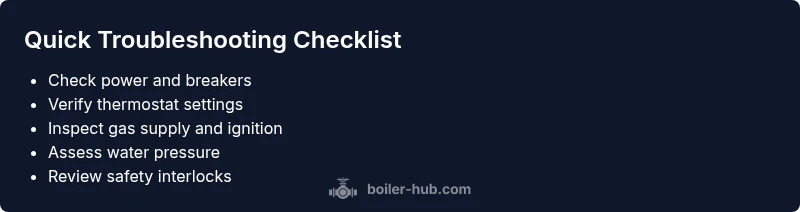
Begin with the symptom: boiler will not turn on. If there is no display, the issue is likely power or main control board. If there is a display but no heat, focus on thermostat, wiring, and safety switches. If you hear clicking but no ignition, investigate ignition electrodes, gas supply, and sensors. If gas odors are present, stop immediately and call a professional. Use the flow: power check → thermostat check → safety interlocks → ignition and gas supply → professional service if needed. This flow helps you stay systematic and reduces the risk of dangerous improvisation. Remember: safety first, and when in doubt, contact a licensed technician.
Step-by-step fixes for the most common causes
This section expands the 7-step plan below with detailed, practical actions you can take to address the most likely causes of a boiler that will not turn on.
Tips and warnings to avoid hazards
- Regularly service your boiler to catch problems before they fail. - Never operate a boiler with obvious leaks or a faulty pressure relief valve. - If you smell gas, evacuate immediately and call emergency services. - Wear protective gear and ensure power is off before touching electrical components. - Keep children and pets away from the boiler room during troubleshooting.
Prevention and maintenance to avoid future no-turn-on events
Routine maintenance, timely part replacements (like fuses, ignitors, and sensors), and ensuring the expansion tank is functioning can prevent future no-heat events. Maintain clean condensate traps and ensure outdoor sensors are protected from frost. A simple annual check can drastically reduce the likelihood of a sudden no-heat incident.
Steps
Estimated time: 60-90 minutes
- 1
Verify power and main switch
Ensure the boiler is plugged in or connected to a live circuit. Check the wall switch and the circuit breaker; reset if tripped and wait 1–2 minutes to see if the boiler responds. Look for indicator lights or error codes on the control panel and note them for later reference.
Tip: If the outlet is controlled by a wall switch, test it with a lamp to confirm it’s powered. - 2
Check thermostat and scheduling
Review the thermostat settings and any linked smart controls. Make sure temperature setpoints are higher than room temperature and that schedules are not suppressing heat during the day. If a remote thermostat is used, ensure it is communicating with the boiler.
Tip: Temporarily set the thermostat higher and see if the boiler responds to bypass any scheduling issues. - 3
Inspect gas supply and safety devices
For gas boilers, confirm the gas valve is open and listen for a gas odor. Do not attempt to light the boiler if you smell gas. Check the condensate drain and flue for blockages that could trigger safety shutoffs.
Tip: If you smell gas, evacuate and call your gas provider or emergency services immediately. - 4
Test ignition system
On spark-ignition units, listen for a click during startup and observe the flame sensor. If there is no ignition after a few seconds, the electrode or sensor may be fouled and require cleaning or replacement.
Tip: Only perform ignition tests if you are trained; improper handling can cause further damage. - 5
Check water pressure and pumps
Many boilers require a minimum water pressure to operate; check the pressure gauge and ensure it sits within the recommended range. Inspect the pump for noise or failure and verify that expansion tanks are not waterlogged.
Tip: Low pressure is a common, fixable cause; consult the manual for the exact target range. - 6
Inspect safety interlocks and reset
Safety interlocks prevent ignition if a door or access panel is not properly seated. Ensure all panels are closed, sensors engaged, and interlocks reset according to the manual.
Tip: Never bypass safety interlocks to force ignition. - 7
Call a professional if unresolved
If the boiler still won’t turn on after these steps, schedule a licensed technician visit. Problems involving gas, flame safety, or complex electrical faults require professional handling.
Tip: Provide the technician with any error codes and a list of what you’ve tested.
Diagnosis: Boiler will not turn on
Possible Causes
- highPower issue (outlet, cord, or breaker)
- mediumFaulty thermostat or control wiring
- lowIgnition or gas-supply problem
- lowLow water pressure or safety interlock tripped
Fixes
- easyCheck outlet voltage, reset breaker, and confirm boiler switch is ON
- mediumTest thermostat settings and replace/repair faulty wiring or sensors
- mediumInspect ignition electrodes and gas line for obstructions, schedule service if needed
- easyCheck pressure gauge, refill if required, and verify expansion tank operation
Questions & Answers
What should I check first if the boiler won't turn on?
Start with power, breaker status, and thermostat settings. Look for any error codes on the display and reset the boiler if safe. If there’s gas involved, proceed with caution and call a pro for safety concerns.
First check power and thermostat settings, then look for error codes. If you detect gas or you’re unsure, contact a professional.
Can a dead battery in a smart thermostat stop the boiler from turning on?
Yes. A dead thermostat can prevent heat call from reaching the boiler. Replace the battery or fix the wireless connection, then test heat call again.
Yes. A dead thermostat can stop heat calls; replace batteries and test.
Is it safe to reset the boiler's control panel myself?
Resetting the control panel can be safe if you follow the manual and power is off during any disconnect. Do not reset repeatedly if the problem persists; this may mask a deeper fault.
Resetting can be safe if you follow the manual and power is off; don’t chase faults with repeats.
Why does the boiler click but not ignite?
A clicking sound often points to ignition or gas supply issues, or a dirty sensor. Inspect electrodes and gas line, and ensure the sensor is clean before seeking professional help.
Clicking without ignition usually means ignition or gas supply problems; check sensors and call a pro if needed.
When should I call a licensed professional?
Call a licensed professional if you smell gas, hear persistent unusual noises, see water leaks, or cannot identify the electrical/gas cause after basic checks.
Call a licensed professional if you smell gas or can’t identify the cause after basic checks.
What maintenance helps prevent no-heat in the future?
Annual servicing, pressure checks, leak inspections, and sensor cleaning help prevent no-heat events. Keep your safety devices functional and replace worn parts promptly.
Regular maintenance and sensor cleaning can prevent future heat failures.
Watch Video
Key Points
- Power and thermostat checks first
- Follow the diagnostic flow before disassembly
- Do not bypass safety devices
- The Boiler Hub team recommends professional inspection for ignition or gas issues