Boiler Not Working Low Pressure: Troubleshooting Guide
Urgent guide to diagnosing and fixing boiler not working low pressure. Learn quick checks, repressurizing steps, bleeding radiators, and safety tips to prevent repeat issues.


Low boiler pressure usually means water isn’t circulating properly or has leaked. The most common causes are leaks, a faulty expansion vessel, or an airlock. Quick fixes include checking the pressure gauge, repressurizing to the recommended range, and bleeding radiators. If pressure keeps dropping, shut off the boiler and call a professional.
Why boiler not working low pressure happens
According to Boiler Hub, boiler not working low pressure is a common symptom that homeowners and facility managers encounter. Low pressure usually signals a leak or a faulty component that allows water to escape or fail to fill the system. In many homes, the pressure gauge dropping below the recommended range triggers an automatic shutdown to prevent damage. Understanding the typical causes can help you act quickly and safely.
Most frequent culprits are leaks in radiators, joints, or the boiler itself; a faulty expansion vessel that can't hold charge; an inadequate repressurization after maintenance; or air trapped in the system which temporarily reduces pressure. If you observe a steady downward trend in pressure over several days, treat it as a potential leak. Remember: even small drips can develop into larger losses if ignored.
Boiler Hub Analysis, 2026 emphasizes that resolving low-pressure problems promptly reduces the risk of overheating, gas safety issues, and costly emergency calls. Always verify the actual pressure when the boiler is cold and consult your manual before attempting any intervention.
Quick checks you can safely perform today
Safety first: always switch off the boiler and disconnect power before touching valves. With the system cold, inspect for obvious water leaks around the boiler, pipes, and radiators. Even a small puddle under the boiler can indicate a hidden fault that needs professional attention.
Next, read the pressure gauge. On most boilers, the recommended cold pressure is around 1 bar to 1.5 bar. If your gauge shows well below 1 bar (often around 0.5 bar or lower), repression may be needed. Do not force pressure beyond the manufacturer’s limit. If you have a filling loop, prepare to repressurize by slowly opening the loop to allow water into the system while watching the gauge rise.
Bleed radiators to remove trapped air, which can falsely depress pressure and cause cold spots. Start with the highest radiator, close the bleed valve when water or air stops, and recheck pressure after the cycle. If you still see pressure dropping after these steps, note any damp spots and plan for a more thorough check or call a pro.
Diagnostic flow: turning symptoms into a plan
Start with the obvious sign: the pressure gauge is lower than the recommended range when the boiler is cold. From there, perform a quick check for leaks in visible joints or under the boiler. If no leaks are found, test the expansion vessel by isolating the boiler from the rest of the system and checking if the vessel is charged. A failed expansion vessel is a common cause of persistent low pressure.
If leaks and the expansion vessel check out, inspect the filling loop or auto-fill valve. A loop that’s stuck open can continuously introduce water, causing pressure to spike temporarily and then drop. Conversely, a valve stuck closed can prevent re-pressurization, leaving you with persistent low pressure. In any case, document the pressure history and verify that all safety devices—such as the pressure relief valve—are functioning.
If you still cannot locate a cause after these checks, consider scheduling a professional inspection. A trained engineer can perform a more thorough leak test and verify the integrity of the central heating circuit.
Common, non-invasive fixes to try first
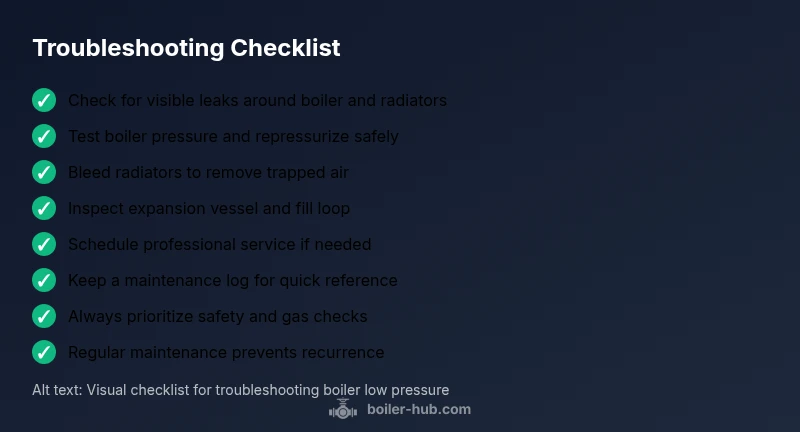
- Repressurize carefully: If the filling loop is clear and you know your boiler’s safe pressure range, open the loop gradually until the gauge reaches the recommended level when cold, usually around 1 bar to 1.5 bar. Don’t exceed the maximum; stop as soon as you see a stable reading.
- Bleed as needed: After repressurizing, bleed each radiator to remove residual air. This can prevent false low readings and improve heating efficiency.
- Check visible leaks: If you notice damp patches or rust, isolate the area and call a pro. Do not ignore minor signs—small leaks can worsen quickly.
- Inspect the expansion vessel: You can often feel for loss of pressure by manually pressing the valve stem on the vessel (with the boiler off). If you suspect a failed vessel, it typically requires replacement by a qualified technician.
- Reset if applicable: Some boilers feature a reset function for fault codes. If your system shows a fault code related to pressure, follow the manual’s reset procedure and check the pressure again.
When to inspect the expansion vessel and fill loop
The expansion vessel is a small tank that maintains pressure as water expands when hot. If it loses charge, the system can’t hold pressure, and pressure will drop again after repressurizing. Signs include rapid pressure drops after repressurizing, or the pipework feeling unusually warm or cold in spots. In many homes, a quick check for a charged vessel with a pressure gauge cap can indicate a lack of charge.
The filling loop is used to restore pressure, but it must be used correctly. If the loop is open for too long, you’ll overfill, and pressure will rise and fall more abruptly. If you’re uncertain about best practices for your model, consult the boiler manual or call a licensed technician.
Safety, warnings, and professional help
Never attempt to work on gas boilers while unsupervised. If you smell gas, leave the area and call emergency services and the gas company. When dealing with electrical connections, switch off power at the mains and use insulated tools. If you see signs of corrosion, a cracked heat exchanger, or leaks that persist after basic checks, it’s time to contact a professional.
Most boiler manufacturers require a licensed engineer to perform repressurization or pressure vessel work beyond basic bleeding. Boiler Hub recommends scheduling a service if the system loses pressure repeatedly or if you notice damp patches, coloured water, or a tripped safety valve. Regular servicing can catch issues before they escalate.
Real-world scenarios and prevention steps
Scenario A: A two-story home with several radiators begins losing pressure during winter. Intervention: check for visible leaks, repressurize to 1 bar when cold, bleed upstairs radiators, and test the expansion vessel. If pressure returns but then drops again, arrange a service call to inspect the loop.
Scenario B: A compact boiler in a condo shows occasional low-pressure warnings even after repressurizing. Intervention: confirm the auto-fill valve works, inspect the filling loop, and consider replacing the expansion vessel if the vessel fails the test. Regular system flushing and descaling can prevent mineral buildup that contributes to pressure instability.
Boiler Hub's guidance for long-term reliability
The Boiler Hub team recommends proactive maintenance as the best defense against boiler not working low pressure. Schedule annual inspections, replace aging expansion vessels, and ensure radiator circuits are bled and flushed as part of a routine service. Keeping the system clean and properly filled reduces the risk of recurring pressure problems and ensures safer operation. For homeowners, a practical plan is to keep a maintenance log, watch for slow pressure loss, and contact a qualified technician at the first sign of trouble.
Steps
Estimated time: 45-60 minutes
- 1
Power off and ensure safety
Shut down the boiler and switch off the electrical supply. Allow the system to cool, and wear non-conductive gloves if you need to touch visible components.
Tip: If you smell gas, evacuate and call the gas emergency line immediately. - 2
Locate the filling loop
Find the filling loop and inspect that it is intact and not leaking. If your system uses a lever, note its position before operating.
Tip: Refer to your boiler manual to locate the precise filling loop on your model. - 3
Repressurize slowly
Open the filling loop gradually while watching the pressure gauge. Stop as soon as the gauge reads the recommended level when cold (usually 1 bar to 1.5 bar).
Tip: Never force the pressure beyond the manufacturer’s maximum; ease in slowly. - 4
Bleed radiators
Starting with the highest radiator, bleed until a steady flow of water and no air comes out. Recheck system pressure after each radiator.
Tip: Keep a cloth ready; water may spill during bleeding. - 5
Check expansion vessel and valves
If pressure falls again after repressurizing, isolate the boiler and assess the expansion vessel and fill valve. A failed vessel often requires replacement.
Tip: A professional should handle expansion vessel replacements due to pressure risk. - 6
Test run and monitor
Restart the boiler and monitor pressure over the next hours and days. If it drifts downward again, schedule a service.
Tip: Keep a simple log of readings to show your technician.
Diagnosis: Low boiler pressure on the gauge (below the recommended range when cold)
Possible Causes
- highWater leaks in boiler, pipes, or radiators
- mediumFaulty expansion vessel losing its charge
- mediumFilling loop/auto-fill valve stuck open or closed
- lowAir trapped in the heating system
Fixes
- easyCheck for visible leaks and repair promptly
- mediumTest and recharge the expansion vessel or replace if required
- easyInspect filling loop and adjust/reconnect to repressurize safely
- easyBleed radiators to remove air and verify stable pressure
Questions & Answers
What is the normal boiler water pressure range?
Most boilers operate around 1–1.5 bar when cold. If your pressure is consistently outside this range, investigate leaks or a faulty expansion vessel and consult your manual or a pro.
Typically about 1 to 1.5 bar when cold.
What causes low boiler pressure?
Common causes include leaks in pipes or radiators, a failing expansion vessel, air in the system, or a faulty filling loop.
Leaks, expansion vessel failure, air in the system, or filling loop faults.
Can I repressurize my boiler myself?
Yes, many models allow careful repressurization using the filling loop. Always follow the manufacturer’s instructions and ensure the boiler is cold before starting.
Yes, if you follow the manual and stay safe.
Is low pressure dangerous?
Low pressure itself isn’t typically dangerous, but it can indicate leaks or component failures that could lead to further issues if ignored.
Not dangerous by itself, but it signals issues to fix.
When should I call a professional?
If pressure drops repeatedly after repressurizing, you notice persistent leaks, or you smell gas, contact a licensed heating engineer promptly.
Call a pro if pressure keeps dropping or you smell gas.
Watch Video
Key Points
- Check for leaks and fix promptly
- Repressurize to 1–1.5 bar when cold
- Bleed radiators to remove air
- Monitor pressure; seek professional help if it falls again
- Schedule annual boiler service for reliability