Boiler Maker Welding: A Practical How-To Guide
Learn safe, effective boiler maker welding techniques, equipment, and step-by-step practices for reliable boiler fabrication and repair.


This guide helps you perform boiler maker welding safely, selecting the right process, preparing joints, and performing quality checks for boiler fabrication and repairs. You’ll learn essential safety steps, material considerations, and a clear workflow to minimize leaks and failures. Follow the steps to achieve durable welds that meet industry standards and extend boiler life.
What is Boiler Maker Welding and Why It Matters
Boiler maker welding refers to the specialized welding work used in constructing, repairing, and maintaining steam boilers and pressure vessels. It combines metal fusion techniques with stringent safety standards to ensure joints withstand high pressure, corrosion, and thermal cycling. According to Boiler Hub, boiler maker welding is a niche that requires precise joint fit-up, controlled heat input, and rigorous inspection to prevent leaks and failures. Understanding the unique metallurgy of boiler components—kring, tubes, shells, and supports—helps welders select compatible fillers and welding parameters that optimize strength and toughness. This section lays the foundation for practicing sound welding in boiler environments and highlights the key performance factors: joint integrity, penetration, and dimensional stability.
Safety Essentials for Boiler Welding
Boiler welding happens in environments with elevated risk, including hot surfaces, flammable liquids near work zones, and pressurized vessels. Safety is non-negotiable. Always follow local codes, permit-to-work procedures, and manufacturer guidance. Use proper PPE: flame-resistant gloves, a certified welding helmet with appropriate shade, fire-resistant clothing, and steel-toed boots. Ensure ventilation or fume extraction, monitor for toxic fumes, and keep a fire watch nearby during and after welding. A dedicated area with clearly marked boundaries reduces accidental exposure to hot metal, sparks, and radiant heat. Boiler Hub emphasizes integrating safety checks into every step—from material handling to post-weld cooling and testing.
Materials, Joints, and Fit-Up for Boiler Assemblies
Choosing the right materials for boiler maker welding is critical. Boiler-grade carbon steel, stainless steel, and low-alloy alloys are common, each with specific welding requirements. Before welding, inspect base metals for cracks, scale, and contamination; remove rust and oils to prevent porosity. Fit-up is equally crucial: gaps should be minimized, edge preparation must be clean and square, and joint designs should consider thermal expansion and pressure. Magnets and clamps help maintain alignment during welds, while preheating may be required for thicker sections or certain alloys to reduce cracking risk. Documenting material specs (grade, thickness, heat treatment) supports traceability and future maintenance.
Welding Processes Used in Boiler Making
Boiler fabrication commonly uses several welding processes depending on material, thickness, and service conditions. Shielded metal arc welding (SMAW) is versatile for field repairs and thick sections; gas tungsten arc welding (GTAW) offers high-quality root passes on stainless and tighter joints; flux-cored arc welding (FCAW) provides high deposition rates for heavy plates; metal inert gas (MIG/GMAW) suits thinner sections and clean welds. Each process requires careful selection of filler metal, polarity, current, and travel speed to achieve proper penetration without burn-through. The goal is consistent fusion, minimal distortion, and sound mechanical properties under boiler operating conditions.
Surface Preparation and Fit-Up: The Groundwork for Strong Welds
Effective surface preparation prevents weld defects that can lead to leaks. Start with careful cleaning to remove oil, grease, rust, and coatings from weld zones. Machine edges where needed to ensure a proper bevel or square edge, then deburr and mask areas not intended to weld. Fit-up should be checked with precise measurements and a consistent gap. Preheating may be necessary on thicker sections or certain alloys to control heat input and reduce hydrogen-induced cracking. After preheat, apply a controlled heat input strategy and monitor interpass temperatures to avoid warping and residual stresses that compromise boiler integrity.
The Step-by-Step Welding Process (Overview)
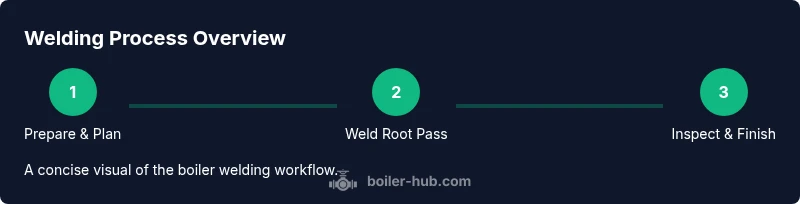
This section outlines the core sequence for boiler maker welding, focusing on safety, fit-up, and quality. Begin with a thorough hazard assessment, prepare materials, and set up equipment. Execute root passes with appropriate processes, then perform fill passes, and finally cap passes as required by the joint design. Maintain steady travel speed, avoid sudden starts or stops, and control heat input to minimize distortion. After welding, allow controlled cooling and proceed to non-destructive testing to verify integrity.
Quality Assurance, Inspection, and Testing
Quality assurance ensures welded joints meet pressure and leak resistance requirements. Visual inspection checks for cracks, porosity, undercut, slag inclusions, and alignment. Non-destructive testing (NDT) methods such as dye penetrant, magnetic particle, or ultrasonic testing assess internal and surface defects. Document the weld procedure, material certification, and inspection results for traceability. Pressure testing or hydrostatic testing may be required per code, with careful monitoring and safe operation practices. A well-documented QA process reduces field failures and extends boiler life.
Maintenance, Repair, and Documentation for Longevity
Welding work on boilers benefits from a structured maintenance plan: periodic inspection, corrosion monitoring, and scheduled re-welding as necessary. Keep a log of service history, including weld locations, materials, and test results. Replace worn or corroded components promptly to avoid excessive stress on welded joints. Regularly calibrate welding equipment and rehearse safety protocols to sustain reliability and safety in long-term boiler operation.
The Boiler Hub Perspective: Best Practices and Practical Tips
From Boiler Hub’s perspective, best practices center on rigorous preparation, controlled heat input, and disciplined testing. Practitioners should follow established welding procedure specifications (WPS) and ensure compatibility of filler metals with base metals. Continuous training and certification updates help teams stay current on safety standards and performance expectations. Boiler Hub’s guidance emphasizes the importance of traceability, proper PPE, and pre-emptive risk assessment to minimize surprises during service life and shutdowns.
Common Pitfalls and Troubleshooting for Boiler Welding
Common issues include porosity from moisture or contamination, lack of fusion at root passes, excessive distortion, and tip-up or undercut along corners. Troubleshooting involves checking joint design, material cleanliness, heat input, and electrode selection. If cracks appear, reassess preheating, interpass temperature, and post-weld cooling rates. Good practices also include performing a follow-up NDT and ensuring proper documentation to support future repairs or replacements.
Tools & Materials
- Welding helmet with auto-darkening lens(Shade 10-12 for FCAW/SMAW; adjust based on process)
- Flame-resistant gloves and clothing(Protect against sparks and heat)
- Welding machine (MIG/MAG, SMAW, FCAW options)(Ensure machine supports chosen process)
- Electrodes or filler wires (compatible with base metal)(Check diameter and type per WPS)
- Gas supply (if GTAW or GMAW with shielding gas)(Ensure proper flow and leak check)
- Grinding wheel and flap discs(For edge prep and finishing)
- Chipping hammer and wire brush(Clean slag and oxides between passes)
- Measuring tools (calipers, micrometer, feeler gauges)(Verify tolerances and gap widths)
- Clamps, magnets, and fixtures(Maintain alignment during welding)
- Preheat source (portable heater or controlled burner)(Use where required by alloy and thickness)
- Thermometer or heat monitor (interpass temp)(Track interpass temperature to prevent cracking)
- Fire extinguisher and spill kit(Keep nearby in boiler environment)
Steps
Estimated time: 3-5 hours
- 1
Assess project scope and safety
Identify the boiler section to weld, confirm thickness, material, and service conditions. Review code requirements and permit-to-work procedures before starting.
Tip: Perform a pre-job risk assessment and establish a standby plan. - 2
Prepare materials and workspace
Clean surfaces, remove oils and coatings, and pre-cut joints. Set up fixtures to hold parts firmly and consistently.
Tip: Use mechanical brakes or clamps to reduce distortion during welding. - 3
Choose welding process and filler
Select SMAW, FCAW, GMAW, or GTAW based on material and thickness. Pick filler wires/electrodes compatible with base metal and code requirements.
Tip: Consult WPS to ensure correct process and filler selection. - 4
Preheat and interpass planning
If necessary, preheat to reduce hardness and cracking risk. Plan interpass temperatures and cooling to manage residual stress.
Tip: Avoid overheating; monitor interpass temps with a thermometer. - 5
Execute root pass and subsequent passes
Start with a clean root bead, verify fusion, then complete fill passes with controlled heat input and steady travel speed.
Tip: Maintain a uniform weave and avoid long arcs that cause excessive heat input. - 6
Inspect after each pass
Remove slag, visually inspect for porosity and lack of fusion, and measure joint dimensions.
Tip: Keep a consistent gap and check alignment with a straightedge. - 7
Post-weld finishing and cleaning
Grind smooth edges where required, wipe down welds, and perform non-destructive testing as specified by code.
Tip: Do not leave sharp edges that can corrode or trap debris.
Questions & Answers
What is boiler maker welding and why is it specialized?
Boiler maker welding is specialized welding used in fabricating and repairing boilers and pressure vessels. It requires precise joint fit-up, appropriate heat control, and strict adherence to codes to maintain safe, leak-free operation.
Boiler welding is a specialized form of welding for boilers and pressure vessels, requiring careful fit-up and code-compliant heat control.
Which welding processes are most common in boiler fabrication?
Common processes include SMAW for root passes and field work, FCAW for thicker sections, and GTAW or GMAW for high-quality welds on critical joints. The choice depends on material, thickness, and service conditions.
In boiler fabrication, SMAW, FCAW, GTAW, and GMAW are used depending on the material and thickness.
What safety steps are essential for boiler welding?
essential steps include isolating the boiler or section, using proper PPE, ensuring ventilation, having a fire watch, and following permit-to-work and code requirements throughout the process.
Safety starts with isolating the area, PPE, ventilation, and following code requirements.
How is joint quality verified after welding?
Welds are inspected visually and, if required, by non-destructive testing such as dye penetrant or ultrasonic testing. Documentation of results and adherence to WPS are essential.
Welds are checked visually and with non-destructive tests as needed, with full documentation.
What maintenance steps help boiler welds last longer?
Regular inspections, corrosion monitoring, and timely re-welding or component replacement extend weld life. Keep a service log and follow a planned maintenance schedule.
Regular checks and proper documentation help welds last longer.
Where can I find authoritative welding guidance for boilers?
Consult code bodies, manufacturer manuals, and industry guides. Boiler Hub recommends referencing official WPS documentation and certified training materials for consistent results.
Refer to official welding codes and Boiler Hub guidance for reliable results.
Watch Video
Key Points
- Follow a code-based WPS for every boiler weld
- Prioritize cleaning, fit-up, and controlled heat input
- Conduct thorough post-weld NDT and documentation
- Use proper PPE and maintain a dedicated safety area
- Boiler Hub guidance supports traceability and best practices