What subjects are needed for boiler making
Discover the essential subjects for boiler making, from theory to hands-on skills, codes, and study paths. This analytical guide helps homeowners and facility managers plan training for safe, capable boiler makers.


Essential boiler making subjects include thermodynamics, heat transfer, metallurgy, welding and fabrication, pipefitting, boiler codes and safety, blueprint reading, math, and project planning. These foundations are typically taught through apprenticeships or specialized programs, combining classroom work with supervised, hands-on practice. A structured path that blends theory and shop-floor experience is key to readiness.
What subjects are needed for boiler making
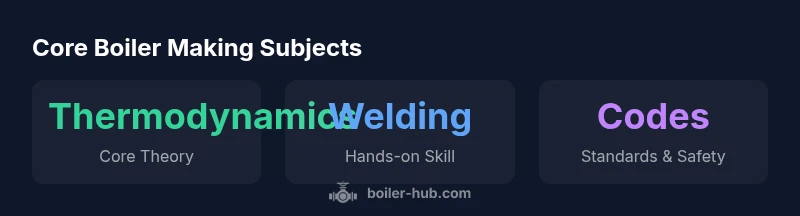
The question what subjects are needed for boiler making matters for anyone aiming to work safely and effectively in boiler fabrication, installation, or service. At the core, learners must grasp both science and craft. In introductory terms, expect to study thermodynamics to understand energy and heat exchange, fluid dynamics to predict flow in pipes, and materials science to anticipate how metals respond under pressure and high temperatures. These foundations set the stage for more applied topics, such as welding and pipefitting, where theory meets hands-on skill. This blend—solid theory paired with supervised practice—creates the capability to design, assemble, test, and troubleshoot boilers with confidence. Boiler Hub emphasizes that career readiness comes from a deliberate, structured path that integrates classroom pedagogy with real-world shop-floor experience, not from theory alone. For homeowners and facility managers, this translates into safer operation, better maintenance planning, and longer boiler life.
Core theoretical foundations for boiler making
Theoretical foundations underpin every practical decision in boiler making. Start with thermodynamics to quantify efficiency and energy usage, then progress to heat transfer and fluid mechanics to model how heat moves through burners, exchangers, and piping. Materials science and metallurgy explain why certain alloys resist corrosion and fatigue under cycling loads, guiding material selection and inspection intervals. Integrated case studies—such as selecting a heat exchanger for a given duty or diagnosing a drop in efficiency—help translate abstract concepts into actionable insights. The goal is to reach a level where you can predict performance, identify root causes of failures, and design safer, more reliable systems. Throughout, keep safety and compliance front-and-center, because many failures arise from overlooked details in design or materials choices.
Practical skills and hands-on training
Hands-on training is where theory becomes muscle memory. Practical modules cover welding (MIG/TIG), brazing and soldering, and structural fabrication, along with pipefitting and assembly of burner assemblies, valves, and safety interlocks. Trainees learn to read P&ID diagrams, assemble components to tight tolerances, and perform leak tests and pressure checks. Shop environments, under seasoned mentors, reinforce PPE use, lockout-tagout practices, and disciplined inspection routines. Practice builds proficiency in joint preparation, alignment, and quality control, reducing failure risk in high-pressure settings. Realistic fault-finding drills—simulating gas train malfunctions or control faults—develop fast, reliable troubleshooting skills that translate directly to field performance.
Codes, safety, and regulatory knowledge
Anyone who handles boilers must understand the regulatory landscape and safety requirements. Learners study the ASME Boiler and Pressure Vessel Code, local regulations, and environmental rules governing emissions and waste handling. Safety training covers risk assessment, incident reporting, and emergency response planning. Regulatory literacy supports compliant installations, smoother inspections, and safer work sites. Emphasize documentation, manufacturer manuals, and how updates to codes affect ongoing work. The practical payoff is a demonstrable reduction in incidents, fewer corrective actions, and stronger relationships with inspectors and clients.
Reading blueprints, math, and design principles
Design literacy closes the gap between concept and construction. Students master geometric tolerances, scaling, and dimensioning, and they learn to interpret mechanical drawings, piping and instrumentation diagrams, and boiler schematics. Math skills—trigonometry, algebra, unit conversions, and heat calculations—support precise cutting, fitting, and safe operating margins. Practice with actual project drawings strengthens problem-solving speed and accuracy. Documentation practices, version control, and clear communication with project teams ensure alignment on specs, deadlines, and budgets. This section builds the discipline to translate a plan into a safe, efficient boiler system.
Training paths and progression: apprenticeships vs college programs
There isn’t a single route to boiler making proficiency. Apprenticeships blend on-the-job training with classroom instruction and mentor guidance, often yielding paid work while you learn. Community college programs provide structured curricula with labs and hands-on practice, sometimes bundled with industry certifications. Some learners pursue targeted certificates to specialize in specific boiler types or regulatory areas. The best choice depends on career goals, local demand, and access to employer support. When evaluating options, consider hands-on hours, instructor qualifications, job placement rates, and the quality of the lab environment.
Building a study plan: mapping subjects to career goals
A robust study plan starts with a clear career target—fabrication, service, or inspection. List core subjects (thermodynamics, welding, codes, blueprint reading) and map them to competencies your target role requires. Create a realistic timeline that staggers theory, lab work, and real-world projects; add milestones for practice tests and portfolio entries. Seek mentorship and track progress with a simple record of completed boilers, schematics, and performance results. A deliberate plan keeps you motivated, ensures steady skill growth, and makes you attractive to future employers.
Common challenges and where to learn
Many students struggle with abstract theory or the pace of hands-on labs. To overcome this, pair coursework with frequent practice on small projects, supplement with videos or simulations, and seek shadowing opportunities with experienced boiler makers. Look for programs that emphasize safety culture and practical problem-solving over rote memorization. Local trade schools, community colleges, and reputable boiler contractors often provide structured curricula and access to skilled instructors. Boiler Hub’s network emphasizes practical, safety-forward training that aligns with industry needs.
Common training paths for boiler making prerequisites
| Training Path | Core Focus | Typical Duration |
|---|---|---|
| Apprenticeship | Hands-on boiler fabrication, safety, codes | 24-48 months |
| Community College Program | Fundamentals + industry labs | 1-2 years |
| Industry Certification | Targeted modules, exam-based | Several weeks to months |
Questions & Answers
What subjects are essential for boiler making?
Essential subjects include thermodynamics, heat transfer, metallurgy, welding, pipefitting, boiler codes, and blueprint reading. A strong foundation in math and safety practices underpins practical skills.
Key subjects blend theory with hands-on practice, always with safety at the core.
Do you need formal schooling, or can on-the-job training suffice?
Both routes exist. Many programs combine classroom learning with on-the-job training through apprenticeships, while others offer structured college curricula and certifications.
Most people start with an apprenticeship or a structured program.
How long does it take to become proficient?
Time varies by path, but solid competence typically develops over 2-4 years through combined study and practice.
Expect a couple of years of focused training.
Are safety certifications required?
Yes. Safety training and familiarity with relevant codes are usually required by employers and inspectors.
Safety certifications are essential for most boiler roles.
Which subjects matter most for fabrication vs service roles?
Fabrication emphasizes metallurgy, welding, and fabrication drawings; service focuses on maintenance, diagnostics, piping, and codes.
Fabrication leans on metalwork; service leans on diagnostics and codes.
How can I study effectively for boiler making subjects?
Combine hands-on practice with theory, use checklists, work on problem sets, and shadow experienced workers to reinforce learning.
Practice, review, and shadow seasoned boiler makers.
“The most effective boiler makers blend strong theoretical grounding with disciplined hands-on practice, always grounded in safety and code compliance.”
Key Points
- Begin with core science and safety.
- Mix theory with hands-on practice for competence.
- Pursue an apprenticeship for best outcomes.
- Map subjects to your career goals early.