Boiler Issues No Hot Water: Quick Troubleshooting Guide
A practical, step-by-step troubleshooting guide to diagnose and fix boiler issues no hot water. Learn quick fixes, when to call a pro, and maintenance tips to safely restore hot-water supply.


Most boiler issues no hot water come from power loss, an incorrect thermostat, or low boiler pressure. Start with easy checks: ensure the boiler is powered, confirm the thermostat is set high enough, and read the pressure gauge. If hot water still won't come, follow the full diagnostic flow below for step-by-step fixes.
Understanding the problem: boiler issues no hot water
When the shower suddenly turns chilly, you know there’s a boiler issue affecting hot water. For homeowners and facility managers, time matters: a boiler malfunction not only disrupts comfort but can indicate safety risks. In 2026, Boiler Hub analyses show that many cases of boiler issues no hot water are preventable with quick checks and timely maintenance. This guide focuses on diagnosing the problem safely and restoring hot water quickly, while also outlining when to call a pro. Key terms: 'hot water supply', 'boiler pressure', 'ignition', 'diverter valve', 'air in system'. The phrase boiler issues no hot water describes a failure to produce heat for domestic water, not just a lack of space heating. In this guide, we’ll walk you through the most likely causes, how to verify them safely, and when to escalate. For homeowners and facility managers, the goal is clear: identify the root cause, implement the safest corrective step, and prevent recurrence through simple maintenance. According to Boiler Hub, quick, careful checks save time and reduce risk of bigger problems. Look for error codes on the display, listen for unusual sounds, and note any changes in water temperature or pressure. In short, this is a safety-conscious, solution-oriented process that boots comfort back into your building.
Common causes of no hot water
Many issues boil down to a handful of common culprits. Understanding which ones are most likely helps you triage without getting bogged down in rare faults. Typical causes include power loss or ignition problems, thermostat mis-set or failed, low system pressure, air trapped in the system, a faulty diverter valve or heat exchanger, or a gas/fuel supply issue in gas boilers. Corrosion, mineral buildup, or a blocked heat exchanger can also gradually reduce hot-water delivery. If you notice error codes, consult your boiler manual or manufacturer site for the exact meaning. Always differentiate between a temporary delay in hot water and a complete lack of heat. If the boiler is old or shows frequent faults, plan for maintenance and possibly a replacement discussion with a pro. Boiler Hub notes that proactive maintenance is a strong predictor of fewer no-hot-water days in the long run.
Quick checks you can perform safely
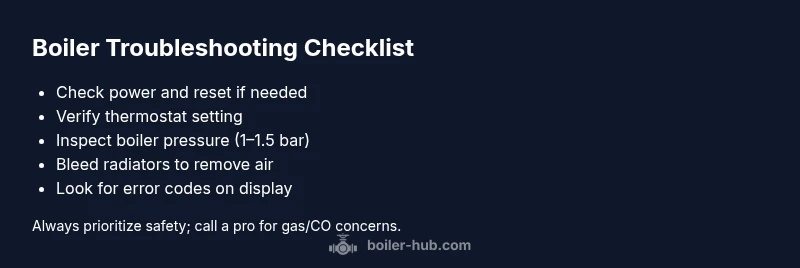
Start with the simplest, safest checks first. These steps cover most common scenarios and reduce risk before you call for service:
- Check that the boiler is powered on and the display is active. If nothing lights up, inspect the circuit breaker and power switch.
- Verify the thermostat setting: aim for 120°F (49°C) or the manufacturer-recommended temperature, and allow a few minutes for the system to respond.
- Inspect the pressure gauge. Most residential boilers operate around 1–1.5 bar when cold; if the needle is much lower, you may need to repressurize (follow the manual).
- Look for error codes on the control panel. Note any codes and refer to the manual or Boiler Hub guidance for a translation.
- If you have a gas boiler, ensure the gas supply valve is open and there is no gas smell. If you smell gas, evacuate and call emergency services.
- Bleed radiators to remove air pockets that can prevent hot water circulation. Do this safely with a towel and a radiator key while the system is cooled.
- If you have an expansion tank, check for signs of leakage or waterlogged conditions, which can undermine pressure stability. Correcting this typically requires a pro. If the above steps don’t restore hot water, proceed with the diagnostic flow or call a professional.
Safety considerations and when to call a professional
Safety is non-negotiable when troubleshooting boilers. Always disconnect power before opening access panels and never work on gas lines without proper training. If you detect a gas smell, hear telltale hissing, or notice exhaust fumes near the boiler, leave the area and contact emergency services. For most homeowners, basic checks are safe, but any suspected fuel issue, carbon monoxide risk, or persistent fault codes should trigger a call to a licensed technician. If you’re unsure, err on the side of caution: a pro can verify gas safety, electrical connections, and venting integrity, which protects occupants and avoids potential code violations. Boiler Hub emphasizes that professional inspection is a wise investment when safety thresholds are crossed or when the problem recurs after basic fixes.
Maintenance tips to prevent future issues
Preventive maintenance reduces the odds of boiler issues no hot water. Incorporate these practices into your annual routine:
- Schedule a professional boiler service at least once per year to check ignition, wiring, pressure, and venting.
- Regularly bleed radiators and monitor pressure to ensure stable performance year-round.
- Inspect and replace worn seals, gaskets, and an aging expansion tank before leaks or pressure drops occur.
- Keep an up-to-date fault code log and consult your manual or Boiler Hub guidance for timely troubleshooting.
- Consider upgrading old boilers to high-efficiency models with smarter controls to minimize cold-water delays and heat losses.
- Maintain clear, accessible boiler space to allow quick maintenance and safe venting. Regular maintenance is the best defense against summer and winter no-hot-water surprises.
Steps
Estimated time: 30-60 minutes
- 1
Verify power and indicators
Ensure the boiler is on and the display is active. Check the wall switch and circuit breaker, resetting if necessary. A blank or flickering display often means a simple power issue.
Tip: Only touch electrical parts with dry hands; do not bypass safety switches. - 2
Check boiler pressure
Locate the pressure gauge; if it sits below 1 bar, you may need to repressurize using the filling loop per the manual. If it’s above 2 bar, you may need to vent some water or have a professional adjust it.
Tip: Do not force the filling loop—follow the manufacturer’s steps exactly. - 3
Inspect thermostat settings
Confirm the thermostat is set high enough and that there aren’t multiple thermostats conflicting with each other (e.g., on a separate zone). Adjust slowly and wait a few minutes for changes to take effect.
Tip: If in doubt, set to 60°C (140°F) as a safe baseline and test hot water. - 4
Assess gas supply and safety (for gas boilers)
If you suspect gas supply issues, do not attempt repairs. Ensure the gas valve is open and there’s no smell of gas. If in doubt, evacuate and call emergency services.
Tip: Never ignite open flames or operate electrical switches near a gas leak. - 5
Bleed radiators and clear air locks
Bleed each radiator to remove trapped air that blocks hot water circulation. Use a cloth and slow, steady turns on the bleed valve until water runs continuously.
Tip: Do this while the system is cool to avoid scalding. - 6
Check for error codes and reset
Note any error codes on the boiler display and consult the manual or Boiler Hub for interpretation. If codes persist after a reset, move to professional service.
Tip: Document codes for faster diagnosis when you call a technician. - 7
Decide on professional help
If hot water remains absent after basic checks or if you notice gas, CO, or venting issues, contact a licensed technician immediately. Do not delay when safety is involved.
Tip: Professional inspection can prevent costly damage and ensure code compliance.
Diagnosis: Hot water not available from boiler
Possible Causes
- highPower issue or boiler not receiving power
- highThermostat set too low or thermostat fault
- mediumLow boiler pressure or air in the system
- lowFaulty diverter valve or heat exchanger blockage
- lowGas supply disruption (gas boilers) or fuel issue
Fixes
- easyCheck that the boiler is powered and that the display is lit; reset at the mains if needed
- easyVerify thermostat temperature and reset if necessary; wait a few minutes to see response
- easyCheck boiler pressure (target ~1–1.5 bar when cold) and repressurize if needed; bleed radiators to release air
- mediumLook for error codes and consult the manual or Boiler Hub guidance for interpretation; if codes point to diverter valve or heat exchanger, call a pro
- hardIf gas smell or ignition/fuel issues are suspected, shut off fuel supply and call a licensed pro immediately
Questions & Answers
Why is my boiler not producing hot water?
Common causes include power loss, thermostat mis-set, or low pressure. Start with power, temperature, and pressure checks, then consult the diagnostic flow for deeper causes.
If your boiler isn’t making hot water, check power, thermostat, and pressure first, then follow the step-by-step flow for deeper checks.
Can low boiler pressure cause no hot water?
Yes. Low pressure can prevent hot water circulation. Check the pressure gauge and repressurize if necessary according to the manual or Boiler Hub guidance.
Low pressure can stop hot water flow. Check and adjust pressure per the manual or Boiler Hub guide.
Is it safe to bleed radiators yourself?
Bleeding radiators is generally safe if you follow proper steps and the boiler is cool. Use a cloth and vent valves slowly to release air.
Bleeding radiators is usually safe when the boiler is cool; vent slowly and use a cloth to avoid spills.
When should I call a professional?
If you detect gas, CO risks, persistent fault codes, or if safety concerns arise, escalate to a licensed technician promptly.
Call a professional if you smell gas, see safety risks, or the issue persists after basic checks.
How often should I service my boiler?
Annual professional service is recommended to maintain efficiency and safety, reducing the odds of future no-hot-water events.
Have your boiler serviced annually to keep it safe and efficient.
What do error codes F1 or F2 mean?
Error codes often indicate ignition or sensor faults. Check the manual or Boiler Hub guidance; if unresolved, contact a pro.
F1 or F2 usually point to ignition or sensor faults; consult the manual and contact a pro if needed.
Watch Video
Key Points
- Power, thermostat, and pressure fix most no-hot-water issues
- Bleed air and monitor pressure to restore circulation
- Call a pro for gas, CO risks, or persistent faults
- Regular maintenance prevents future boiler problems