What to Do When Your Boiler Is Not Igniting
Practical steps to diagnose and fix a boiler that won't ignite, from power checks to gas supply and ignition issues. Safe, actionable guidance for homeowners and facility managers.


Boiler not igniting is usually caused by a simple ignition fault or fuel issue. The most likely culprits are a power issue, a faulty thermostat or control, an empty or blocked gas supply, a dirty igniter or pilot, low boiler pressure, or an active safety lockout. Start with quick checks (power, thermostat, gas valve) and escalate to professional service if ignition still fails.
Quick checks you can perform before calling a pro
When your boiler is not igniting, the fastest path to restore heat is a sequence of simple, safety-conscious checks. According to Boiler Hub, many ignition failures stem from everyday issues that non-specialists can verify safely. Start with basic power and gas checks, then test the thermostat and control wiring. If you discover a loose wire, a tripped breaker, or a gas valve that’s fully closed, you’ve found a common cause that you can fix without tools. Keep in mind that working with gas and ignition equipment carries safety risks; if you smell gas, or if anything feels warm to the touch or unfamiliar, stop and call a licensed technician immediately.
This quick-start section primes you to identify the low-hanging fruit: power supplies, the status of the thermostat, and whether the gas line is open. It also reinforces the critical rule to never bypass safety devices. By approaching the problem in small, verifiable steps, you can often reestablish ignition without waiting for a service call—provided you stay within safety limits and know when to stop and seek professional help.
Understanding the ignition sequence and why it fails
Boilers today typically ignite through an electronic ignition or a standing pilot, coordinated by a control module. The typical sequence looks like this: the thermostat calls for heat, the control signals the gas valve and the ignition device, the igniter fires, and the flame sensor confirms flame presence before the burner stays open. If any part of this chain fails—faulty igniter, dirty sensor, closed gas valve, insufficient gas pressure, or a blown fuse—the boiler will fail to ignite. In a scenario where the boiler is not igniting, symptoms often include a clicking sound, a flashing fault code, or a complete lack of ignition spark. Understanding the sequence helps you pinpoint where the fault originates and communicate more effectively with technicians. As Boiler Hub notes, many ignition faults trace back to simple, addressable causes, making a careful, logical check routine essential.
Electrical and control signals to inspect
The ignition sequence depends on reliable electrical signals. Check that the boiler’s power supply is stable and that the circuit breaker for the boiler isn’t tripped. Inspect the thermostat wiring and any external controls for loose connections. If the boiler uses a 24-volt control circuit, you may need a multimeter to verify that the thermostat is sending a heat-demand signal when commanded. Look for error codes on the boiler’s control board; these codes often point to gas valve issues, ignition failure, or flame sensor faults. If you don’t have training with live electrical testing, skip voltage checks and rely on safe visual inspections; attempting repair of live circuits without proper training is dangerous. Boiler Hub’s guidance emphasizes prioritizing safety alongside diagnostic progress.
Fuel and combustion: gas supply and burner basics
A reliable fuel supply is essential for ignition. Confirm that the gas supply valve is fully open and that there isn’t a downstream blockage or regulator fault. If you hear a hiss or smell gas, evacuate the area and call the gas emergency line. Once the gas is confirmed, inspect the burner and flame sensor for obstructions or corrosion. A dirty igniter, carbon buildup on the burner, or a misaligned flame sensor can prevent ignition even when power and gas are present. If the gas supply and burner seem clear but ignition still fails, the issue may lie with the ignition device itself or a safety lockout that requires professional service. Regular inspection by a qualified technician, as Boiler Hub recommends, helps prevent recurring ignition problems.
Step-by-step: fix for the most common cause
The most common cause of a boiler not igniting is a dirty or faulty igniter and a stuck flame sensor. Begin by turning off power to the boiler and closing the gas supply if safe to do so. Access the ignition area and gently clean the igniter and flame sensor with a soft brush or cloth—avoid touching the electrode with bare fingers. Reassemble and restore power, then attempt ignition. If a flame is sensed but the burner won’t start, replace the igniter or thermocouple as needed. Finally, check the boiler pressure and top up if required (usually with the filling loop) to ensure the combustion chamber remains within its operating range. If you observe a persistent fault code after trying these steps, contact a licensed professional to avoid safety risks. This approach follows a logical progression from the easiest checks to targeted replacements, reducing downtime and keeping you safe.
Safety, prevention, and when to call a pro
Ignition problems can escalate quickly if safety protocols aren’t followed. Always ensure you can ventilate the area and that you have a functioning CO detector when dealing with fuel-burning systems. Do not attempt repairs if you smell gas or if there is dense smoke, a burning odor, or a hot surface near electrical components. Maintain a regular boiler service schedule and have a professional inspect your ignition system, gas valve, and control module at least once per year. Boiler Hub emphasizes that prevention is cheaper than emergency fixes; routine maintenance reduces the risk of sudden ignition failure during cold weather and helps extend boiler life.
Troubleshooting beyond basics: when systems are older or have safety concerns
Older boilers may use more obtrusive ignition systems and become susceptible to sensor drift, corrosion, and clogged burners. If your boiler has been serviced irregularly or shows multiple fault codes, you should escalate to a professional evaluation. Safety devices like flame sensors, pressure switches, and CO sensors are critical for safe operation and must be tested with appropriate tools by trained technicians. If you have recently attempted a DIY fix without success, re-evaluate the risk, because forcing ignition can create hazardous situations. The Boiler Hub team recommends scheduling a formal diagnostic appointment for complex systems or aged equipment to prevent unsafe conditions and ensure compliance with local regulations.
Steps
Estimated time: 60-75 minutes
- 1
Power and safety check
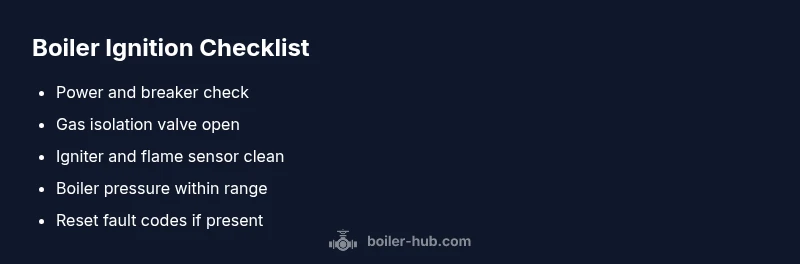
Power down the boiler, verify the circuit breaker is on, and reset the boiler if it has a reset button. This reduces the risk of electrical faults triggering false ignition failures. If the boiler still won’t ignite, proceed to the next check.
Tip: Always start with the simplest, safest checks before touching internal components. - 2
Thermostat and controls review
Inspect the room thermostat and boiler controls. Ensure the thermostat is calling for heat (display shows heat demand) and that any timer or programmer is set correctly. A misconfigured setting is a common reason for no ignition.
Tip: If you notice a loose wire, secure it and ensure connections are clean and dry. - 3
Gas supply verification
Confirm the gas isolation valve is fully open and there’s no odor of gas. If you suspect a supply issue, do not operate the boiler. Contact your gas supplier or a licensed technician to verify pressure and safety systems.
Tip: Never bypass gas safety devices or manually adjust gas pressure without professional supervision. - 4
Igniter and flame sensor inspection
Access the ignition area and visually inspect for soot or corrosion. Clean the igniter tip and flame sensor with a soft brush or cloth (avoid touching the electrodes with bare skin). Reassemble and attempt ignition.
Tip: If there is visible damage to the igniter or sensor, replacement is typically required. - 5
Pressure check and refill
Check the boiler’s pressure gauge. If it’s below the recommended range, use the filling loop to re-pressurize slowly until the proper level is reached. Low pressure can prevent ignition even when fuel and electrical systems are fine.
Tip: Consult the manual for your exact pressure range before making adjustments. - 6
Reset lockouts and fault codes
If the boiler shows a fault code, reference the manual to understand the meaning. Perform the recommended reset sequence and re-test ignition. If codes persist, escalate to a professional for safety-critical assessment.
Tip: Document fault codes and times for your service appointment to speed up diagnosis.
Diagnosis: Boiler won't ignite after thermostat calls for heat
Possible Causes
- highPower issue or tripped circuit breaker
- mediumFaulty thermostat or control wiring
- highGas supply issue (valve closed or regulator fault)
- mediumDirty igniter or flame sensor
- mediumLow boiler pressure
- highSafety lockout or fault code
Fixes
- easyCheck main power, reset breakers, and ensure boiler is receiving 230V (or correct supply) with a safe inspection.
- easyTest thermostat wiring and replace or recalibrate thermostat/controller as needed.
- easyOpen gas isolation valve if it is closed; verify gas pressure with a qualified technician if the supply is uncertain.
- mediumClean or replace the igniter; inspect flame sensor for buildup and clean if accessible.
- easyCheck boiler pressure using the filling loop and top up to the recommended range.
- easyRead fault codes on the control panel and perform the recommended reset or call a professional for safety-critical checks.
Questions & Answers
Why won't my boiler ignite after I turn it on?
Common causes include power issues, thermostat faults, gas supply problems, a dirty igniter or flame sensor, low boiler pressure, or an active safety lockout. Start with power and gas checks, then inspect ignition components if needed.
Common causes are power, gas, or ignition problems. Start with power and gas checks, then inspect ignition components if needed.
Can low boiler pressure prevent ignition?
Yes. If the pressure is below the operating range, the burner may fail to ignite. Refill the system to the recommended pressure and retry ignition after ensuring other safety checks are satisfied.
Low pressure can prevent ignition. Refill to the recommended level and retry after safety checks.
Is a dirty igniter always the problem?
A dirty igniter or flame sensor is a frequent culprit. Cleaning the igniter and sensor can restore ignition in many cases, but worn components may require replacement.
Dirty igniter or flame sensor is common; cleaning helps, but worn parts may need replacement.
When should I call a professional?
If you smell gas, see sparking, hear unusual noises, or fail repeated safety checks, hire a licensed boiler technician. Gas systems and safety devices require professional handling.
Call a licensed technician if you smell gas or if safety checks fail.
What fault codes indicate ignition problems?
Fault codes vary by model but commonly relate to flame sensing, ignition failure, or gas valve issues. Check your manual or contact support with the code for precise diagnostics.
Flame sensor or ignition fault codes point to ignition or gas valve issues; refer to your manual for specifics.
Key Points
- Start with power and gas checks before deeper diagnostics
- Understand the ignition sequence to identify fault points
- Address safety concerns first; call a pro for complex issues
- Keep boiler pressure within the recommended range
- Document fault codes to speed up professional service