Where Should Boiler Pressure Be: Normal Ranges, Readings, and Practical Tips
Learn the normal boiler pressure ranges for cold and hot conditions, how to read gauges accurately, and practical steps to diagnose and fix common pressure issues—trusted guidance from Boiler Hub.


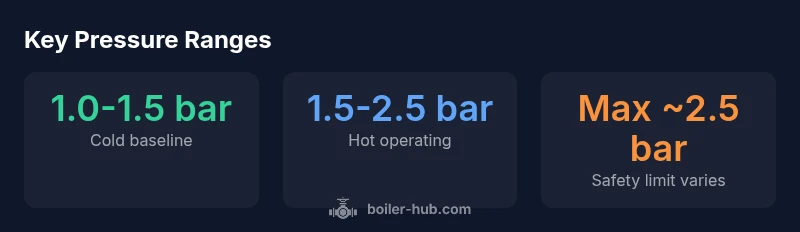
Normal boiler pressure when the system is cold should be about 1.0-1.5 bar, rising to roughly 1.5-2.5 bar when hot. Readings outside these ranges can indicate issues with the fill valve, expansion vessel, or a faulty pressure relief valve. Always consult your boiler manual and stay within the manufacturer's limits.
Understanding boiler pressure: normal ranges and why it matters
According to Boiler Hub, boiler pressure is a critical indicator of system health. In most residential boilers, the pressure should read about 1.0-1.5 bar when cold. As the boiler heats, this typically climbs to around 1.5-2.5 bar. Consistently high readings or pressure that drops quickly can signal problems with the filling loop, expansion vessel, or the pressure relief valve. Maintaining the correct pressure improves heating efficiency, reduces cycling, and minimizes the risk of radiator noise or leaks. Over time, components such as the pressure relief valve or the expansion vessel may drift, so regular checks are essential. The goal is steady pressure within manufacturer-recommended bands and minimal fluctuations during heating cycles. For facility managers, documenting pressure trends can help budget future maintenance and filter replacements, ensuring reliable boiler performance.
- Regular checks prevent costly damage and inefficiency.
- Small deviations often stem from air in the system or a partially closed valve.
- Always follow the boiler manual for model-specific ranges.
Boiler Hub’s guidance emphasizes that you should treat pressure readings as a pulse check for the entire heating loop, not just a single number on a dial. A consistent approach to measurement, top-ups, and venting will protect the boiler and extend its service life.
How to read your boiler pressure gauge accurately
Reading boiler pressure accurately requires understanding whether your system is cold or hot, and whether your gauge is analog or digital. Start with the system off and cold to obtain the baseline cold pressure, then recheck after the system reaches normal operating temperature. For analog gauges, the needle should rest between the 1.0 and 1.5 bar marks when cold. For digital gauges, read the value shown on the display and compare it to the manufacturer’s recommended ranges. If your gauge shows a value outside the typical cold 1.0-1.5 bar range or hot 1.5-2.5 bar range, note the deviation and plan a top-up or service. When topping up, interrupt the process if you see rapid, erratic changes, and consult a professional. Always vent any trapped air only after confirming the system is safe to handle. Regularly inspecting connectors and the filling loop helps prevent gradual pressure drift, which can complicate future maintenance.
- Use a steady hand when reading analog gauges.
- Note both cold and hot readings for a complete picture.
- Digital gauges simplify trend analysis but still rely on manufacturer ranges.
Cold vs hot readings: typical ranges and what they imply
Cold and hot readings tell different stories about the boiler’s health. Cold pressure of 1.0-1.5 bar indicates a ready-to-top-up baseline. When the system heats, the pressure should rise within the 1.5-2.5 bar window. If the hot reading approaches the upper limit or exceeds it (for example, above 2.5 bar), you may be dealing with an overpressure condition that triggers the internal safety valve or risks leaks. Conversely, if cold pressure sits well below 1.0 bar, your system may need a top-up. A sudden drop while running often signals a leak somewhere in the circuit, such as a radiator repair, a faulty valve, or a failing expansion vessel. Understanding these ranges helps homeowners and facility managers differentiate normal operation from issues that require action. In both cases, keep a log of readings and cross-check with the boiler’s service manual.
- Normal cold vs hot readings provide a quick health check.
- Persistent deviations warrant professional inspection.
- Temperature-related shifts are a normal part of operation but must stay within range.
Common causes of abnormal boiler pressure and quick checks
Abnormal boiler pressure can result from several common causes. Air trapped in the system reduces effective water volume, causing pressure to fluctuate. An expansion vessel that has lost its charge or a faulty fill valve can prevent proper pressure regulation. Leaks in radiators, joints, or the boiler itself will gradually reduce pressure, often more obvious when the system cools down. If the pressure rises too quickly during heating, a partially closed filling loop or a blocked automatic fill valve may be at fault. Quick checks include locating and inspecting the expansion vessel (look for a taut diaphragm), ensuring the filling loop is fully closed after topping up, inspecting radiator valves for leaks, and listening for hissing sounds that indicate escaping air. Always bleed air only when safe and after isolating the heating circuit. If you identify a leak, contact a professional to avoid further damage.
- Air in the system is a common culprit.
- Check expansion vessel and fill valve first when pressure drifts.
- Leaks require prompt professional attention.
Step-by-step troubleshooting for pressure drift
If your boiler pressure drifts, follow these steps carefully. 1) Shut off the boiler and let it cool to a safe temperature. 2) Check the cold pressure gauge; if below 1.0 bar, you’ll need to top up water through the filling loop, keeping the pressure in the 1.0-1.5 bar range. 3) Reheat gradually and monitor the pressure rise. 4) If the hot pressure exceeds 2.5 bar, switch off the boiler and inspect for leaks or valve faults. 5) Bleed air from radiators if you hear banging or hissing, then recheck pressure. 6) Check the expansion vessel’s charge and integrity; if it’s waterlogged or stiff, replacement is likely required. 7) Confirm the pressure relief valve is functioning by seeking a professional test rather than attempting a DIY test. 8) Document readings and correlate with maintenance history to guide future care.
- Top up slowly and verify after heat-up.
- Address leaks and valve faults promptly.
- Seek a professional if pressure remains unstable.
When to seek professional help and what to expect
If pressure readings remain erratic after basic checks, or if the relief valve trips, it’s time to call a professional. A qualified technician will verify gauge accuracy, inspect the expansion vessel, fill valve, and pressure relief valve, and check for leaks or air pockets in the system. They may perform a more thorough diagnostic, such as pressure testing the boiler circuit, inspecting pump performance, and confirming the integrity of joints and radiators. Expect a service report that includes pressure readings over time, recommended fixes, and a maintenance plan tailored to your boiler model. Boiler Hub’s team emphasizes proactive maintenance to prevent sudden failures and ensure efficient heating.
- Persistent issues require professional assessment.
- A service report will guide future care and costs.
- Regular maintenance results in better efficiency and fewer surprises.
Boiler pressure reference table (typical ranges)
| Aspect | Cold pressure | Hot pressure | Notes |
|---|---|---|---|
| Normal cold pressure | 1.0-1.5 bar | — | Baseline check when system is cold |
| Operating pressure (hot) | — | 1.5-2.5 bar | During heating, monitor rise |
| Safe max working pressure | 2.0-2.5 bar | 2.0-2.5 bar | Depends on boiler model |
| Pressure relief valve setting | — | — | Valve setting per manual |
Questions & Answers
What is a normal boiler pressure range when the system is cold?
Typically 1.0-1.5 bar when cold. Check your manual for any boiler-specific variations and monitor for stable readings over time.
Cold boiler pressure is usually between 1.0 and 1.5 bar; check the manual for your model.
Why does pressure increase when the boiler heats up?
Water expands as it heats, raising pressure within the closed loop. This is normal up to the operating range, but persistent overshoot or spikes require inspection of the expansion vessel and fill valve.
Pressure rises as water heats, due to expansion, but big spikes mean something should be checked.
What should I do if pressure goes above 2.5 bar?
Turn off the boiler, let it cool, and contact a professional. Overpressure can trigger safety mechanisms and indicate valve or expansion issues.
If it goes above 2.5 bar, switch off and call a pro.
How often should I check boiler pressure?
Check monthly or after any major heating system work. Regular monitoring helps catch drift before it causes damage.
Check once a month or after work on the system.
Is a high-pressure reading dangerous?
Yes, overpressure can cause leaks or valve failures. If readings stay high, stop the boiler and seek professional help.
Yes, high pressure can be dangerous; get it checked if readings stay high.
What is the role of the expansion vessel?
The expansion vessel accommodates water expansion, helping maintain stable pressure as the system heats. A faulty vessel leads to pressure drift.
Expansion vessels handle water expansion to keep pressure steady.
“Maintaining correct boiler pressure is essential for safety and efficiency; small deviations can indicate a worn valve, air in the system, or fill errors.”
Key Points
- Check cold pressure first (aim 1.0-1.5 bar).
- Expect hot pressure to rise to 1.5-2.5 bar during operation.
- Avoid letting pressure exceed 2.5 bar; seek help if needed.
- Inspect expansion vessel, fill valve, and relief valve regularly.
- Log readings to detect trends and plan maintenance.