What Should Boiler Water Pressure Be: A Practical Guide
Learn safe boiler water pressure ranges, how to measure readings, and steps to fix low or high pressure. Boiler Hub provides practical guidance for homeowners and facility managers in 2026.


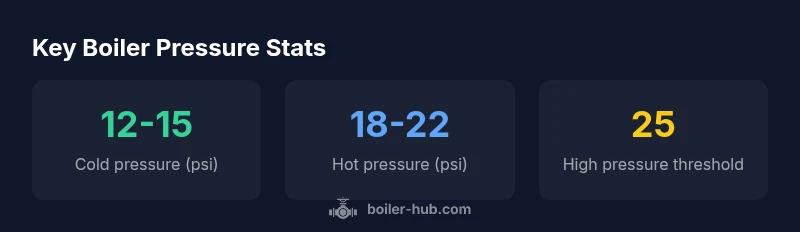
Based on Boiler Hub Analysis, 2026, typical residential boiler water pressure should read about 12-15 psi when cold, rising to 18-22 psi when the system is hot. Consistently higher or lower pressure signals a maintenance issue. Use the gauge on your boiler and check expansion tank, pressure relief valve, and fittings as needed.
Understanding the purpose of boiler pressure
The lingering question many homeowners ask is: what should boiler water pressure be? The pressure gauge on your boiler is a signal of how hard the circulating pump pushes hot water through pipes and radiators. In most homes, a cold reading of about 12-15 psi is typical, and as the system heats up the pressure should climb within a safe band to roughly 18-22 psi. Keeping pressure within these ranges helps ensure efficient heating, balanced radiator performance, and reliable hot water delivery. According to Boiler Hub, stable pressure supports longer equipment life and reduces the risk of cold spots in radiators. If pressure routinely deviates from these bands, it can indicate an underlying issue such as an aging expansion tank, a leaking valve, or air in the system. Regular checks are part of smart boiler maintenance, especially at the start of the heating season.
In practical terms, think of pressure as a push that moves heated water through loops and radiators. Too little pressure means the pump cannot push water far enough, resulting in weak heating or cold spots. Too much pressure can strain seals, trigger safety devices, or cause excessive wear on the expansion tank over time. A balanced pressure setup keeps your system quiet, efficient, and safe for family members and equipment alike. For homeowners, the most important takeaway is this: know your target ranges, monitor the gauge, and address anomalies early.
Normal pressure ranges by boiler type
Understanding what should boiler water pressure be also requires acknowledging the differences among boiler types. Different configurations—combi, system, and conventional—have distinct pressure behavior. A combi boiler, which provides hot water and heating from a single unit, typically runs around 12-15 psi when cold and 18-22 psi when hot. System boilers and conventional systems, which rely on an expansion tank to manage water volume, share the same cold baseline but can tolerate slightly different hot-end pressures depending on the installation. Stabilizing pressure in these systems minimizes cycling noise and ensures radiators heat evenly. From Boiler Hub Analysis, 2026, the general guidance remains consistent: never let pressure drift far beyond about 25 psi, and address issues before this threshold to avoid valve leakage or PRV triggering. For new installations or renovations, confirming the expected pressure range with an installer helps prevent future headaches.
How to measure and read your boiler pressure
To accurately measure boiler pressure, locate the pressure gauge on the front panel of your boiler. If the system is cold, read the gauge before turning on the boiler; this gives you the cold baseline. If the system is hot, allow it to cool briefly and then check again, since hot water expands and raises the reading. Record both values to gauge stability over time. If you notice the reading drift outside the 12-15 psi cold or 18-22 psi hot bands, inspect the expansion tank for proper air charge, examine the fill valve for leaks, and check radiator bleed valves for air pockets. Additionally, confirm that the pressure relief valve remains correctly oriented and free of obstructions. Maintaining a consistent gauge helps detect slow leaks or inveterate air introduction early.
Fixes and maintenance to stabilize pressure
Low pressure (below 12 psi) usually indicates water loss, a leak, or an undercharged expansion tank. The first step is to locate and seal any visible leaks, then repressurize the system using the filling loop according to the manufacturer’s instructions. After repressurizing, check whether pressure returns to the normal cold range and monitor during the next heating cycle. If pressure drops again, the culprit could be a faulty expansion tank or a damaged pump. High pressure (above 22-25 psi when hot) often points to an overfilled system, a failing expansion tank, or a stuck PRV (pressure relief valve). In many cases, bleeding radiators to release trapped air can help rebalance pressure. If symptoms persist, it’s prudent to call a qualified technician to inspect valves, the expansion tank’s air charge, and the overall piping for blockages. Regular maintenance—seasonal checks, radiator bleeding, and occasional expansion-tank tests—prolongs boiler life and reduces surprises during cold months.
Practical troubleshooting checklist and when to call a professional
Before contacting a pro, run through a concise checklist: verify the gauge reading is accurate, inspect the expansion tank for proper air pressure, check for visible leaks, bleed air from radiators, and test the fill valve for smooth operation. If low pressure persists after recharging, or high pressure remains despite bleeding, there may be a more complex issue—such as a faulty expansion tank or a failing pressure relief valve—that requires expert assessment. The Boiler Hub team recommends scheduling a service call if pressure readings remain outside the safe bands for more than a week, if you notice frequent pressure drops after any fill, or if you observe damp patches around radiators or pipes. Regularly documenting readings helps track trends and makes troubleshooting faster for a technician.
Boiler pressure ranges by type
| Boiler Type | Cold Pressure Range (psi) | Hot Pressure Range (psi) | Notes |
|---|---|---|---|
| Combi boiler | 12-15 | 18-22 | Typical domestic setup |
| System boiler | 12-15 | 18-22 | Requires expansion tank |
| Conventional boiler | 12-15 | 20-25 | Common in older homes |
Questions & Answers
What is the ideal boiler pressure?
For most residential boilers, ideal cold pressure is around 12-15 psi and hot pressure should be 18-22 psi. These ranges help ensure consistent heating and reduce wear on components.
Ideal pressure is typically 12-15 psi when cold and 18-22 psi when hot. If you see readings outside these ranges, plan a quick inspection.
How often should I check boiler pressure?
Check the pressure at least once per quarter and after any major service or radiator bleeding. More frequent checks during the heating season are advisable.
Check quarterly, especially after heating season or after any service.
What causes pressure to drop in a boiler?
Common causes include slow leaks, a faulty expansion tank, air in the system, or a loose filling valve. Address leaks and recharge the system if needed.
Leaks, tank problems, or air can drop pressure. Fix leaks and recharge as needed.
What causes pressure to rise too high?
Overfilling the system, failing expansion tank, or a stuck pressure relief valve can push pressure up. Bleed radiators and inspect the relief valve.
Overfill, bad expansion tank, or faulty relief valve can raise pressure.
Can an expansion tank fix pressure issues?
An expansion tank helps absorb water volume changes. If it's waterlogged or charged incorrectly, pressure can spike or drop. Replacement or recharging may be necessary.
An expansion tank helps stabilize pressure; if faulty, replace or recharge it.
Is high boiler pressure dangerous?
Very high pressure can activate safety valves and cause leaks or damage. It’s best to address sustained high readings promptly with a pro.
Yes, sustained high pressure can be dangerous and should be checked by a professional.
“Maintaining correct boiler pressure isn't glamorous, but it prevents inefficient heating and costly damage. Regular checks keep systems running smoothly and safely.”
Key Points
- Know your target ranges: cold 12-15 psi, hot 18-22 psi.
- Monitor the gauge regularly, especially after heating cycles.
- Low pressure (<12 psi) usually means water loss; high pressure (>22-25 psi hot) signals a problem.
- Expansion tanks play a key role in stabilizing pressure.
- Call a professional if readings stay outside safe bands or if leaks are suspected.