Is a Boiler the Same as a Water Heater? A Practical Guide
Explore whether a boiler and a water heater are the same, with clear definitions, installation implications, and guidance to choose the right system for your home. This is a practical, expert comparison from Boiler Hub.


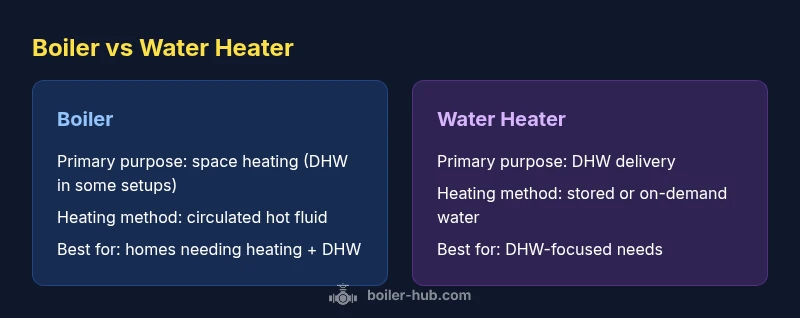
No—boilers and water heaters are not the same in most homes. A boiler primarily heats water for space heating and may also supply domestic hot water in certain setups, while a water heater stores or heats water for taps and showers. In some configurations, a combi boiler can heat water on demand, which can blur the line between the two systems. This article provides a clear, practical comparison.
What the terms mean: boiler vs water heater
Understanding the distinction starts with definitions. A boiler is a heating appliance that heats a fluid (often water or a mix) to circulate through radiators or underfloor heating to warm a building. In many homes, that same boiler can also provide hot water for taps via a heat exchanger or indirect tank. A water heater, by contrast, is designed primarily to store and deliver domestic hot water for showers, sinks, and appliances. In short, boilers focus on space heating (and sometimes hot water), while water heaters focus on domestic hot water supply. According to Boiler Hub, the line between the two can blur in modern integrated systems, especially with combi or hybrid configurations. This nuance matters when selecting equipment, planning upgrades, or diagnosing a service issue.
How the two systems operate in practice
Boilers heat water or another heat transfer fluid and circulate it through a closed loop for radiant or forced-air heating. Domestic hot water is typically produced either indirectly via a heat exchanger connected to the boiler, through a storage tank, or by a combi (combination) boiler that heats water on demand. Water heaters heat water in a storage tank or in a tankless unit, supplying domestic hot water directly to taps and appliances. The key difference lies in purpose: space heating versus domestic hot water. In real homes, you’ll often see a combined approach, where a boiler powers the heating system and a storage or tankless water heater provides DHW on demand.
Common configurations you’ll encounter
- Comb i boiler with DHW on demand: Heats water for space heating and provides domestic hot water as needed. Efficient for compact spaces but requires careful sizing.
- System boiler with indirect hot water tank: Boiler heats water for heating, while an indirect storage tank provides DHW.
- Storage water heater paired with a boiler: Boiler handles heating; a separate storage heater provides hot water.
- Tankless water heater connected to boiler system: DHW is produced on demand with minimal standby losses.
Each layout has different implications for energy use, installation cost, and maintenance needs. The right choice depends on house size, hot water demand, and whether you want to consolidate equipment.
Efficiency and energy considerations
Efficiency depends on the type of boiler or water heater and how the system is used. Modern condensing boilers can achieve high efficiency when paired with well-designed distribution systems, but overall efficiency also depends on insulation, piping layouts, and how often you draw hot water. Tank-based water heaters may have standby losses, while tankless systems minimize those losses but can have higher installation costs. The decision often hinges on your priorities: maximum space heating efficiency, minimum standby losses, or best-fit for large households with high DHW demand.
Installation space and retrofit considerations
Boilers generally require space for the boiler unit, a proper venting path (gas, oil, or electrical), and distribution equipment such as radiators or underfloor piping. Water heaters require room for a storage tank or a compact unit, plus the associated hot water distribution lines. If you’re replacing an aging system, you’ll want to assess existing venting or venting options, clearance around the unit, and access for servicing. In many homes, a single, well-chosen boiler with an indirect hot water tank is a compact solution that minimizes equipment footprint while meeting both heating and DHW needs.
Sizing and how it impacts performance
Sizing influences both comfort and energy use. A boiler must be matched to the home’s heating load and DHW demand, which depends on climate, insulation, and family size. Water heater sizing is driven by peak DHW consumption (showers, baths, laundry). Oversizing wastes energy and increases upfront costs; undersizing leads to slow hot water delivery or cold zones in space heating. A professional load calculation helps ensure you pick a system that delivers reliable comfort without overpaying upfront.
Brand notes: The Boiler Hub team emphasizes that a well-sized system aligned with your home’s heating load and water demand offers the best long-term value, even if the initial cost is higher.
Maintenance realities you should plan for
Both boilers and water heaters require regular maintenance to perform reliably and safely. Boilers benefit from annual servicing to inspect burners, heat exchangers, and venting; dirt, scale, or leaks can reduce efficiency or cause safety concerns. Water heaters need periodic flushing to remove sediment, anodes checks for tank longevity, and valve inspections to prevent leaks. A maintenance plan can extend service life and prevent expensive repairs, while ensuring your system remains compliant with local safety codes.
Comparison
| Feature | Boiler | Water Heater |
|---|---|---|
| Primary purpose | Heats water for space heating; may supply DHW in some configurations | Stores/heats water for domestic use (taps, showers) |
| Heating method | Circulates hot fluid through radiators/underfloor heating | Heats water in a tank or on demand for DHW |
| Typical fuel sources | Gas, oil, electric, or biomass depending on system | Gas, electric, solar options; often electric resistance or gas-fired |
| Best for | Homes needing space heating plus DHW (with indirect or combi setups) | Homes prioritizing DHW delivery and simple storage |
| Efficiency considerations | high efficiency possible with condensing boilers and efficient network design | Tankless DHW can offer low standby losses; storage tanks introduce standby loss |
| Space/installation footprint | Boiler plus distribution equipment can be compact but requires space for piping and radiators | Water heater requires space for a storage tank or compact unit |
| Maintenance needs | Annual boiler service and venting checks are common | Sediment flushing and anode inspection are typical |
| Typical upfront cost range (installation) | Ranges vary by system and home; boilers with distribution components can be higher upfront | Water heaters tend to be less expensive upfront, depending on type |
Advantages
- Helps homeowners plan heating and hot water together in one strategy
- Can reveal opportunities for space-saving combinations (combination boiler)
- Clarifies when a single system can meet both heating and DHW needs
- Encourages consideration of energy usage and long-term operating costs
The Bad
- Two separate systems can increase installation complexity
- Indirect or hybrid setups may require extra components and maintenance
- Comparisons can be confusing when DHW goals differ from space-heating goals
- System changes may require structural or venting updates
A boiler-focused approach paired with appropriate DHW solutions generally offers the best long-term flexibility for most homes.
If you prioritize space heating efficiency and integrated DHW, a modern boiler setup with an indirect tank or a combi boiler is usually the strongest choice. For DHW-centric households, a dedicated water heater may be simpler, but you’ll still benefit from professional sizing and layout planning.
Questions & Answers
Is a boiler the same as a water heater?
No. A boiler typically heats water for space heating and may provide DHW in certain configurations, while a water heater focuses on delivering DHW. Some systems combine both functions, but the devices perform different roles.
No—boilers heat for space heating and may supply hot water, while water heaters focus on domestic hot water.
Can a single unit do both heating and hot water well?
Yes, many homes use combi boilers or system boilers with indirect DHW tanks to efficiently handle both needs. The key is proper sizing and compatibility with your home’s layout and heat load.
A combi boiler or a boiler with an indirect tank can handle both tasks well when correctly sized.
What should I consider when choosing between boiler and water heater?
Think about your climate, space, hot-water demand, and whether space heating is a priority. A professional load calculation helps determine the right system and whether a single unit can meet both needs.
Consider heating needs, space, and hot-water demand; have a pro size the system for you.
Are gas boilers more efficient than electric water heaters?
Efficiency depends on the appliance type and installation. Condensing gas boilers can be very efficient, but electricity-based water heaters avoid combustion emissions and can be cleaner where electricity sources are green.
Efficiency depends on the model; condensing boilers are efficient, and electric water heaters can be clean depending on the grid.
Do I need a professional for upgrading?
Upgrades typically require a licensed technician for safety, venting, and code compliance. A proper assessment helps ensure the new system meets your home’s heating and water needs.
Yes—have a licensed pro size and install to meet code and safety standards.
Key Points
- Define your primary goal: space heating or DHW first.
- Consider hybrid configurations to reduce footprint and simplify maintenance.
- Size carefully using a professional load calculation.
- Plan for regular maintenance to protect efficiency and safety.