Is a Boiler the Same as an Evaporator? A Clear Comparison
Explore whether a boiler is the same as an evaporator. This analytical guide clarifies definitions, differences, and when each device is used in residential and industrial systems.


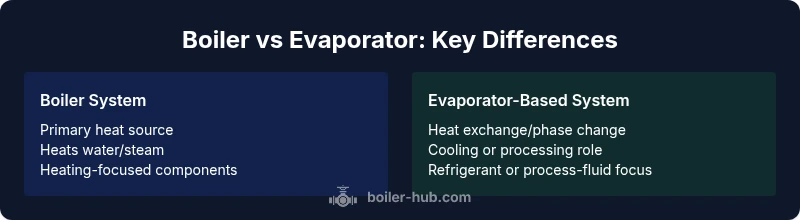
Is a boiler the same as an evaporator? Not in typical heating or cooling definitions. A boiler generates hot water or steam for heating and domestic use, while an evaporator is a heat-exchanging component used to absorb heat and produce vapor in cooling or processing systems. They serve distinct roles, and understanding these roles helps avoid misapplication in real-world systems.
What is a Boiler? Definitions and Roles
A boiler is a device designed to transfer heat to a fluid, typically water, to produce hot water or steam for space heating, radiators, or domestic hot water. In many homes, a boiler acts as the central heat source, converting a fuel or electrical input into thermal energy that is carried through pipes to heat exchangers or radiators. The key performance concerns for boilers include reliability, steam quality, and the ability to maintain safe operating pressure. In discussing terms like is a boiler the same as an evaporator, it helps to anchor the definition: a boiler’s primary function is to generate a usable heat carrier rather than to phase-change refrigerants or process fluids in a separate cycle. According to Boiler Hub, homeowners often conflate the terminology, which can lead to selection mistakes in both retrofit projects and new installations. A robust understanding of boiler types—hot-water vs. steam—and the typical fuel sources helps homeowners and facility managers choose equipment that matches their climate, demand profile, and energy strategy.
What is an Evaporator? Definitions, Contexts
An evaporator is a heat-exchanging device that facilitates the transformation of a liquid into vapor by absorbing heat from its surroundings. In HVAC systems, evaporator coils absorb heat from indoor air as refrigerant circulates, enabling cooling. In industrial processes, evaporators are used to concentrate solutions or to drive vaporization in distillation or drying steps. The evaporator's performance is characterized by heat transfer efficiency, pressure drop, and the type of refrigerant or process fluid used. Unlike a boiler, an evaporator does not function as the primary heat source for heating spaces or water; instead, it enables phase changes within a closed loop. The Boiler Hub team notes that evaporator configurations vary widely across applications, from finned coils in air conditioning to multifold evaporators in chemical processing. Understanding these contexts makes it clear that evaporators are fundamentally about heat exchange and phase change, not heat generation for a primary heating load.
Core Differences: Function, Environment, and System Role
The most obvious distinction lies in function. A boiler creates a heat medium (hot water or steam) for space heating or domestic supply, whereas an evaporator facilitates heat absorption and vaporization within a system. The location of each component in a system also reflects their roles: boilers typically sit near the energy source, feeding a network of radiators or heat exchangers; evaporators are embedded in cooling or processing loops where heat transfer drives vaporization. Energy sources differ as well: boilers draw from fuels or electricity to generate heat, while evaporators rely on the surrounding heat source and the refrigerant loop or process fluids. In terms of safety, boilers require pressure-relief systems and water treatment to prevent corrosion and scaling, whereas evaporators demand attention to refrigerant safety, seals, and potential vapor leaks. The distinction matters for maintenance planning and for communicating with contractors to ensure proper equipment matching and sizing.
System Diagrams and How They Interact
Visualizing a system helps demystify terminology. In a typical heating system, a boiler heats water that circulates through a loop of radiators or a heat exchanger. The evaporator, in cooling or processing contexts, sits in the refrigerant loop or in a unit designed for vaporizing liquids. When both components are present in a combined system, they operate on opposite ends of the heat transfer spectrum: the boiler supplies thermal energy, while the evaporator extracts or reuses heat within its loop. Contractors rely on precise naming to avoid mis-sizing. A misidentified evaporator could be in a cooling coil where the primary device should instead be a heat exchanger or condenser, while a boiler mislabel could lead to selecting equipment incapable of meeting the required steam quality or pressure.
Residential vs Industrial Scenarios: When Each Is Predominant
For most homes, the boiler remains the central source of heating and hot water, especially in colder climates where consistent temperatures are desired. Evaporators are more common in cooling-dominated environments, such as air conditioning systems and certain industrial setups where heat is removed rather than added. Industrial facilities may pair boilers with economizers or steam systems to improve energy efficiency, while large-scale cooling plants utilize evaporators within chiller loops to maintain target temperatures. The difference in use-case scenarios affects equipment choice, maintenance priorities, and regulatory considerations, including safety standards and environmental compliance.
Practical Guidance: When to Specify Each Device
Choosing between a boiler and an evaporator should be guided by the system’s primary objective. If the goal is to generate heating energy for spaces or hot water, a boiler is typically appropriate. If the objective is to remove heat, produce cooling, or effect vaporization as part of a processing chain, an evaporator is essential. In some cases, facilities operate combined systems that use a boiler for heating and an evaporator coil within a cooling module to address year-round comfort. When specifying equipment, consider factors such as climate, load profiles, energy sources, and available space. Engaging a qualified HVAC or process engineer can help ensure the components are properly integrated, sized, and code-compliant.
Maintenance, Safety, and Common Pitfalls
Maintenance strategy differs between boilers and evaporators. Boiler care emphasizes corrosion prevention, scale control, water quality, and pressure safety. Routine inspections focus on venting, boiler controls, and relief valves. Evaporators require attention to refrigerant charge levels, coil cleanliness, leaks, and refrigerant handling safety. A common pitfall is assuming that the same maintenance schedule applies to both devices; another pitfall is misinterpreting labels on equipment shipped as a combined package. Contractors should provide detailed schematics and verify compatibility with control systems and safety interlocks. Boiler Hub’s guidance emphasizes clear terminology and thorough system documentation to prevent errors that could affect performance or safety.
Frequently Confused Terms and How to Speak with Contractors
Term confusion often arises from overlapping vocabulary in heating, cooling, and processing disciplines. When discussing designs, use precise language: specify whether you mean a boiler for steam or hot water generation, or an evaporator coil or evaporator vessel within a refrigeration or processing loop. Providing a schematic or a one-page process diagram can help suppliers and installers understand the intended configuration. If you are upgrading an older building, clarify whether the goal is improved heating efficiency, enhanced cooling capacity, or integration of both—this will guide whether a boiler, an evaporator-based system, or a combined approach is most appropriate.
The Takeaway: Not the Same, but Related Roles
In summary, a boiler is a heat generator, while an evaporator is a heat-exchange element that enables phase change or heat transfer in cooling or processing contexts. They are not interchangeable, though they may operate within the same facility to deliver year-round comfort and process efficiency. By understanding the distinctions, homeowners and facility managers can communicate more effectively with installers, select components that align with system goals, and avoid costly misapplications.
Comparison
| Feature | Boiler System | Evaporator-Based System |
|---|---|---|
| Primary Function | Generates hot water or steam for heating/domestic use | Facilitates heat transfer to vaporize a liquid or absorb heat in cooling/processing |
| Location in System | Energy source near boiler room feeding heating network | Placed in cooling/processing loop or within an HVAC/industrial module |
| Energy Source | Fuel or electricity heats water/produces steam | Depends on refrigerant loop or process heat source |
| Common Applications | Residential heating, hot water supply, some industrial steam | HVAC cooling, refrigeration, distillation, processing operations |
| Maintenance Focus | Water treatment, boiler inspections, safety valves | Coil cleanliness, refrigerant management, leaks |
| Efficiency Considerations | Boiler efficiency and steam quality matter; energy recovery options exist | COP and heat transfer efficiency depend on refrigerant and coil design |
| Cost Context | Moderate to high upfront; ongoing maintenance varies by system | Costs depend on system complexity; coil and refrigerant service can be significant |
| Safety Concerns | Pressure vessels, relief valves, and water quality safeguards | Refrigerant safety, leaks, and high-pressure components |
| Best For | Consistent heating and hot water supply; long-term reliability | Cooling-focused applications; process heating or vaporization needs |
Advantages
- Clear separation of heating and cooling roles in most systems
- Established maintenance practices and safety standards
- Flexible for residential and commercial sizing
- Broad availability of parts and service
- Can be energy-efficient in high-heat-demand scenarios
The Bad
- Can be more complex to specify and install
- Initial cost can be higher than simple evaporator-based solutions
- Requires regular maintenance to prevent scale, corrosion, and leaks
- Terminology confusion can slow procurement and commissioning
Not the same device; choose based on system goals and correct terminology
Boilers generate heat for heating/hot water; evaporators enable heat transfer and vaporization in cooling or processing. Misidentification can lead to improper sizing and performance issues.
Questions & Answers
Is a boiler the same as an evaporator in home heating systems?
No. A boiler generates heat for heating water or steam, while an evaporator is a component that facilitates heat transfer and vaporization in cooling or processing loops. They serve different purposes and are not interchangeable in standard residential setups.
No—boilers generate heat, evaporators transfer heat or vaporize fluids. They serve different roles in heating and cooling systems.
Can an evaporator replace a boiler?
Typically not. An evaporator cannot generate heating energy for spaces or hot water. Replacing a boiler with an evaporator would remove the primary heat source in a heating-dominated system. Some hybrid configurations exist, but they require careful design.
Usually not; evaporators don’t generate heating energy. Hybrid designs exist but need proper engineering.
What is the main function of a boiler?
The main function of a boiler is to convert energy into heat to produce hot water or steam for space heating and domestic use. It is a primary heat source in many buildings.
To generate hot water or steam for heating and domestic use.
What is the role of an evaporator in HVAC?
In HVAC, an evaporator coil absorbs heat from indoor air as the refrigerant inside evaporates. This enables cooling by removing heat from the space.
In HVAC, the evaporator coil absorbs heat to cool the space.
How can term confusion affect projects?
Confusing boiler and evaporator terminology can lead to selecting wrong equipment, improper sizing, and safety concerns. Clear definitions and diagrams help prevent these issues.
Confusion can lead to wrong equipment and unsafe installations.
Are boilers and evaporators ever used together?
Yes, in some facilities a boiler and an evaporator-based system operate in tandem to address heating and cooling or processing needs. Coordination is essential for efficiency and safety.
They can operate together in complex systems with careful design.
Key Points
- Assess the primary system goal before selecting components
- Boiler = heat generation; evaporator = heat transfer/phase change
- Clear terminology reduces risk in procurement and maintenance
- Residential heating typically uses boilers, while evaporators are central to cooling/processing
- Consult a qualified engineer for system-wide compatibility