Are Boiler and Furnace the Same Thing? A Practical Guide
Explore whether boilers and furnaces are the same thing, how they differ in heat delivery, efficiency, and installation, and which system best fits your climate, budget, and home.


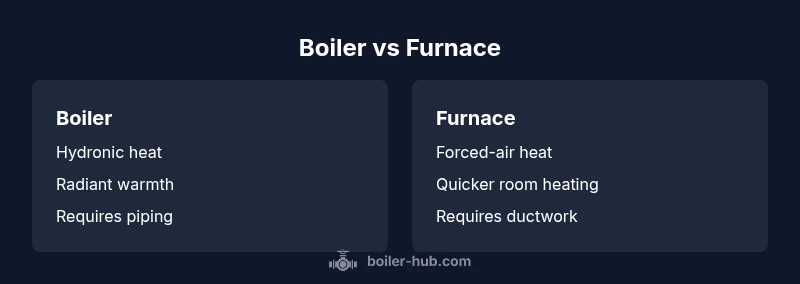
Are boiler and furnace the same thing? No—boilers heat water to produce radiant heat, while furnaces heat air for forced-air delivery. They differ in heat delivery, comfort, and installation. The Boiler Hub team notes that existing ducts, radiators, and thermostats largely dictate which system fits best for your climate and budget. This article compares them clearly.
Are boiler and furnace the same thing?
Many homeowners wonder: are boiler and furnace the same thing? No—boilers heat water to produce radiant heat, while furnaces heat air for forced-air delivery. They differ in heat delivery, comfort, and installation. The Boiler Hub team notes that existing ducts, radiators, and thermostats largely dictate which system fits best for your climate and budget. This section kicks off a careful examination of how each system works, how they feel in daily living, and what to expect during installation and maintenance. Understanding these differences helps homeowners and facility managers avoid costly substitutions and design errors down the line. Across residential and commercial settings, the decision often hinges on whether you prioritize quiet, even warmth with radiant heat or fast, flexible heat via ducted air. As you read, remember that are boiler and furnace the same thing is not true, but the underlying physics explain why they are used in different ways to achieve comfort.
Hydronic vs air-based heat delivery: the core distinction
Central to the debate is how heat travels from the equipment to living spaces. A boiler-based hydronic system heats water and distributes it through pipes to radiators, baseboards, or radiant floors. A furnace-based system heats air and pushes it through a network of ducts. Radiant heat from boilers tends to feel more uniform and quiet, while furnaces can offer rapid temperature changes in individual rooms. If you’re asking are boiler and furnace the same thing, it’s essential to separate the delivery medium (water vs air) from the fuel source. Both can use natural gas, propane, or electricity, and both require regular professional service to stay efficient and safe. The best choice depends on existing infrastructure, climate, and your comfort preferences.
Heat delivery and comfort: radiant warmth vs blown air
Radiant heat from a boiler-delivered system provides a steady, envelope-friendly warmth that minimizes drafts. In contrast, a furnace can heat spaces quickly by circulating warm air through ducts, which can be advantageous in large homes or areas with cold snaps. The difference in delivery also affects air quality and allergen exposure. Homes with ductwork must consider filtration and zoning to maximize comfort; homes without ductwork may favor boilers with radiant floors or baseboard options. When evaluating are boiler and furnace the same thing, recognize that the delivery method is the primary differentiator, not just the fuel or efficiency rating. This nuance matters for long-term comfort and energy usage.
Efficiency and total cost of ownership: what to expect
Efficiency is a key driver in total cost of ownership, but it’s not the only factor. Modern condensing boilers can achieve very high efficiency, especially when paired with well-insulated homes and properly designed radiant systems. Furnaces also offer high-efficiency options, but the payoff depends on ductwork, insulation, and climate. Boiler Hub analysis shows that upfront equipment costs are typically higher for boilers, while installation complexity varies with existing piping versus duct infrastructure. Over the life of the system, energy savings, service costs, and repair frequency will influence the long-term value. Always compare seasonal energy costs alongside purchase price to gauge true value.
Sizing, installation, and space needs: planning considerations
Sizing a boiler or furnace requires accurate heat load calculations that account for insulation, window efficiency, and occupancy patterns. Boilers require space for the boiler unit, piping, and radiant distribution components, plus access for annual maintenance. Furnaces demand ductwork, often requiring attic or crawlspace access for run sizes and filter changes. Replacing an old system with the other option typically involves modifications—such as adding or removing ducts or radiant piping. In short, installing either system should be preceded by a comprehensive assessment of current infrastructure and future needs. If you’re considering a swap or upgrade, consider the compatibility with thermostats, zoning, and smart controls to maximize efficiency and comfort.
Maintenance considerations and reliability
Both boiler and furnace systems deserve regular professional maintenance, typically annually. For boilers, attention centers on seals, heat exchangers, and circulating components; for furnaces, burners, heat exchangers, and blower motors require periodic checks. Maintenance frequency and cost depend on fuel type, usage, and the build quality of the equipment. When diagnosing are boiler and furnace the same thing in practice, think about maintenance resilience: boilers often have fewer moving parts, which can reduce mechanical wear, but radiant systems demand careful water chemistry management. In climate zones with harsh winters, proactive service can prevent costly breakdowns and improve longevity.
Choosing between boiler and furnace: a decision framework
A practical decision framework starts with your home’s current infrastructure. If you already have ductwork and prioritize quick, zone-based heating, a furnace may be a natural fit. If you want quiet operation, even warmth, and you have radiators or plans for radiant floors, a boiler could be the better long-term match. Climate matters: in very cold regions, consistent heat distribution matters; in milder climates, a boiler’s efficiency with radiant heat can be attractive. Budget constraints, local labor availability, and expected lifespan should influence the final choice. Use a side-by-side comparison and cost projection to determine which system aligns with your goals.
Real-world scenarios: climate, occupancy, and home type
Climates with long winters and drafty homes often benefit from the stability of radiant heat from boilers, especially when paired with good insulation and programmable thermostats. For older homes with existing ductwork, furnaces may be easier to install or replace, delivering fast warmth where people spend time. In new constructions, both systems can be engineered for optimal comfort, but the decision will hinge on whether you value uniform warmth over speed of heating. By map-reading your priorities—noise, heat distribution, energy cost, and space—you can better anticipate the maintenance schedule and potential upgrades down the line.
How to evaluate bids and maintenance costs
When soliciting bids, request a full breakdown of equipment, installation labor, ductwork or radiant piping needs, and any required upgrades to insulation or thermostats. Ask for energy consumption estimates under typical winter conditions and a maintenance plan for the first five years. Compare not just upfront price, but long-term cost of ownership, including potential repair costs, fuel price volatility, and the expected lifespan of boilers versus furnaces. Boiler Hub recommends obtaining multiple quotes, verifying contractor certifications, and requesting references to ensure you’re buying a system that will perform reliably in your climate.
Comparison
| Feature | Boiler | Furnace |
|---|---|---|
| Heat delivery | Hydronic (water-based) radiant/baseboard | Forced-air via ducts |
| Typical distribution | Radiant heat through pipes | Air through ducts |
| Upfront installation considerations | Requires piping/radiators or radiant floors | Requires ductwork and air-handling equipment |
| Maintenance focus | Circulating pumps, scale, water chemistry | Burners, heat exchangers, blower, filters |
| Space requirements | Boiler room or closet with piping | HVAC cabinet and duct network |
| Typical noise level | Quieter operation; distant radiators | Quieter in rooms but may have duct noise |
| Lifespan and reliability | Long, with proper water management | Long, with proper duct maintenance |
| Energy considerations | Very efficient with modern condensing models | Efficient options exist; depends on duct leakage and insulation |
Advantages
- Radiant heat comfort and quiet operation (boilers)
- Fast, consistent room heating with ducts (furnaces)
- Good support networks and service availability for both
- Compatibility with modern controls and zoning options
The Bad
- Higher upfront cost for boilers and radiant piping
- Boiler systems require space for piping and radiators
- Ductwork can accumulate dust and require filtration upgrades
- Switching systems can require major renovations
Neither is universally better; choose based on infrastructure and climate
Choose a boiler for radiant warmth and quiet operation if you have radiators or radiant floors. Choose a furnace when ducted heat and rapid room response are priorities, especially in homes with existing ducts.
Questions & Answers
What is the fundamental difference between a boiler and a furnace?
A boiler heats water to provide radiant heat, while a furnace heats air for distribution through ducts. They use different delivery methods, which shapes comfort, space needs, and installation requirements.
Boilers heat water for radiant heat; furnaces heat air for ducted delivery. The delivery method drives comfort and installation needs.
Which is more energy-efficient, a boiler or a furnace?
Efficiency depends on the model and installation. Modern boilers and high-efficiency furnaces can perform very well, but efficiency is also tied to insulation, duct sealing, and zoning.
Efficiency depends on model and setup; both can be very good if properly installed and insulated.
Can I convert from a boiler to a furnace or vice versa?
Conversions are possible but can be costly and invasive, often requiring duct or piping work and potential space modifications. A professional assessment is essential.
Conversions are possible but can be expensive and involve substantial changes.
Which system is better for older homes with radiators?
Boilers pair naturally with radiators and hydronic floors, while converting to forced-air may require ductwork updates. Consider efficiency goals and existing radiators when deciding.
Boilers fit radiators; adding ducts can be more complex in older homes.
What maintenance do boilers and furnaces require?
Both require annual professional service. Boilers focus on water quality and burners; furnaces focus on burners, heat exchangers, and filters. Regular checks improve safety and efficiency.
Annual service helps prevent breakdowns and keeps efficiency high.
What are the signs I need a repair or replacement?
Look for persistent leaks, unusual noises, rising energy bills, uneven heating, or frequent breakdowns. A professional evaluation can determine whether repair or replacement is more cost-effective.
Leak, noises, or uneven heating usually signals a service check is needed.
Key Points
- Assess existing ductwork or radiant piping before deciding
- Radiant heat favors boilers; forced air favors furnaces
- Climate and insulation strongly influence value
- Consider long-term maintenance costs and lifespan
- Get multiple bids with full scope and energy projections