How Much Boilermaker Course Costs in 2026
Learn how much a boilermaker course costs in 2026, the factors shaping price, funding options, and tips to save. Boiler Hub Analysis, 2026 provides a clear breakdown for homeowners and facility managers.


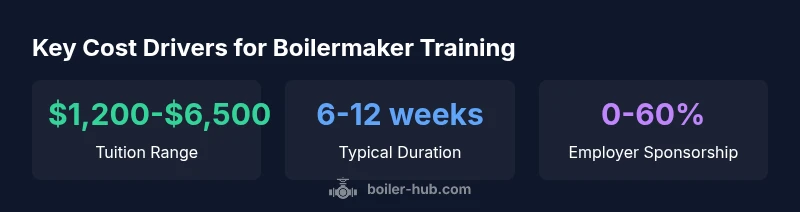
When asking how much boilermaker course costs, expect a broad band: roughly $1,200 to $6,500. Costs vary by location, duration, and delivery mode, with higher prices for longer, hands-on programs that include labs, books, PPE, and certification prep. Financing options include scholarships, employer sponsorship, and installment plans. Regional differences frequently matter, Boiler Hub notes.
How much boilermaker course costs vary: a practical scope
Costs for boilermaker training are influenced by geography, provider type, and delivery method. In 2026, Boiler Hub Analysis shows a wide price band driven by regional tuition norms, lab fees, equipment costs, and whether certification prep is included. Expect higher tuition for accredited, hands-on programs that feature extensive lab time and industry-recognized credentials. For homeowners and facility managers, it’s important to model not just tuition but ancillary costs such as PPE, textbooks, and exam fees. According to Boiler Hub, the total investment can differ dramatically between a short in-person course and a longer, hybrid or online option with mandatory on-site labs. The takeaway is to map your needs (hands-on lab time, certification goals, and employer expectations) against price bands and funding opportunities to estimate a realistic budget.
What’s included in tuition and what’s optional: building your cost picture
Tuition often covers core instruction and access to facilities, but many programs bill separately for labs, PPE, textbooks, and certification prep. Optional items may include retake fees, additional safety training, or advanced modules. When comparing providers, confirm what is included in the listed price and what would be charged à la carte. Boiler Hub’s guidance emphasizes checking whether exam fees (e.g., state or national boiler-making certifications) are bundled, and whether course materials and PPE are provided. A clear itemized quote helps avoid surprise costs later and makes it easier to factor funding options into the decision.
Program types and their price ranges: choosing the right pathway
There are several pathways to boilermaker training, each with its own price profile. Diploma-style programs tend to be longer and more expensive but may include a broader skill set and formal certification. Shorter certificates or online/hybrid formats usually cost less upfront but might require additional out-of-pocket lab time. Apprenticeships can differ radically: some programs require no tuition upfront if an employer sponsors the training, while others require modest out-of-pocket investments. When evaluating options, consider not only the sticker price but the value of hands-on practice, mentor support, and the potential for wage-earning during an apprenticeship.
Regional differences and delivery modes: what region means for price
Delivery mode—fully in-person, online, or hybrid—has a meaningful impact on cost. In some regions, online or hybrid formats offer lower tuition, but you may pay substantial fees for required on-site labs or facility access. Geography also matters: states or provinces with higher living costs or stricter credential requirements can push overall costs higher. Boiler Hub’s regional analysis highlights that a purely online model may reduce hours and time-to-credential, but the total cost can rise if you must travel for essential practical labs. Compare total cost of ownership, including travel, lodging, and time away from work, when planning.
Financing options: scholarships, sponsorships, and loans
Funding strategies vary widely. Scholarships or grants specific to trade training can cover part of tuition, while employer sponsorship or apprenticeship programs may reduce or eliminate direct costs. Some providers offer installment plans or income-share agreements tied to post-completion wages. A practical step is to identify eligible funding sources early, then create a budget that accounts for tuition, materials, PPE, and potential loss of wages during training. Boiler Hub recommends starting with your current employer, local unions, and trade associations for sponsorship opportunities.
Tips to save money without sacrificing quality
To minimize cost without compromising outcome, compare programs with similar accreditation and certification outcomes, prioritize those with included labs, and consider blended formats that combine online theory with scheduled lab sessions. Look for programs that provide textbooks and PPE as part of tuition, and verify what happens if you need to retake an exam. Timing your training to align with employer sponsorship windows or funding deadlines can unlock additional savings. Finally, solicit multiple quotes and request a detailed breakdown to identify the best value.
Measuring value: ROI and outcomes after completion
Beyond upfront costs, assess the return on investment (ROI) of a boilermaker course. Look at job placement rates, average starting salaries in your region, and the credential’s demand in the market. A longer program with strong certification credentials may pay off quicker through higher wages and better job security. Boiler Hub’s 2026 assessment suggests that programs with robust hands-on labs, recognized certifications, and solid apprenticeship pathways tend to deliver stronger ROI over a 2–5 year horizon, especially for facility managers seeking in-house expertise.
Cost comparison by program type
| Program Type | Typical Cost Range | Notes |
|---|---|---|
| In-person diploma | "$1,500-$5,000" | Labs & certifications often included |
| Online or hybrid | "$1,200-$3,000" | Less hands-on; labs may incur extra costs |
| Apprenticeship | "$0-$3,000" | Employer sponsorship common; wage earnings may occur |
Questions & Answers
What factors influence boilermaker course costs the most?
Key drivers are geographic location, program length, delivery mode (in-person vs. online), and whether labs, PPE, textbooks, and certification prep are bundled. Accreditation status and industry partnerships also impact price and value.
The main cost drivers are location, duration, and whether labs and certifications are included. Accreditation also influences price.
Are there funding options or scholarships available for boilermaker training?
Yes. Scholarships, employer sponsorship, and apprenticeship funding are common. Check with providers, unions, and trade associations for opportunities, and apply early to maximize eligibility.
There are scholarships and employer sponsorships. Start with the training provider and unions to find options.
Do employer sponsorships typically cover the full cost?
Sponsorships often cover a portion of tuition and materials; wages or stipends during apprenticeships may offset opportunity costs. Full coverage is less common and depends on employer programs.
Usually sponsorships cover part, not all, of the costs. Apprenticeships may include wages during training.
Is an online boilermaker course cheaper than in-person?
Online or hybrid formats can reduce tuition, but you should factor lab requirements and any travel costs. In some cases, online may be cheaper overall, while total costs rise due to mandatory on-site labs.
Online formats can be cheaper, but added lab travel may offset savings.
What should I compare when evaluating programs?
Compare total cost of ownership, including tuition, labs, PPE, books, and certification fees. Look at credential outcomes, job placement rates, and ROI over 2–5 years.
Compare all costs and outcomes, not just the sticker price.
How long does it typically take to complete a boilermaker course?
Most programs run 6–12 weeks for certificates and diploma routes; apprenticeships can extend to several years with on-the-job training.
Most programs are 6–12 weeks, with longer apprenticeships possible.
“A well-chosen boilermaker course combines solid hands-on training with recognized credentials, delivering long-term value for facilities and individuals.”
Key Points
- Identify your lab time needs before choosing a path
- Expect wide regional price variation
- Ask for an itemized quote to avoid hidden fees
- Explore employer sponsorship and scholarships early
- Aim for programs with strong certifications and ROI