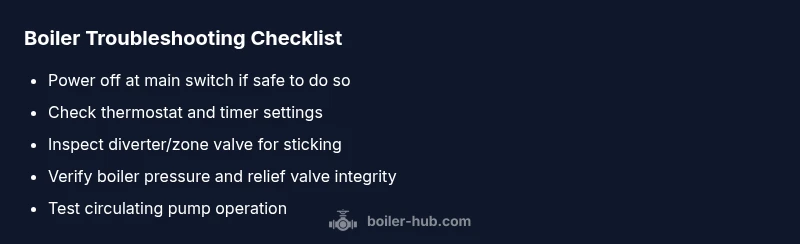
What to Do When Your Boiler Won’t Turn Off
A practical, step-by-step guide to diagnose and fix a boiler that won’t shut off. Learn safety checks, common causes, and when to call a pro. Boilder Hub Analysis, 2026.


Most likely, the boiler won’t turn off due to a stuck thermostat, a faulty diverter valve, or wiring/controls that keep the boiler energized. Start with the thermostat and timer: set to off, check the power switch and fuse, and listen for cycling. If it continues, shut off power at the main switch and call a professional immediately.
Understanding the symptom and why it matters
When a boiler won't turn off, it signals a control fault, a stuck valve, or a wiring issue that keeps the burner energized. According to Boiler Hub, this is a safety concern because overheating or pressure buildup can occur if the boiler cannot shut down. Recognizing the pattern—continuous humming, warm pipes, or a boiler that remains hot after the heating cycle—helps you act quickly and reduce the risk of damage. This issue is not rare in aging systems, and recognizing it early reduces the chance of a major failure. Treat it with urgency, but proceed methodically to avoid unsafe DIY attempts.
Why it matters for homeowners and facilities managers: persistent heat puts stress on pipes, valves, and the heat exchanger. A prompt, well-documented approach saves energy, prevents leaks, and minimizes the risk of carbon monoxide exposure when gas-fired boilers are involved. Boiling points of safety concerns should be taken seriously, and professional assessment is often warranted when basic checks fail.
Immediate safety steps you should take
Safety comes first. If you suspect a gas leak, unusual odor, or odd sounds, evacuate calmly and call emergency services. If you are certain there is no gas leak, switch off the boiler at the main power switch or circuit breaker to prevent continued operation. Do not bypass safety devices or attempt to adjust gas valves yourself. Do not attempt major repairs if you are not trained. Once power is off, ventilate the area and prepare for a professional inspection. These steps reduce risk while you gather information for the technician.
What to document for the pro: note what you were doing when the issue started, any error codes, and the boiler model. This information speeds up diagnosis and helps determine whether a control board, valve, or sensor is at fault. Regular safety checks protect occupants and the building’s infrastructure.
Check thermostat, timer, and control wiring
Begin with the simplest controls. Ensure the thermostat is set correctly (not perpetually calling for heat) and that the display is healthy—no fault codes. Disable any independent timers or smart schedules that could re-energize the boiler. Inspect the thermostat wiring for loose connections, corrosion, or a stuck button. If you find obvious issues, cut power before handling, and replace damaged components. If the boiler still won’t turn off, proceed to the valve and control inspections. Cleaning or reseating wires can resolve intermittent faults in many cases.
Common mistakes to avoid: never run the boiler with exposed wiring, avoid DIY electrical work on gas-fired units, and never ignore warning codes from the control panel. If you don’t see a fix after these checks, move to valve inspection and professional assessment.
Inspect the diverter valve and zone controls
The diverter valve or zone valve directs hot water to different parts of the system. A stuck or malfunctioning valve can keep the boiler running even when the thermostat is satisfied. Look for sluggish movement, leaks, or unusual resistance when manually actuating valve levers or actuators. In many systems, electric actuators can fail and cause a motor to stay engaged. Replacing a faulty actuator or freeing a jammed valve may resolve the issue, but misadjustment can worsen performance. If you’re unsure, contact a professional for precise valve calibration.
If you notice unusual noises when the valve should be idle, that’s a strong signal to stop and call for service. Valve issues often require specialized tooling and knowledge about your boiler’s control logic. Document any observed valve behavior to aid diagnosis.
Look at boiler pressure, relief valve, and circulating pump
Improper pressure can confuse safety controls and cause heating cycles to continue. Check the boiler pressure gauge; many residential systems run around 1–1.5 bar when cold. A pressure that climbs unexpectedly or remains high after cycling can keep the boiler engaged. Inspect the expansion tank for signs of waterlogging and listen for a relief valve that may leak or chatter—these are warnings of pressure problems. The circulating pump should start and stop with the cycle; a pump that stays on or makes grinding noises is a clue to pump or wiring faults. If you spot leaks or abnormal sounds, stop operation and call a pro immediately.
Note: Pressure and safety components interact with every other control. A misread pressure can fool the entire system into staying on. A professional test can confirm correct calibration and component integrity.
When to call a professional and what to expect
If basic checks don’t resolve the issue, a professional diagnostic is required. A trained technician will test control circuits, valve positions, and safety devices, verify gas safety compliance, and inspect for carbon monoxide risk. Expect a thorough inspection, with potential valve replacement, control reseating, or control-board testing. The technician should provide a clear plan, explain the fault, and offer preventive recommendations. Regular service can prevent recurrence and extend the life of the boiler.
What to bring to the appointment: model and serial number, observed symptoms, any fault codes, and a calendar of recent maintenance. This helps the technician quickly reproduce and diagnose the problem. If gas safety concerns arise, never delay; safety comes first.
Prevention and maintenance to avoid future episodes
Ongoing maintenance is key to preventing this issue. Schedule annual boiler servicing that includes safety checks, control calibration, and valve operation tests. Bleed radiators to maintain system balance and ensure consistent flow. Keep the thermostat and wiring in good condition by replacing worn components promptly, and maintain the boiler area free of dust and clutter. Regular checks of pressure, expansion tank, and relief valve can catch issues before they cause a non-stop heat cycle. A proactive maintenance plan saves money and reduces risk over time.
Steps
Estimated time: 25-45 minutes
- 1
Verify the basics (power, thermostat, timer)
Turn off the boiler at the main switch, then back on to see if the issue reoccurs. Confirm the thermostat setting is not forcing heat and that the timer isn’t re-energizing the system.
Tip: Document any codes or odd behavior you observe during the reset. - 2
Check electrical connections
Turn off power before touching wiring. Inspect thermostat wires, control panel connectors, and any visible looms for looseness or corrosion. Tighten or replace as needed.
Tip: Take a photo of wire configurations before disconnecting anything. - 3
Inspect the diverter/zone valve
Access the diverter valve and zone valve if present. Manually operate the valve to check for smooth movement. Listen for grinding or sticking sounds.
Tip: If you hear grinding, do not force movement—call a pro. - 4
Assess boiler pressure and safety devices
Read the pressure gauge when cold and when hot. Check the expansion tank condition and inspect the relief valve for leaks or chatter.
Tip: Do not ignore rapid pressure changes; they indicate a fault. - 5
Test the circulating pump and flow path
Ensure the pump starts and stops with the cycle. Look for blockages or air in the system that could cause recirculation when not required.
Tip: If the pump hums continuously, it may need lubrication or replacement. - 6
Call a professional if unresolved
If the boiler still won’t shut off after these steps, professional diagnosis is essential to evaluate control boards and gas safety compliance.
Tip: Request a written repair plan and a safety certification after service.
Diagnosis: Boiler won't turn off
Possible Causes
- highStuck thermostat or misprogrammed timer
- highStuck or faulty diverter/zone valve
- mediumWiring/controls short or failed sensor
- mediumFaulty soft-start or control board
- lowPressure sensor or relief valve fault
Fixes
- easyReset thermostat and timer, then reseat any loose wiring
- mediumFree or replace a stuck diverter/zone valve actuator
- hardRepair or replace faulty wiring or control module
Questions & Answers
What are the most common causes of a boiler that won’t turn off?
The most frequent causes are a stuck thermostat, a faulty diverter valve, or wiring/controls that keep the boiler energized. Other possible issues include a faulty control board and pressure-safety faults. Start with basic control checks and move to valve inspections if needed.
Common causes are a stuck thermostat or valve. Start with basic controls, then valve checks if the issue persists.
Is it safe to turn off my boiler manually?
Yes, you can turn off the boiler at the main power switch or circuit breaker in case of an unsafe runaway heat situation. Do not remove safety devices or alter gas controls. If gas is involved or you smell fuel, evacuate and call emergency services.
Yes, turn it off at the main switch if it’s unsafe, but don’t tamper with safety devices.
Can a stuck diverter valve cause continuous heating even with the thermostat off?
Yes. A stuck diverter valve or faulty zone valve can keep circulating hot water and maintain heat, preventing the boiler from shutting down. A professional should inspect and replace the valve if needed.
Yes, a stuck valve can keep the boiler running; a professional should check and fix or replace it.
When should I call a professional for a boiler that won’t turn off?
If basic checks don’t resolve the issue within one diagnostic session, or you detect gas concerns, leaks, or pressure anomalies, contact a licensed technician promptly. Early professional intervention prevents safety risks and further damage.
Call a pro if basic checks don’t fix it or if there’s a gas smell or pressure issue.
Will replacing the thermostat solve the problem?
It can help if the thermostat is faulty, but it may be one of several issues. The technician will verify all controls and valves before concluding that the thermostat is the root cause.
Replacing the thermostat can fix it if that’s the faulty part, but a full diagnostic is needed.
Watch Video
Key Points
- Identify safety risks first and shut off power if necessary
- Check thermostat and diverter valve as primary fault sources
- Don’t bypass safety features—call a pro for persistent issues
- Regular maintenance prevents non-stop boiler problems