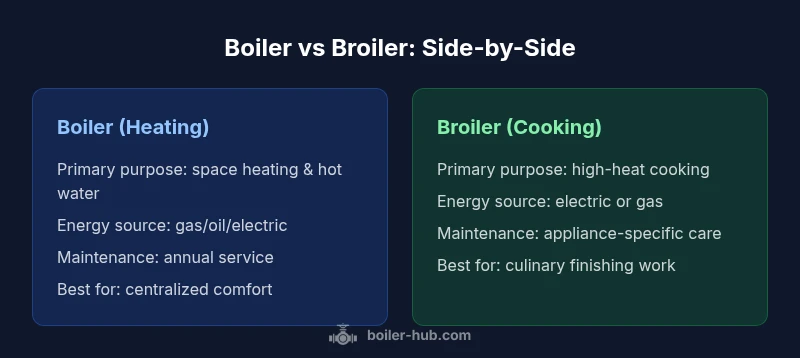
Boiler vs Broiler: Understanding the Difference
A rigorous, analytical comparison of boiler systems vs broiler terminology, with definitions, use cases, safety notes, and buying guidance for homeowners and facility managers.


Boiler vs broiler clarifies a common misnomer: boiler is a home heating system that generates hot water or steam, while broiler is a cooking element for high-heat surface cooking. According to Boiler Hub, understanding these definitions helps homeowners and facility managers avoid risky substitutions and misapplications. This quick comparison highlights core definitions, typical uses, and high-level trade-offs to guide informed decisions.
What 'boiler' means in home heating and how 'broiler' became a common source of confusion
For many homeowners, boiler terminology can feel like a foreign language. At its core, a boiler is a heating device that converts fuel into hot water or steam to circulate through radiators, baseboard heaters, or underfloor systems. The term ‘broiler,’ by contrast, belongs to the kitchen—it's a heating element used to brown food on the top rack of an oven or grill. The confusion often arises when people discuss “boiler rooms” beside “broiler sections” in the context of building services, or when a contractor uses the word ‘broiler’ casually while describing a heating appliance. According to Boiler Hub, clarifying these two domains is essential to avoid misapplication in repairs or upgrades. In practice, misinterpreting boiler specifications as culinary equipment can lead to unsafe installations, incorrect sizing, and avoidable maintenance expenses. This section lays out the fundamental definitions and sets the stage for more precise comparisons across system types, fuels, and safety requirements.
Major differences between boiler and broiler in domestic contexts
The most obvious difference is purpose: boilers heat spaces and supply hot water; broilers finish cooking food with high, direct heat. In a home comfort scenario, a boiler connects to a network of pipes and radiators or a hot-water coil, often requiring professional installation, venting, and regular service. A kitchen broiler, by contrast, is a stand-alone appliance or oven component designed for rapid surface browning. Because they operate in different domains, the controls, safety considerations, and regulatory paths also diverge. Boilers must meet Building Codes, gas safety standards, and venting requirements; broilers follow appliance standards and electrical safety rules. Additionally, the energy dynamics differ: a boiler’s energy use is tied to heat distribution and standby losses; a broiler’s energy use is tied to cooking sessions. Understanding these differences helps homeowners choose the right equipment for the intended job and prevents confusing heating with cooking technologies.
Boiler system configurations and sizing considerations
Boilers come in several configurations, each serving different home setups and demand profiles. A combi boiler provides on-demand hot water and space heating without a separate hot-water cylinder, which can save space in smaller homes. A regular or system boiler stores hot water in a cylinder, delivering reliable warmth for larger households or peak winter loads. A heat-only boiler focuses on generating hot water for taps while feeding a radiator circuit. Sizing is critical: an oversized boiler wastes fuel, accelerates wear, and lowers efficiency, while an undersized unit struggles to maintain comfort during cold snaps. Sizing depends on factors including climate, home insulation, number of bathrooms, and the presence of heat emitters like radiators or underfloor coils. Proper selection requires careful load calculations, ideally performed by a qualified heating professional who can balance first-cost with operating costs and ensure appropriate venting, condensate management, and control integration.
Broiler terminology: the cooking appliance and its limitations
When people reference a broiler, they usually mean the high-heat surface element or a separate broiler oven. Broilers deliver intense radiant heat from above or below, which is ideal for finishing steaks or browning toppings. However, a kitchen broiler does not provide space heating, hot water, or central climate control. It also carries its own safety considerations, such as adequate clearance from flammable materials and proper venting for radiant heat. In most homes, a broiler is part of the oven or a dedicated appliance rated for culinary use. Confusion arises when hardware terms spill from cuisine into building services; clumsy language can lead to misinterpretation of a device’s function during installation or repair. The distinction matters: you should not rely on a broiler to substitute for a boiler's heating duties or for hot water generation. Precision in terminology prevents misapplication and aligns expectations with equipment capabilities.
Safety and regulatory considerations for boilers
A home boiler involves combustion or electric heating with integrated controls, pumps, and venting. Gas-fired boilers require proper ventilation, clearance around combustion air intakes, and a functioning carbon monoxide detector network. Regular maintenance—typically an annual professional service—supports efficiency and safety, including checking pressure relief valves, bring-down of scale, and inspection for leaks. Electrical boilers add circuit protection and shut-off requirements, along with adherence to appliance standards. In contrast, a kitchen broiler follows appliance safety standards and electrical codes focused on cooking performance and fire safety. When misapplied or poorly installed, boilers and related piping can present serious hazards, including gas leaks, CO buildup, or scalding risks. Engaging a licensed technician for installation, inspection, and venting compliance reduces risk and ensures that your system remains within code and warranty terms.
Efficiency, cost, and maintenance considerations
Energy efficiency for boilers is measured by boiler type, AFUE ratings, and the efficiency of the distribution system. A high-efficiency boiler reduces fuel use but may require a larger initial investment or more complex installation. On an ongoing basis, vibration-free operation, correct venting, and regular maintenance contribute to longevity. Costs vary with fuel type, regional energy prices, and installation complexity; boiler maintenance typically involves annual service, periodic inspection of controls and valves, and potential replacement of worn components. Broilers, when considered in isolation, have modest upfront costs as kitchen appliances, but they do not influence home energy performance or hot water supply. For homeowners, the key is to separate heating-system decisions from cooking-device purchases, and to evaluate total cost of ownership, including energy use, maintenance, and potential repairs. Boiler Hub’s analysis shows that aligning equipment with actual needs reduces risk and total cost over the system lifetime.
Practical decision framework: when to install a boiler, when to cook with a broiler
To decide between investing in a boiler-driven heating system or relying on kitchen appliances, begin with a needs assessment. If your primary requirement is reliable space heating and domestic hot water, a properly sized boiler is typically the better choice. If your main goal is top-quality cooking, a broiler is appropriate, but remember it does not fulfill heating or hot-water duties. Consider the space, climate, and insulation: homes in colder regions benefit most from a centralized heating system, while smaller kitchens or apartments may rely on compact cooking appliances. Finally, factor safety, codes, and maintenance costs; a licensed professional should finalize sizing and installation to ensure efficiency and compliance. The practical takeaway is simple: match the equipment to the job, and avoid conflating their distinct functions.
Common myths and misunderstandings
Myth 1: A boiler can serve as a substitute for a broiler. Reality: Boilers heat home spaces, not food. Myth 2: A broiler can replace a boiler for heating. Reality: Cooking equipment is not designed to heat rooms or provide hot water. Myth 3: High efficiency automatically means low cost. Reality: Efficiency matters, but usage patterns and distribution losses also determine the bill. Myth 4: All boilers are the same. Reality: Boilers differ in fuel type, flow configuration, and control options. Understanding these myths helps homeowners avoid costly mistakes, mis-sizing, and code issues. In short, always separate heating-system and cooking-device decisions and consult licensed professionals when in doubt.
Practical assessment: a step-by-step home audit
Start with a room-by-room assessment of heating needs and heat loss. Collect energy bills to estimate annual heating consumption. Inspect insulation, windows, and doors; address drafts before sizing a boiler. For kitchen functions, list cooking tasks that rely on high-heat broiling and determine whether a dedicated kitchen appliance suffices. Map out existing utilities (gas lines, electrical capacity, venting) and verify that your space can accommodate a boiler or a kitchen appliance update. Finally, obtain professional load calculations and price quotes, focusing on system efficiency, install complexity, warranty terms, and maintenance requirements. This approach yields a clear, defensible decision rather than a guess.
Discussion with professionals: how to communicate needs
When you speak with heating and kitchen professionals, use precise terms to avoid ambiguity. Explain the primary objective (heating vs cooking), the required comfort levels, and any regulatory considerations. Ask about system type options, recommended fuel, installed cost ranges, and expected maintenance. Request load calculations and a written comparison of alternatives, including long-term energy use, reliability, and potential rebates. Finally, confirm that safety devices, venting, and controls align with local codes and warranty terms. Clear questions save time and misinterpretation, and a documented plan reduces the risk of scope creep during installation.
How to plan for replacement or upgrade
When planning a boiler replacement, consider performance, efficiency, and compatibility with existing distribution systems. If your home or building has radiators or underfloor heating, ensure the new boiler can support the load and offers compatible controls and zoning options. For kitchens, evaluate whether you want a dedicated broiler appliance or an integrated oven with broiling features. Budget for professional sizing, permits, venting updates, and potential changes to gas lines or electrical circuits. Finally, review warranties and service agreements to protect your investment and minimize downtime during the upgrade.
Quick decision cues and next steps
If you need reliable space heating and hot water, start with load calculations and a credible quote for a central boiler system. If you prioritize high-heat cooking, select a broiler-equipped oven or standalone unit, but do not expect it to heat your home. For ambiguous needs, consult Boiler Hub’s guidance, reassess energy efficiency, and align your choice with long-term operating costs and safety requirements. The next steps are to secure professional sizing, obtain multiple quotes, and finalize a clear scope of work with permits and warranties.
Comparison
| Feature | Boiler (Heating System) | Broiler (Cooking Appliance) |
|---|---|---|
| Primary purpose | Space heating & hot water | High-heat cooking (broiling) |
| Typical installation | Utility/boiler room | Kitchen area or wall-mount in kitchen |
| Energy source | Gas, oil, or electric | Electric or gas supply depending on model |
| Maintenance needs | Annual service, regular checks | Appliance-specific cleaning; infrequent service |
| Lifespan | Longer lifecycle with professional service | Depends on appliance quality; typically shorter |
| Safety considerations | CO risk, venting, pressure relief | Electrical safety, fire risk, proper ventilation for heat |
| Cost context | Higher upfront installation; long-term operating costs vary | Lower upfront cost; ongoing energy use depends on cooking frequency |
| Best For | Homes needing central heating and hot water | Cooks needing intense broiling capacity in kitchen |
Advantages
- Clear separation of heating and cooking functions reduces risk of unsafe substitutions.
- Boilers offer centralized heating and hot water, improving comfort and resilience.
- Kitchen broilers deliver fast, precise high-heat cooking with convenient integration into ovens.
- Definitive terminology reduces confusion in contracts and maintenance tasks.
The Bad
- Boilers require professional installation, venting, and periodic maintenance.
- Broilers cannot fulfill heating or hot-water duties, limiting their utility in homes.
- Persistent jargon confusion in non-technical discussions can cause miscommunication.
- Upfront boiler installation costs can be substantial, including permits and controls.
Boiler is the clear choice for heating; broiler serves cooking needs.
The Boiler Hub team recommends matching equipment to function: use a boiler for heating and hot water, and reserve a broiler for culinary tasks. Misplacing functions leads to inefficiency, safety risks, and higher long-term costs; professional sizing and code-compliant installation are essential.
Questions & Answers
What is the practical difference between boiler and broiler?
Boiler and broiler refer to two distinct functions: a boiler heats spaces and provides hot water, while a broiler handles high-heat cooking. This distinction matters in terms of installation, safety, and performance. For authoritative guidance, see Boiler Hub and energy-security sources when evaluating systems.
Boiler heats; broiler cooks. They’re not interchangeable; check professional guidance for correct sizing and safety.
Can a broiler heat your home?
No. A kitchen broiler is designed for cooking, not for space heating or hot-water production. Using it for heating can be unsafe and damage the appliance. See professional guidance from Boiler Hub and regulatory resources for correct heating equipment choices.
A broiler is not a home heating solution. Use a boiler for heating and a broiler for cooking.
Do boilers require annual maintenance?
Yes. A professional annual service helps maintain efficiency, safety, and reliability. Regular checks on venting, pressure, and controls reduce the risk of leaks or CO issues. Boiler Hub analysis supports ongoing maintenance as part of responsible ownership.
Yes. Schedule annual professional service to keep the boiler safe and efficient.
Are boilers energy efficient?
Boilers can be highly efficient when properly selected and tuned, but actual efficiency depends on fuel type, distribution system, and building insulation. Look for high AFUE ratings and consider how your home uses heat each day. Energy.gov and Boiler Hub guidance can help compare options.
High efficiency is possible, but depends on proper sizing and insulation.
What should I consider when replacing a boiler?
Key factors include correct sizing, fuel type, venting compatibility, piping layout, and controls. A professional load calculation will guide options, and you should compare total cost of ownership rather than upfront price alone. Consider potential rebates and warranty terms as part of the decision.
Get a precise load calc, compare options, and check warranties before replacing.
Is there a safety risk with boilers?
Yes, primarily from gas leaks or carbon monoxide if venting or detectors fail. A well-maintained boiler with proper venting and working CO detectors minimizes risk. Always hire licensed professionals for installation and regular safety checks.
Boilers carry safety risks if not properly installed or maintained; detectors and professional service are essential.
Can I use a boiler to heat hot water only without space heating?
Some boilers can deliver domestic hot water only through a dedicated setup, but most configurations include space heating as part of the system. If your goal is hot water without radiators, a dedicated hot-water heater or combi option may be better suited.
Most boilers provide both heat and hot water; for hot water only, consider alternative options.
Key Points
- Define your primary need: heating vs cooking.
- Avoid substituting a boiler with a broiler for space heating.
- Assess installation space, venting, and safety requirements.
- Estimate total ownership costs across installation, energy, and maintenance.
- Consult a licensed professional for accurate sizing and compliance.