Boiler Size Calculator App: A Practical Sizing Guide
Discover how a boiler size calculator app helps homeowners and facility managers estimate heating output, improve energy efficiency, and start sizing with confidence.


How a boiler size calculator app helps homeowners and facility managers
Choosing the right boiler size is essential for comfort, efficiency, and long-term costs. A boiler size calculator app simplifies this task by turning your building data into a sizing estimate. According to Boiler Hub, such tools support better decisions than guesswork alone. By entering your home’s footprint, insulation quality, local climate, and hot-water demand, you can see a recommended boiler output in BTU/h or kilowatts. This helps prevent oversizing that wastes fuel and undersizing that leads to cold rooms or short cycling. The app educates you on the underlying factors so you understand why a particular size is suggested, not just a number. In practice, use the tool as part of a wider sizing process that also considers equipment efficiency, ductwork, and expansion tanks. The result is a transparent starting point for conversations with HVAC professionals and your maintenance team.
Core inputs you should understand
A reliable sizing result depends on clear inputs. The most common fields are the building footprint (homeArea), the insulation quality (R-value or insulation rating), a climate adjustment (climateFactor), and hot-water demand (hotWaterKWh). Each input plays a specific role:
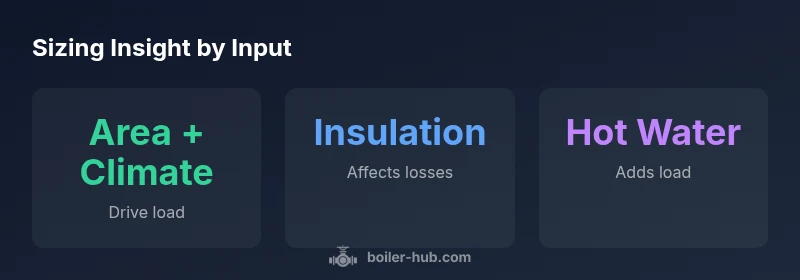
- Home footprint sets the baseline heat load: larger spaces generally require more heating capacity.
- Insulation quality reduces or increases load depending on R-value: better insulation lowers the needed boiler size.
- Climate factor reflects local weather: harsher climates raise the required output.
- Hot-water demand adds to the load because producing hot water requires sustained heating.
If your app offers presets or unit toggles, use them to keep data consistent. The goal is to produce an output that is sensible for your building and usage patterns, not to chase a perfect number.
How the calculator translates inputs into a size recommendation
Most boiler sizing calculators use a simple, teachable heuristic so users can grasp what drives the result. A typical approach combines the area, climate, insulation, and hot-water demand to estimate a nominal load, then applies efficiency and system adjustments. In this article, we’ll describe a straightforward, educational formula that demonstrates the logic without getting into specialized HVAC math. The key idea is that space and climate drive demand, insulation lowers heat loss, and hot water contributes additional load. Understanding this flow helps you interpret the size recommendation and what you might adjust to optimize performance.
Step-by-step example: sizing a typical home
For illustration, imagine a 2,400 sq ft home with moderate insulation (R-value around 20) in a temperate climate, and an annual hot-water demand of about 1,200 kWh. Enter these values into a boiler size calculator app. The simple heuristic might compute a base load of 2,400 × 1.0 = 2,400, adjust for insulation by dividing by a factor related to R-value (e.g., divide by 1.1 if insulation is decent), and add hot-water contribution (1,200 ÷ 60 ≈ 20). The result is a rough sizing ballpark in the low thousands of BTU/h. Note this is a simplified example to illustrate how the inputs influence the output; real-world sizing should include professional assessment and equipment efficiency considerations.
Practical tips for accuracy and safety
- Use consistent input units and save presets for different projects to reduce errors.
- Double-check insulation and climate inputs; unrealistic data undermines accuracy.
- Treat the calculator as a starting point, not a final decision; a professional should verify the final equipment choice.
- Compare results for multiple scenarios (e.g., better insulation vs. different climate) to see potential energy benefits.
- Remember safety: boilers require proper ventilation, clearance, and regular maintenance.
Features that boost usefulness: presets, profiles, and sharing
Good boiler sizing tools offer more than a single number:
- Presets let you save scenarios for different buildings or zones.
- Profiles store inputs for ongoing projects so you don’t re-enter data.
- Export and share results with colleagues or a maintenance team to align decisions.
If your app supports unit toggles (BTU/h vs kW), use it to communicate with HVAC professionals who prefer different metrics.
Residential vs commercial sizing: key differences
Residential sizing focuses on comfort, energy efficiency, and hot-water supply for homes. Commercial sizing often involves larger, more variable loads across multiple zones and equipment types, which may require professional engineering input. A boiler size calculator app for residential use is a great starter tool, but commercial applications typically demand load calculations that follow industry standards and codes. Always ensure the final selection adheres to local regulations and safety guidelines.
Common mistakes to avoid when using a boiler size calculator app
- Relying on a single input without cross-checking others, which skews results.
- Ignoring real-world constraints like ductwork, venting, and equipment availability.
- Not considering system efficiency or future changes in usage.
- Failing to validate inputs when switching between metric and imperial units.
- Skipping professional confirmation when sizing for critical or large installations.
How Boiler Hub guides sizing decisions with calculator apps
The Boiler Hub team emphasizes using calculator apps as educational aids that support transparent sizing discussions. Our guidance is to pair digital estimates with on-site measurements, equipment efficiency considerations, and professional review before purchase. By adopting calculator-based sizing, homeowners and facility managers can communicate clearly about needs, justify equipment choices, and pursue energy-saving outcomes in line with Boiler Hub Analysis, 2026.