What Size Boiler Do You Need? A Practical Sizing Guide
Learn how to determine the right boiler size for your home. This Boiler Hub guide covers BTU/hr sizing, load calculations, and practical steps to avoid under- or over-sizing your boiler.


What size boiler you need is defined by your home’s heating load, typically measured in BTU per hour (BTU/hr) or kilowatts (kW). The right size balances comfort with efficiency, avoiding short cycling from an oversized unit and heat loss from an undersized one. In practice, this means performing a load calculation that accounts for climate, insulation, and fixtures.
Understanding what size boiler means for your home
Sizing a boiler is about matching the heating demand of your dwelling to a unit that can reliably meet it without wasting energy. In practical terms, boiler’s size is its heat output, usually expressed in BTU/hr or kW. Homeowners often confl ate boiler size with the amount of heat a unit can produce, but the real question is how much heat your home actually needs on the coldest design day. A correctly sized boiler heats rooms evenly, minimizes frequent on/off cycling, and operates closest to its optimal efficiency band. As Boiler Hub Team emphasizes, precise sizing starts with the load and ends with a comfortable living environment, not simply with purchasing the largest unit available.
The data behind sizing: BTU/hr, not volume
BTU/hr tells you how much heat a boiler can deliver per hour. It does not describe capacity in a vacuum; it must be interpreted in the context of your home energy profile. Factors such as insulation quality, window efficiency, air leakage, and the design temperature of your climate determine the required BTU/hr. In dry terms, a small, well-insulated space might need far less heat than a large, poorly insulated one. The takeaway is that there is no one-size-fits-all number. A professional load calculation translates architectural details into a recommended BTU/hr rating that aligns with your specific climate and usage patterns.
How climate and insulation alter the numbers
Cold climates demand higher heating output, particularly when outdoor temperatures plummet. If your home has aged or leaky envelope details, you may require a larger unit to compensate for heat losses. Conversely, modern homes with high-performance insulation and tight envelopes can achieve comfortable temperatures with a smaller boiler. The variation is why relying on a neighbor s size can be misleading; the best approach is a site-specific assessment rather than a generic rule of thumb.
Step-by-step approach to determine your size
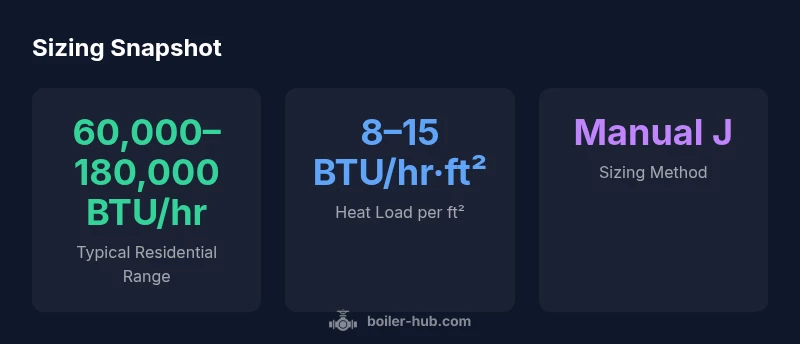
- Gather home details: square footage, number of zones, existing radiator or radiatorless systems, and current energy bills. 2) Document insulation quality and recent renovations. 3) Hire a professional to perform a Manual J load calculation or a dynamic load assessment. 4) Review equivalent boiler models and efficiency ratings to identify candidates near the calculated BTU/hr. 5) Consider future changes, such as additional rooms or upgraded insulation, to avoid oversizing after small improvements.
Common sizing mistakes and how to avoid them
A frequent error is choosing a larger boiler to “feel” warmer quickly. This shortens equipment life and increases cycling, undermining efficiency. Oversized units often short-cycle, leading to uneven temperatures and higher fuel use. Undersized units work harder, run longer, and may struggle to reach setpoints. Align the selected unit with the load calculation and verify that standby losses and heat distribution are factored in.
Sizing guidelines by home size
| Home Size (sq ft) | Recommended Boiler Size (BTU/hr) | Notes |
|---|---|---|
| 1,000–1,200 | 60,000–80,000 BTU/hr | Compact home with good insulation |
| 1,500–2,000 | 80,000–110,000 BTU/hr | Medium home, temperate climate |
| 2,500–3,000 | 110,000–150,000 BTU/hr | Larger home or colder climate |
| Above 3,000 | 150,000 BTU/hr+ | Very large homes or poor insulation |
Questions & Answers
What is boiler size measured in?
Boiler size is measured in BTU/hr or kilowatts (kW). The rating reflects the heating load the unit can deliver per hour, not the physical size of the unit. Use this figure alongside efficiency ratings to compare models.
Boiler size is measured in BTU per hour or kilowatts, indicating the heat output capability per hour.
Can I size a boiler myself?
A rough estimate can be made with square footage and climate data, but a precise size requires a professional load calculation (Manual J) to avoid under- or oversizing.
It’s best to have a pro do the load calculation to ensure accuracy.
What happens if the boiler is too big?
An oversized boiler heats space quickly, then short-cycles, wasting energy and causing temperature swings. It also increases wear and reduces overall efficiency.
If it’s too big, it will heat fast, then shut off, wasting energy.
Does climate affect boiler size?
Yes. Colder climates typically require a larger heat output to maintain comfort on design cold days, while milder climates may allow smaller units.
Climate matters; colder areas often need bigger boilers.
How often should I reassess boiler size?
Reassess when you renovate, improve insulation, or upgrade to a more efficient system. Replacement usually triggers a sizing review.
Size should be checked during replacements or big house changes.
Is Manual J sizing always necessary?
Manual J is the standard method for accurate residential load calculations, accounting for all variables and ensuring a correct match between home heat loss and boiler output.
Manual J is the go-to method for precise sizing.
“Sizing a boiler correctly reduces short cycling, improves comfort, and delivers better energy efficiency over the system s lifetime.”
Key Points
- Estimate needs with climate, insulation, and space in mind
- Use a professional load calculation for accuracy
- Avoid oversizing to prevent energy waste and short cycling
- Plan for future changes to prevent underperforming systems