Can You Get Government Help for a New Boiler? A Practical Guide
Discover if you can get government help for a new boiler, who qualifies, and how to apply. This practical Boiler Hub guide covers grants, rebates, loans, and common pitfalls for homeowners and facility managers.


Definition: Government help for a new boiler varies by country and program. In many regions, qualifying homeowners can access grants, subsidies, or low-interest loans to upgrade to energy-efficient models. This guide explains who qualifies, where to find programs, typical application steps, and how Boiler Hub recommends navigating rules and timelines to avoid common mistakes.
Overview: Can you get government help for a new boiler?
According to Boiler Hub, many homeowners and facility managers ask whether the government offers support for a boiler upgrade. The short answer is that programs exist, but eligibility depends on your location, program availability, and household status. In several regions, government agencies, energy commissions, and utility-sponsored initiatives provide grants, rebates, or low-interest loans to encourage energy-efficient boiler replacements. This section lays out the landscape, the types of assistance you might encounter, and how to begin your search with clarity. The goal is to help you determine if you can access financial support and to set realistic expectations about timelines and documentation.
By addressing the question directly and linking to official resources, readers get a practical starting point for their own situation.
Program types and how they work
Government support for boilers usually falls into a few broad categories: grants that do not have to be repaid, rebates that reduce the upfront cost, and low-interest loans that spread payments over time. Some programs target low-income households, while others reward upgrades to high-efficiency models or to systems that meet or exceed energy-performance standards. Utility companies and regional energy offices often collaborate to fund these initiatives, which can be delivered through municipalities, energy efficiency programs, or national schemes. It’s important to note that program design and funding levels can shift year to year, which is why a proactive, year-by-year check is essential. Boiler Hub’s guidance emphasizes checking regional portals and utility pages to see what’s current and applicable to your property type.
Eligibility and required documents
Eligibility criteria for government boiler programs commonly hinge on location, ownership status, property type, and energy-efficiency improvement plans. Many programs require homeowners to commit to upgrading to an ENERGY STAR-certified boiler, complete a home energy assessment, or implement complementary efficiency upgrades such as insulation or smart controls. Documentation often includes proof of ownership, income verification for needs-based programs, utility bills, and estimate quotes from licensed installers. While income thresholds, property eligibility, and retrofit requirements vary, the core approach remains consistent: prove need, demonstrate that the upgrade aligns with efficiency goals, and provide clear project plans.
Boiler Hub emphasizes the importance of proactive preparation. Having a current energy assessment and a contractor’s quote ready can accelerate processing and reduce back-and-forth requests from program administrators.
Where to find programs and how to compare them
Programs are typically listed on federal, state or provincial energy portals, local government sites, and official utility pages. Start with your regional energy office, then cross-check with trusted national databases or consumer protection agencies. When comparing programs, look at the total potential cost reduction, eligibility requirements, required upgrades, and any post-installation follow-up or monitoring. Some programs cap the number of applicants per year or require a competitive bidding process, so it helps to organize applications in parallel where possible. Boiler Hub recommends compiling a side-by-side comparison to identify the best fit for your home’s needs.
Application steps and timelines
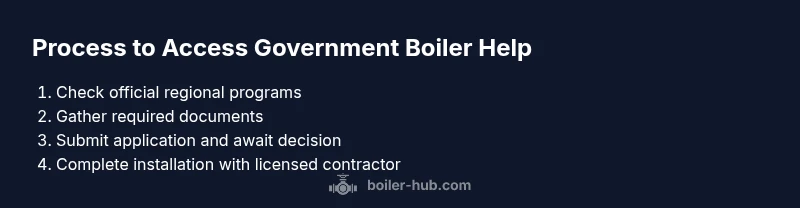
A typical path involves identifying eligible programs, gathering documentation, obtaining contractor assessments, submitting applications, and then awaiting a decision. Timelines vary widely depending on funding levels and administrative workloads. Applicants who pre-qualify, submit complete documentation, and respond quickly to requests tend to move through reviews more smoothly. After approval, you’ll coordinate installation with a licensed contractor and provide any required verification or follow-up reports to the program administrator.
Boiler Hub’s experience shows that early preparation and clear communication with both the program office and your installer can prevent delays and mitigate surprises during the process.
Practical considerations and next steps
If you’re near a furnace or boiler replacement window, consider bundling upgrades (insulation, smart thermostats, and zoning) to maximize program value and long-term energy savings. Some programs require site inspections after installation to confirm compliance, so expect additional scheduling time. Even if you don’t qualify for full funding, some jurisdictions offer partial subsidies or low-interest loan options that can ease cash flow during a retrofit. Always verify the latest program details from official sources and document everything for audits or future reference.
Boiler Hub’s practical recommendation
The Boiler Hub team recommends starting with a quick scan of local programs, then validating eligibility with an official portal. If you’re unsure about requirements, seek guidance from a licensed contractor who understands energy efficiency standards and can help assemble the necessary documents. Following a disciplined, documentation-first approach increases your chances of success and minimizes last-minute hurdles. By staying organized and leveraging available incentives, you can pursue a boiler upgrade confidently.
Tools & Materials
- Internet-enabled device (computer, tablet, or smartphone)(For researching programs and submitting applications.)
- Digital copies of income verification (if required)(Some programs use income-based eligibility; prepare documents like tax returns or benefit statements.)
- Proof of home ownership or lease agreement(You may need to show ownership or consent to retrofit work.)
- Contractor quotes and energy assessment report(ENERGY STAR or equivalent certification is often preferred.)
- Utility bill(s) from the last 12 months(Used to establish energy usage baseline and program alignment.)
- Notebook or digital folder for documentation(Organize forms, IDs, app confirmations, and receipts.)
Steps
Estimated time: Varies by program (days to weeks)
- 1
Identify eligible programs
Search official regional portals and utility pages to list programs available where you live. Note which programs focus on energy efficiency, boiler replacement, or low-income assistance, and record application steps.
Tip: Start with your local energy office’s website and verify current funding status. - 2
Gather documents and assessments
Collect proof of ownership, income documentation if required, energy assessments, quotes from licensed installers, and any prior energy-efficiency records.
Tip: Prepare a single folder (digital or physical) with every document labeled and dated. - 3
Get a contractor pre-assessment
Ask a licensed technician to assess your current boiler, determine upgrades needed, and estimate efficiency improvements.
Tip: Choose an ENERGY STAR-certified boiler and ensure compatibility with your home system. - 4
Submit the application
Complete the online or mailed application with all required fields and attach supporting documents. Double-check for accuracy before submitting.
Tip: Keep a timestamp and confirmation number for follow-ups. - 5
Monitor review and respond to requests
Check your portal for status updates, respond promptly to any additional document requests, and prepare for a possible energy audit.
Tip: Set calendar reminders for deadlines and follow-up dates. - 6
Receive decision and plan installation
If approved, coordinate installation with a licensed contractor and verify compliance documentation is in place.
Tip: Schedule installations during favorable weather and confirm post-install requirements. - 7
Complete installation and verify results
Finish the installation, provide any required post-install documentation, and monitor energy usage to verify savings.
Tip: Save all receipts and energy usage data for future audits or claims. - 8
Assess long-term options
If the program doesn’t cover the full cost, explore partial subsidies, financing options, or combined upgrades for better value.
Tip: Consider bundling insulation upgrades to maximize energy savings.
Questions & Answers
Can I get government help for a new boiler?
Yes, depending on your location and program availability. Eligibility typically considers income, ownership, and energy-efficiency upgrades. Always verify current offerings through official portals.
Yes, you may qualify depending on your location; check official sources for current programs and requirements.
What kinds of programs exist for boiler upgrades?
Programs commonly offer grants, rebates, or low-interest loans to offset upgrade costs, with emphasis on energy efficiency.
Programs usually include grants, rebates, or loans to help with the upgrade.
Do I need an energy assessment to apply?
Many programs require or reward an energy assessment to verify the upgrade’s impact and ensure efficiency targets.
An energy assessment is often needed to qualify and maximize benefits.
How long does the application process take?
Processing times vary by program and funding levels; some take days, others weeks. Prepare documentation to speed up reviews.
Processing can take days to weeks depending on the program.
Can landlords apply on behalf of tenants?
Some programs target homeowners; others are available to landlords, depending on local rules and program structure.
It depends on the program—check eligibility for landlord or tenant applications.
Are there income limits or other eligibility rules?
Many programs have income-based or property-based criteria; always review the official guidelines for specifics.
Yes, many programs have income or property criteria; check the official guidelines.
Watch Video
Key Points
- Check eligibility across local, state, and federal programs.
- Gather required documents before applying.
- Work with licensed contractors to meet efficiency standards.
- Track deadlines and respond promptly to requests.