Can You Get a Grant for a New Boiler? A Practical Guide
Discover how homeowners and facility managers can access grants for new boilers, eligibility, sources, and step-by-step guidance. Boiler Hub analyzes current programs and practical tips for securing energy-efficiency funding in 2026.


Yes. You can often qualify for a grant or rebate when installing a new boiler, especially high-efficiency models. Programs come from federal, state or province governments, utility providers, and local authorities. Eligibility varies by location, income, and project type. Check current listings, as funds, amounts, and application steps change regularly. According to Boiler Hub analysis, many programs target energy savings and emission reductions.
Can you get a grant for a new boiler? How it works in practice
When you start shopping for a new boiler, the question often is not only about price or efficiency but also about funding options. can you get a grant for a new boiler? grants, rebates, and low-interest loans exist to offset equipment costs and installation. In 2026, homeowners and facilities managers are increasingly turning to these programs to reduce upfront costs while upgrading to high-efficiency equipment. The exact availability depends on your location and the current policy landscape. Start by identifying whether your project qualifies for energy-saving incentives and, if so, what documentation is needed to prove eligibility. This section sets the stage for a practical, steps-based approach to funding your boiler upgrade.
Where funding typically comes from: levels of government and utilities
Funding streams for boilers commonly come from federal or provincial/state programs, local government initiatives, and utility sponsorships. Some programs emphasize low-emission heating, others target energy efficiency improvements in older homes or facilities. In many regions, utility companies offer rebates for equipment that meets efficiency thresholds. Programs may cover equipment costs, installation, or both. Because funding rules change, it’s essential to consult official sources and Boiler Hub’s up-to-date guidance before launching a replacement project.
Eligibility factors that influence grant approval
Eligibility hinges on several factors: whether the boiler is replacing an older unit, the model’s efficiency rating, whether energy audits are required, and your household or business income or property type. Some programs require energy-saving targets or completion within a specified window. Documentation often includes proof of ownership, contractor quotes, and detailed equipment specs. Applicants should verify that their project aligns with the program’s priorities, such as reducing emissions or cutting utility bills.
Grant types you may encounter: grants, rebates, and subsidized loans
Grant programs usually offer partial subsidies rather than full coverage. In some cases, rebates cover a percentage of material costs, while others provide a fixed amount based on efficiency improvements. Subsidized loans can also be offered with reduced interest rates. When evaluating options, compare total project costs, potential energy savings, and payback periods. Understanding these distinctions helps you estimate the true value of any boiler upgrade.
Step-by-step: applying and preparing documents
A successful application typically requires clear documentation and timely quotes. Gather proof of residence, ownership, and current heating system details. Obtain a contractor quote that itemizes equipment costs and installation labor. An energy assessment or efficiency certificate is often helpful or required. Prepare a concise description of the project, including the boiler model, efficiency rating, and expected energy savings. Submitting early improves your odds, especially in programs with annual funding cycles.
Pro tips to maximize grant odds
- Focus on high-efficiency boilers that meet or exceed recommended ratings for your region.
- Choose installers who are approved or listed by the program to avoid claim rejections.
- Align your project with program goals, such as energy savings or emissions reductions.
- Document all communications and keep copies of applications and receipts. Early planning reduces last-minute stress.
- Recheck deadlines and eligibility each year, as funds and rules can change with the policy cycle.
Timelines and installation considerations
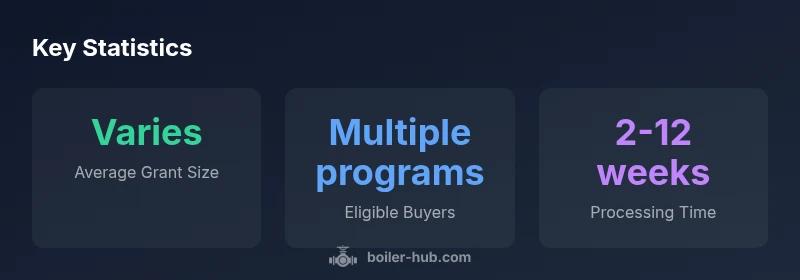
Be mindful that grant approvals may take several weeks to months, and installation scheduling can affect eligibility windows. Plan for potential delays and confirm whether the grant requires a specific installation timeline or contractor requirements. After installation, you may need to submit completion proofs or post-installation energy data to receive final funding. This keeps your project compliant and ensures you receive the intended benefit.
Next steps: where to look up current boiler grant programs
Start with national energy departments, state/provincial energy agencies, and utility company pages. Check reputable sources and avoid outdated or unofficial listings. Boiler Hub updates regularly with new programs and changes to existing ones, so bookmark our guidance for ongoing reference and compliance.
Illustrative boiler grant programs and typical pathways
| Program | Eligible buyers | Typical benefit | How to apply |
|---|---|---|---|
| Federal Energy Grant (illustrative) | Residential homeowners, small businesses | Varies by program | Apply through official portal |
| Utility Rebate Program (illustrative) | Homeowners upgrading to high-efficiency boilers | Partial equipment cost covered | Submit contractor quote and efficiency certificate |
| Local Retrofit Grant (illustrative) | Property owners in eligible districts | Fixed amount based on efficiency | Complete eligibility form and allow site visit |
Questions & Answers
Are boiler grants available for all boiler types?
Not all boilers qualify. Grants typically favor high-efficiency models and replacements that meet program thresholds. Always check current program rules before selecting a boiler.
Grants often prefer high-efficiency boilers and certain replacement scenarios; verify the program terms before choosing a unit.
What should I prepare before applying?
Prepare proof of ownership, residence, a contractor quote, and the boiler specifications. Some programs require an energy assessment or eligibility form.
Have ownership proof, a contractor quote, and boiler specs ready; energy assessments may be required.
Can businesses qualify for boiler grants?
Yes, small businesses and nonprofits may qualify if the program targets commercial energy efficiency or heating upgrades. Rules vary by program.
Businesses can qualify in some programs; check the specific eligibility criteria.
How long does the grant process take?
Processing usually spans several weeks to a few months, depending on program demand and backlog. Plan for potential delays.
Expect weeks to months for approvals; planning ahead helps.
Do grants cover installation costs or just equipment?
Most programs cover a portion of both equipment and installation, but coverage varies widely. Review the grant terms carefully.
Most grants cover part of equipment and installation; read the terms.
Where can I find current boiler grant programs?
Check national energy departments, state/provincial agencies, and utility pages. Also refer to Boiler Hub for up-to-date guidance.
Look up government and utility pages; Boiler Hub helps with current listings.
Are there income requirements for grants?
Some programs use income thresholds, others focus on property type or income-based energy targets. Verify the criteria.
Some grants have income or property-based criteria; check specifics.
“Grants and rebates for boilers are highly location-specific; always verify current programs before purchasing. Treat eligibility as a moving target and plan early.”
Key Points
- Check local programs first to maximize chances.
- High-efficiency boilers qualify more often.
- Gather documents early to speed applications.
- Funding rules change annually; verify before purchase.