Boiler Room Can t Breathe: Urgent Troubleshooting Guide
Boiler Hub's urgent troubleshooting guide helps homeowners and facility managers diagnose why a boiler room can t breathe, with safety steps, a diagnostic flow, and prevention tips.


Short answer: a boiler room can t breathe due to insufficient ventilation and CO buildup. Immediate steps: ventilate the space, shut off the boiler if safe, evacuate if symptoms appear, and call emergency services for suspected carbon monoxide exposure. A licensed technician should inspect venting, gas supply, and combustion air without delay.
Immediate Risks and What 'boiler room can t breathe' Means
A boiler room that can t breathe is a red-flag for potentially dangerous carbon monoxide (CO) buildup and poor combustion air. In tightly sealed spaces, boilers rely on adequate fresh air to burn fuel cleanly; when that air is restricted, incomplete combustion can release CO into the room. CO is colorless and odorless, so detectors become vital safety tools. The phrase boiler room can t breathe reflects a condition where ventilation, venting, or makeup air is insufficient for safe operation. In practical terms, you may notice headache, dizziness, nausea, or fatigue among occupants, or a CO detector alarm sounding. According to Boiler Hub, the root cause is usually a combination of limited air and faulty venting or insulation around the combustion chamber. If you ever sense symptoms or smell unusual exhaust, treat it as an emergency, evacuate, and call emergency services. After the immediate danger, arrange a professional inspection of venting, burners, and the gas supply to prevent a repeat incident. Regular maintenance reduces risk and preserves boiler life.
Checklist: First Things to Inspect
- Clearances around the boiler: keep a safe distance from walls, stored materials, and dust that can hinder airflow.
- Makeup air: ensure the room has an unobstructed path for fresh air, especially in tight spaces.
- Venting and flue: look for visible blockages or disconnections; listen for rattling or whistling from the vent.
- CO detectors: verify placement near sleeping areas and on every floor; test batteries and sensor response.
- Gas supply and burner operation: confirm valves are fully open and the flame is healthy (blue with a steady glow).
- Room door and ventilation ducts: ensure doors aren’t propped closed and ducts aren’t blocked by debris or insulation.
- Signs of leakage: check for soot, corrosion, or unusual condensation on pipes which can indicate venting problems.
If any item is suspect, don’t delay professional assessment. Early checks can avert serious harm and keep your boiler running safely.
Ventilation and Building Codes: Why It Matters
Modern building codes emphasize adequate combustion air and properly vented appliances. A boiler room that can t breathe often violates minimum ventilation requirements, increasing CO risk and reducing system efficiency. Beyond code compliance, operators should treat proper ventilation as a continuous safety practice, not a one-time fix. Boiler Hub analyses indicate that many CO-related incidents originate from sealed rooms, blocked vents, or improper makeup air. By ensuring steady air exchange and verifying vent integrity, you help maintain safe combustion, extend equipment life, and protect occupants. Building owners should partner with licensed professionals for annual or semi-annual inspections, especially in older facilities where ventilation paths may have degraded. Regular testing with calibrated CO detectors adds a critical layer of protection and provides documentation for compliance checks.
How to Test for Carbon Monoxide in Your Boiler Room
CO testing should be part of a routine safety plan. Place a UL-listed CO detector near the boiler room and at sleeping areas, ensuring it has a clear path to air circulation. If the detector alarms, evacuate immediately and call emergency services. Do not re-enter until responders declare the space safe. For ongoing monitoring, keep detectors with fresh batteries and test monthly. If you notice symptoms like headaches or dizziness that align with CO exposure, treat it as an emergency even if detectors show low readings. A professional should verify venting integrity, combustion air, and the burner’s operating condition using proper gas pressure measurements and inspection protocols.
Step-by-Step: Quick Fixes You Can Safely Attempt
- Improve air exchange: Open doors/windows where safe, or temporarily relocate occupants to increase makeup air.
- Clear the immediate area: Remove clutter around the boiler to improve airflow and heat dissipation.
- Inspect for obvious vent blockages: Look for birds’ nests, debris, or exterior vent caps that may be closed or damaged.
- Test detectors: Ensure CO detectors are active and calibrated; replace batteries if needed.
- Verify the flame color: A healthy burner should produce a blue flame; a yellow/orange flame signals incomplete combustion and a need for professional service.
- Do not tamper with gas valves: If you suspect a gas issue or smell gas, evacuate and call emergency services; do not operate the boiler. Tip: These fixes are stopgaps and do not replace a thorough inspection by a licensed technician. Remember safety first—when in doubt, stop using the boiler and call for help.
When to Call a Professional and What They Will Do
If you observe CO detector alarms, persistent dizziness, or any symptoms suggesting gas exposure, call emergency services and evacuate. After the danger is removed, a licensed boiler technician will inspect the combustion air supply, venting, flue integrity, and the burner system. They will assess gas pressure, CO production, heat exchanger integrity, and make necessary repairs or replacements. A professional evaluation also helps identify whether the issue stems from a damaged vent, a blocked exhaust, or a failing safety interlock. Regular maintenance contracts with a trusted technician are strongly recommended to prevent recurring problems and ensure compliance with safety regulations.
Prevention: Keeping the Boiler Room Safe Long-Term
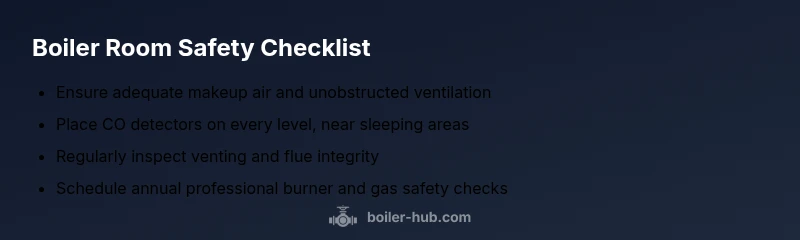
Ongoing prevention combines proper ventilation, detector placement, and routine maintenance. Schedule annual professional inspections that include venting checks, clearance assessments, and combustion analysis. Install and maintain CO detectors on every level and test them monthly. Keep the boiler room uncluttered, ensure make-up air pathways remain unobstructed, and document service visits for regulatory compliance. By treating safety as a continuous process, you minimize CO risk, protect occupants, and preserve boiler efficiency.
Quick Takeaways
- Ensure adequate combustion air and unobstructed ventilation.
- Use CO detectors and test them regularly.
- Do not ignore alarm symptoms; evacuate and call for help.
- Schedule professional maintenance for venting and burner checks.
- Maintain clear space around the boiler and follow local safety codes.
Steps
Estimated time: 60-90 minutes
- 1
Assess immediate danger
If anyone shows CO symptoms or detectors alarm, evacuate quickly and call emergency services. Do not re-enter until responders say it is safe.
Tip: Prioritize personal safety before investigating equipment. - 2
Improve makeup air
Create as much fresh air as possible by opening doors and windows that are safe to open. If feasible, use fans to direct air toward the boiler room and away from it.
Tip: Even a few extra minutes of ventilation can reduce CO concentration. - 3
Inspect for obvious vent issues
Check exterior vent caps for blockages and interior flue connections for disconnections or damage. Do not attempt to repair damaged venting yourself.
Tip: Document any visible issues with photos for the technician. - 4
Test and verify detectors
If detectors exist, ensure they are powered, calibrated, and placed correctly. Replace batteries if indicated and test alarms.
Tip: Replace old detectors; consider multiple detectors on each floor. - 5
Evaluate burner appearance
Look for a healthy blue flame; a yellow or orange flame can indicate incomplete combustion and potential CO risk. Do not adjust gas settings yourself.
Tip: Only trained professionals should adjust burner settings. - 6
Call a licensed professional
Arrange a service visit to inspect venting, gas supply, and combustion performance. They will test CO levels and perform necessary safety repairs.
Tip: Keep a service log for future safety audits.
Diagnosis: Resident reports headaches or dizziness with a CO detector alarm in a boiler room
Possible Causes
- highInsufficient combustion air due to small or sealed room
- highBlocked or restricted venting/exhaust flue
- mediumFaulty burner or heat exchanger causing CO production
- lowGas supply or valve issue causing incomplete combustion
Fixes
- easyOpen ventilation paths and ensure makeup air; improve room airflow
- easyInspect and clear vent blocks; ensure venting is properly installed and sloped
- mediumShut off boiler if safe and contact a licensed technician to inspect burner/heat exchanger
- easyIf CO exposure is suspected, evacuate and call emergency services; do not re-enter until cleared
Questions & Answers
What are the first signs that a boiler room isn t breathing properly?
Common early signs include headaches, dizziness, nausea, fatigue, and CO detector alarms. If these occur in a building with a boiler, evacuate and seek professional assessment of ventilation and combustion safety.
Early signs are headaches, dizziness, and detector alarms. Evacuate and call for professional help.
Can I fix venting or CO issues myself?
No. Venting and combustion safety require a licensed technician. You can improve ventilation temporarily but permanent fixes must be performed by professionals.
Venting fixes should be done by a licensed professional. Don’t attempt permanent repairs yourself.
How should CO detectors be placed for boiler rooms?
Place detectors on each level near sleeping areas and near the boiler room. Ensure they are easily accessible for testing and battery replacement.
Use detectors on each level near sleeping areas and near the boiler room.
What ongoing maintenance helps prevent 'boiler room can t breathe' situations?
Regular professional inspections of venting, burners, and gas connections, plus routine CO detector checks, are key to prevention.
Regular inspections and CO detector checks prevent these issues.
If there is a CO alarm, should I immediately shut off the boiler?
Only if you can do so safely and without entering a hazardous area. If in doubt, evacuate and call emergency services.
If safe, shut off the boiler; if not, evacuate and call for help.
What will a professional inspect during a safety visit?
They inspect combustion air supply, venting integrity, burner operation, gas pressure, and CO production to ensure safe operation.
They check air supply, venting, and burner safety during a visit.
Watch Video
Key Points
- Verify adequate ventilation and air exchange
- Use and test CO detectors regularly
- Address alarms as emergencies and call professionals
- Maintain clear space and routine boiler maintenance