Why Would a Boiler Leak Carbon Monoxide? An Urgent Troubleshooting Guide
Urgent guide to boiler carbon monoxide leaks. Learn signs, immediate safety steps, diagnosis, and when to call a professional. Boiler Hub.


The most likely cause of a boiler leaking carbon monoxide is a faulty heat exchanger or cracked venting that allows combustion gases into the living space. If you smell rotten eggs or notice dizziness, evacuate immediately and call emergency services. Do not operate the boiler; shut off the unit and vent the area until inspected by a professional. Install CO alarms if you haven’t already.
Understanding the risk: why would a boiler leak carbon monoxide
Carbon monoxide (CO) is a colorless, odorless gas that can invade living spaces when a boiler burns fuel inefficiently or exhausts improperly. If a boiler is cracked, poorly vented, or aging, CO can seep into rooms before a detector sounds an alarm. The question why would a boiler leak carbon monoxide isn’t just academic—it’s a matter of safety for every home. According to Boiler Hub, recognizing the signs early and knowing where to look helps homeowners act quickly and reduce exposure risk. Confident, informed action is essential because CO exposure can be life-threatening even at low levels. Regular maintenance and correct ventilation dramatically lower risk. In this guide we’ll cover the most common causes, how to diagnose safely, and where a professional should intervene.
Key takeaway: CO leaks often originate from the combustion side of the boiler or from exhaust pathways failing to vent outside properly.
Immediate safety steps if you suspect carbon monoxide
If you suspect a CO leak, prioritize safety over everything else. First, evacuate everyone from the area and move to fresh air. If anyone shows symptoms such as headache, dizziness, confusion, or nausea, call emergency services immediately. Do not re-enter the space until authorities declare it safe. If you have a CO detector that alarms, follow its instructions and call your gas or heating professional after you are in a safe location.
Next, shut off the boiler at the breaker or switch only if you can do so safely from outside the boiler room. Do not attempt to repair or bypass safety devices. After people are safe and the space is ventilated, contact a licensed heating technician to inspect the unit, vent, and flue path. If you suspect a persistent leak in a multi-occupant building, implement safe evacuation and alert building management.
Tip: If you have sleeping areas above or adjacent to the boiler, ensure CO alarms are installed on every level and near bedrooms. sirens should prompt immediate action.
Common causes of CO leaks in boilers
CO leaks don’t appear out of nowhere. They happen when the combustion process isn’t venting properly or when a component fails. The most frequent causes include a faulty heat exchanger or a cracked exhaust path, which can introduce exhaust gases into living spaces. Blocked or damaged venting, improper venting configuration for the chimney, or backdraft due to inadequate draft can also force CO back indoors. Aging boilers, corroded seals, or improper fuel-air mixtures can worsen conditions, especially in smaller, poorly ventilated spaces. In some cases, improper installation or retrofits without proper venting create hidden CO routes. Understanding these causes helps homeowners prioritize safety and scheduling a professional inspection.
- Faulty or cracked heat exchanger
- Blocked or leaking vent/flu path
- Backdraft caused by poor venting or appliance placement
- Aging or poorly maintained boiler components
- Inadequate combustion air or improper fuel mix
How to safely diagnose a CO leak (non-invasive checks)
Diagnosis should start with safety and non-invasive checks. If a CO detector triggers or someone experiences symptoms, evacuate and ventilate. Check nearby detectors for fresh batteries and ensure they are located according to manufacturer guidance. Do not attempt to disassemble or test the boiler’s internals if you are not trained. Visually inspect obvious external clues: damp flue piping, signs of rust or corrosion on vent connections, and any unusual soot near the boiler. If your space has a pronounced rotten egg smell or you’re unsure about air quality, treat it as an emergency and contact the utility or a licensed technician. Remember, CO is invisible; detectors are your first line of defense.
Non-invasive checks you can perform safely: ensure detectors are functioning, confirm vents are not visibly obstructed, and ensure that the room has adequate air supply. If any indicator suggests a leak, stop using the boiler and call a professional immediately.
What a professional inspection covers and why it’s essential
A licensed technician will perform a thorough safety assessment and diagnose the exact cause of any CO presence. They will inspect the heat exchanger for cracks, verify venting connections and chimney integrity, test combustion efficiency, and check for backdraft or improper air supply. They may perform a pressure test, CO analyzer readings, and a carbon monoxide sweep to map gas flow and determine whether CO is entering the living space or being vented correctly. An inspection also includes verifying safety devices—carbon monoxide detectors, interlocks, and shut-off controls—to ensure they function when needed. If a leak is confirmed, the professional will advise on repairs, replacement, or decommissioning of the boiler as dictated by safety and cost considerations.
Prevention: maintenance, alarms, and safe operation
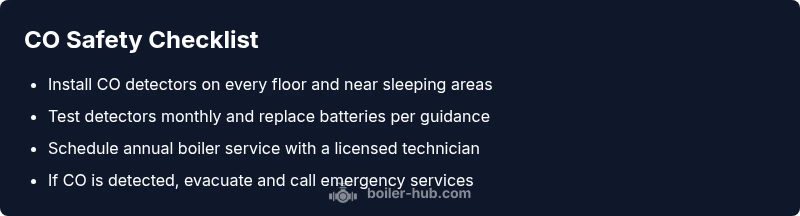
Prevention is better than emergency responses. Schedule annual professional servicing and follow the manufacturer’s maintenance plan. Ensure proper ventilation in boiler rooms and maintain clear air paths around the appliance. Install CO detectors on every floor, especially near sleeping areas, and test them monthly. Keep a log of service visits and any warning signs such as unusual smells, smoke, or pilot lights that won’t stay lit. Never bypass safety devices, and avoid storing flammable materials near the boiler. If you live in a temporarily unventilated space (e.g., during renovations), temporarily relocate occupants away from the area and use portable CO monitors. Regular maintenance reduces risk and extends equipment life.
Steps
Estimated time: 60-90 minutes
- 1
Stop using the boiler and evacuate
If CO exposure is suspected, leave the area immediately with all occupants. If you can do so safely, switch off the boiler at the main breaker and shut off the gas supply only if you must, keeping personal safety in mind. Stand in fresh air until help arrives.
Tip: Do not re-enter until authorities declare it safe. - 2
Call for help
Dial local emergency services if anyone exhibits symptoms. If detector alarms, leave immediately and call emergency services. Notify your energy supplier if you suspect a gas issue.
Tip: Have a clear family meeting point outside the home. - 3
Ventilate and secure the area
Open doors and windows to improve airflow, ensuring no one re-enters until professionals arrive. Keep doors between the boiler room and living spaces closed to limit exposure.
Tip: Do not create a draft by forcing doors repeatedly. - 4
Contact a licensed boiler technician
Arrange a same-day or ASAP inspection by a qualified technician to diagnose the heat exchanger, venting, and combustion settings.
Tip: Ask for a written service report and a scope of recommended repairs. - 5
Follow the professional’s guidance
If a leak is confirmed, the technician will outline repairs or replacement options and safety steps. Do not operate the boiler until cleared.
Tip: Request a copy of warranty and maintenance recommendations. - 6
Verify detectors and safety systems
After repairs, test all CO detectors and boiler safety devices. Ensure detectors are functioning and batteries are replaced as needed.
Tip: Keep detectors in working order and maintain a safety log.
Diagnosis: Boiler room or home shows CO symptoms (headache, dizziness, nausea) or detector alarms trigger, or rotten egg smell
Possible Causes
- highFaulty or cracked heat exchanger allowing combustion gases to mix with room air
- mediumBlocked or leaking vent/flu preventing proper exhaust
- lowInsufficient combustion air or improper venting causing backdraft
Fixes
- easyShut off the boiler and evacuate; call emergency services if exposure is confirmed or symptoms persist
- easyDo not operate the boiler; schedule a professional inspection to assess heat exchanger and venting
Questions & Answers
What are the early signs of carbon monoxide exposure from a boiler?
Headache, dizziness, nausea, and confusion are common early signs. If exposure is suspected, leave the area and seek medical help.
Early signs include headache, dizziness, nausea, and confusion. Leave the area and seek help.
Can a boiler leak CO even if it is well maintained?
Yes, CO leaks can occur even with regular maintenance if components fail or venting is incorrect. Regular checks reduce risk but cannot eliminate it.
CO leaks can happen even with maintenance; regular checks reduce risk.
What should I do if my CO detector alarms?
Evacuate immediately, call emergency services, and do not re-enter until authorities declare safety.
If the CO detector alarms, leave and call emergency services.
Is carbon monoxide from boilers more likely in old homes?
Older boilers and aging venting can increase risk, but failures can happen with any system. Regular inspections are essential.
Older systems can be higher risk, but any boiler can leak CO if not maintained.
How often should a boiler be serviced to prevent CO leaks?
Most manufacturers recommend annual professional service, with extra checks if symptoms appear.
Most boilers should be serviced yearly, with extra checks if symptoms appear.
Watch Video
Key Points
- Act quickly if CO suspected
- Install and test CO detectors
- Schedule professional boiler service annually
- Never ignore CO symptoms while at home