How to know if your boiler is leaking carbon monoxide: urgent troubleshooting
Learn how to spot signs of a carbon monoxide leak from your boiler, test safely, and respond quickly. This practical guide from Boiler Hub helps homeowners and managers protect lives.


Most CO leaks from boilers stem from poor venting, cracked heat exchangers, or improper combustion. If you suspect a leak, immediately evacuate, call emergency services, and turn off the boiler if safe. Install or check CO detectors on every level, and arrange a licensed professional inspection as soon as possible to confirm and repair.
What carbon monoxide is and why boilers leak
Carbon monoxide (CO) is an odorless, colorless gas that can cause sudden illness or death in enclosed spaces. When a boiler leaks CO, occupants may not perceive anything until detectors alarm or symptoms appear. If you're asking how to know if your boiler is leaking carbon monoxide, you're not alone—early detection saves lives. According to Boiler Hub, the most common leaks start with improper venting or a cracked heat exchanger, then escalate if the unit runs without adequate combustion air. Boilers produce CO as a byproduct of incomplete combustion or venting problems; a healthy system usually keeps CO out of living spaces. Regular maintenance, proper venting, fresh combustion air supply, and functioning detectors are essential defenses against a leak. In this guide we focus on practical steps homeowners and facility managers can take without waiting for the next service visit.
Health signs and consequences of CO exposure
CO exposure is deceptive because its symptoms mimic the flu and can worsen quickly in confined spaces. Common early signs include headaches, dizziness, confusion, nausea, and fatigue. Prolonged exposure can lead to fainting, cognitive impairment, or heart stress. Because CO is colorless and odorless, detectors are the most reliable early warning. If detectors alarm or anyone in the building experiences symptoms, act immediately: evacuate, call emergency services, and seek medical evaluation. Boiler Hub's guidance emphasizes that rapid action saves lives, especially in kitchens, boiler rooms, or multi-unit dwellings where inhabitants spend long periods indoors. After you are safe, do not re-enter until authorities confirm air quality is restoration. Keep doors open during evacuation if it’s safe and you can do so.
Common causes of boiler CO leaks
Several everyday issues can turn a normally safe boiler into a CO source. A cracked or corroded heat exchanger is a frequent culprit, allowing CO to migrate into living spaces. Blocked or damaged flue and venting can back up exhaust and push gases indoors. An improperly adjusted burner or a leak in the fuel supply can produce excessive CO generation. Inadequate combustion air—such as a tight room or obstruction around the air intake—forces incomplete burning. External wind gusts or poor venting design can also cause backdrafting. Aging equipment and skipped annual service raise the likelihood of one or more failures. In all cases, professional assessment is essential because CO leaks require precise diagnosis and safe repair.
Immediate safety steps if you suspect a CO leak
Act quickly to protect people in the building. If CO detector alarms or you notice symptoms, evacuate immediately and call emergency services. Do not re-enter until responders declare the area safe. If you can do so safely, switch off the boiler at the wall switch or breaker and avoid using other gas appliances in the area. Open exterior doors or windows to improve ventilation only if it’s safe to do so from outside the affected space. Once you are safe, contact a licensed boiler technician or gas safe engineer to perform CO testing, diagnose the leak, and perform required repairs. In multi-occupancy settings, notify building management and follow your CO safety plan.
How to test for CO safely and accurately
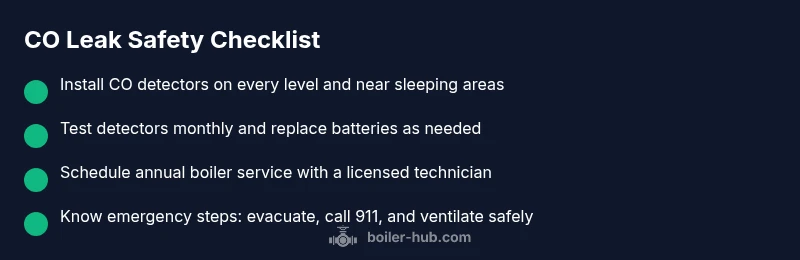
Reliable testing starts with properly placed CO detectors and professional testing when needed. Install at least one digital CO detector on each floor, especially near sleeping areas and in boiler rooms. Test detectors monthly, replace batteries as needed, and replace units every 5-7 years. Do not rely on any sense of smell; CO is invisible and odorless. If detectors alert or levels remain elevated after evacuation, a licensed technician should conduct a combustion safety test, inspect venting, and measure CO levels in indoor air. Ask the technician to review combustion air supply, vent piping integrity, and the overall risk of future leaks. Regular testing and maintenance reduce the probability of dangerous leaks and improve long-term safety.
Diagnostic and maintenance plan to minimize risk
Proactive maintenance and simple diagnostic steps go a long way toward preventing CO leaks. Schedule annual service with a qualified gas-safe technician to inspect the heat exchanger, burners, venting, and air intake. Ensure the exhaust vent is clear and not blocked by debris, snow, or insulation. Verify there is adequate combustion air and that the boiler is installed according to local codes. Place CO detectors at appropriate heights and locations to avoid dead zones where gas might accumulate. Keep a log of service visits, detector tests, and repairs so you can track when the next service is due. Boiler Hub recommends a clear safety plan, routine detector checks, and timely repairs to minimize risk, particularly in high-use facilities.
Aftercare: what to do once the area is cleared and safe
After a successful repair, confirm that CO levels are back to normal in all living spaces and that ventilation continues to function. Schedule a follow-up inspection after the first heating cycle to ensure the fix holds under typical operating conditions. Maintain detectors, renew batteries, and keep records of service calls. Use this incident as a learning opportunity: review your safety plan, practice evacuation routes, and ensure all occupants know how to respond to alarms. A long-term commitment to maintenance lowers the chance of a repeat incident and protects everyone in your home or facility. The Boiler Hub team emphasizes ongoing vigilance as the key to safety.
Steps
Estimated time: 60-90 minutes
- 1
Evacuate and call emergency services
If CO suspicion arises, leave the area immediately with others; call 911 or your local emergency number. Do not re-enter until responders declare the area safe.
Tip: Do not re-enter or switch on electrical devices until professionals clear the area. - 2
Shut off the boiler and power if safe
Turn off the boiler using the wall switch or breaker while keeping a safe distance from gas lines and vents. If you smell gas or see signs of a leak, skip this step and wait for professionals.
Tip: Only perform this step if you can do so without putting yourself at risk. - 3
Ventilate the space safely
Open exterior doors or windows to improve air exchange, but only if you can do so without entering a hazardous zone. Avoid using fans or appliances that could ignite any accumulated gas.
Tip: Stay outside or in a safe area during ventilation. - 4
Call a licensed technician for testing
A gas-safe engineer should perform CO testing, inspect venting, and verify there are no persistent leaks. Request a combustion safety report and a written repair plan.
Tip: Ask for the test results and recommended fixes in writing. - 5
Verify detectors and plan replacements
Test detectors after any service, replace batteries, and replace old units. Ensure at least one detector per floor and near sleeping areas.
Tip: Keep spare batteries and a maintenance log accessible. - 6
Return to service only after clearance
Only resume boiler operation after a professional confirms air quality is safe and the leak source is repaired. Monitor for any repeated symptoms.
Tip: Establish a post-repair testing schedule and safety drills.
Diagnosis: CO detector alarm or occupant symptoms (headache, dizziness, nausea) suggesting a CO leak
Possible Causes
- highFaulty heat exchanger allowing CO into living spaces
- highBlocked or cracked venting/backdraft
- mediumImproper burner adjustment causing excessive CO production
- lowCracked gas line or supply issues near the boiler
Fixes
- easyEvacuate occupants and call emergency services if CO levels are suspected
- easyShut off the boiler at the switch/breaker and avoid using it until inspected
- hardArrange a licensed boiler technician to perform CO testing, vent inspection, and, if needed, component replacement
- easyTest detectors and venting after repair and replace detectors if necessary
Questions & Answers
What are the common signs that a boiler is leaking carbon monoxide?
The most frequent indicators are flu-like symptoms (headache, dizziness, nausea) and CO detector alarms. If these occur, evacuate and seek help immediately. Early recognition saves lives.
Common signs include headaches, dizziness, and alarm bells from CO detectors; act quickly and seek help.
Can a boiler leak CO even after a recent service?
Yes. Leaks can develop or reappear after service due to vent blockages, new cracks, or improper venting. Always investigate detector alarms and consider a fresh combustion safety check.
CO can recur after service; detectors will help you know when to act.
Should I ignore a faint CO detector alarm?
No. Any CO detector alarm requires immediate evacuation and contact with emergency services. Do not assume a low level is safe.
Never ignore a CO detector alarm; evacuate and call for help.
Is a boiler with a CO leak repairable, or does it need replacement?
It depends on the source. A cracked heat exchanger often requires replacement, while some venting or burner issues may be repairable by a qualified technician.
Repairs depend on the fault; some parts may be replaceable, others require replacement.
How often should CO detectors be tested and boilers inspected?
Test detectors monthly, replace batteries yearly, and schedule a professional boiler inspection annually.
Test detectors monthly and have yearly professional boiler inspections.
Watch Video
Key Points
- Act fast if CO risk is detected
- Install and maintain CO detectors
- Schedule annual boiler service and vent checks
- Never delay professional assessment when detectors alarm