How Much New Boiler: Costs, Types, and Installation Guide (2026)
Learn how much a new boiler costs, what affects price, and how to plan for installation in 2026. Practical guidance for homeowners and facility managers on choosing, budgeting, and saving.


If you’re asking how much new boiler costs, the installed price typically ranges from a few thousand in local currency to several thousand, depending on boiler type (combi, system, or regular), fuel source, and installation complexity. Expect additional costs for venting, controls, and removing an old unit. Boiler Hub Analysis, 2026 notes that regional labor rates and VAT/taxes can push final prices higher or lower.
How much new boiler costs: a practical overview
If you’re evaluating a boiler replacement, the question "how much new boiler" costs is best answered by breaking down the components of the total price. The installed cost typically reflects three big buckets: the boiler unit itself, installation and labor, and any required upgrades (flue, venting, controls, and system checks). In practice, expect a price range that accommodates different boiler types (combi, system, and regular/conventional) and fuels (gas, oil, or LPG). In 2026, Boiler Hub Analysis, 2026 shows that regional factors—such as labor rates and VAT—play a significant role in final figures. When budgeting, plan for contingencies like upgrading a dated flue or adding smart controls that improve efficiency.
What this means for homeowners and facility managers: know your baseline needs (hot-water demand, space constraints, and existing piping) and request itemized quotes that separate parts, labor, and ancillary costs. This helps you compare apples-to-apples quotes and identify where you might save without compromising safety or performance.
What drives the price of a new boiler
Prices are driven by several interrelated factors. The boiler type affects the unit cost: combi boilers tend to be cheaper upfront than system or regular boilers, but the relative savings depend on usage patterns and home size. Fuel source and energy efficiency matter: higher AFUE ratings generally cost more but reduce operating costs over time. Installation complexity—like removing old equipment, upgrading flues, relocating the boiler, or changing controls—can significantly increase labor time and cost. Warranty terms, accessibility of the installation site, and the need for additional parts (e.g., expansion tanks, condensate drainage) also affect the final invoice. Finally, regional demand and contractor availability cause price volatility across neighborhoods and seasons.
Choosing between boiler types: combi, system, and regular
- Combi boilers are compact, provide on-demand hot water, and are often best for smaller homes or apartments. They usually have shorter installation times but may require more careful water-heating planning for high-demand households.
- System boilers store hot water in a cylinder, enabling quicker hot-water delivery while still using a dedicated boiler to heat water. They are well-suited to homes with higher demand or multiple bathrooms.
- Regular/conventional boilers work with separate storage cylinders and expansion tanks, offering flexibility for homes with existing radiator systems and complex layouts. They can be advantageous if you already have a large radiator network or if gas supply constraints exist.
Each type has a different upfront cost pattern and long-term operating cost profile. A reputable installer will assess your home’s size, flow rates, insulation, and existing plumbing to recommend the best match.
Regional price expectations: UK vs US vs Europe
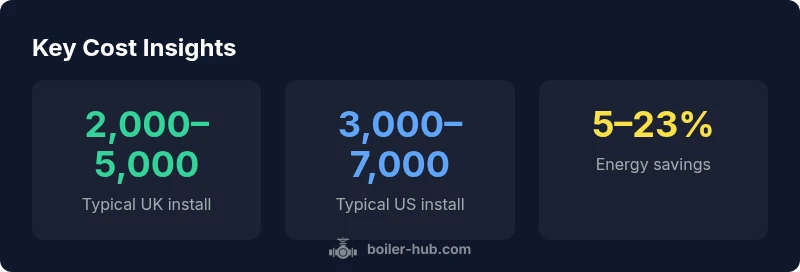
Prices differ by country due to labor rates, VAT or sales tax, and availability of skilled installers. In the UK, typical installed cost ranges can be illustrated as lower for smaller homes and higher for larger properties requiring additional venting upgrades. In the US, regional labor markets and permitting processes influence the final number. In European markets, variations in fuel prices, efficiency standards, and contractor rates contribute to a broad spread. Across regions, the decision to upgrade to higher-efficiency models can alter long-term total cost of ownership, often offsetting higher upfront costs over time.
Hidden costs and upgrade considerations
Some items that commonly appear as extra charges include the removal and disposal of the old boiler, new flue work, upgrading from a standard to a condensation-ready system, pressure testing, flushing of the heating circuit to prevent sludge, upgrading controls (digital thermostats or smart home integration), and potential radiator refurbishments. If your home requires additional pipework or a re-run of the gas line, plan for substantial cost increases. Always ask for a detailed quote that lists these line items separately so you can compare quotes accurately.
Timing, logistics, and planning for installation
Scheduling a boiler replacement involves not only the installation day but pre-work visits, hoisting of the unit if needed, and post-install checks. Some projects require building regulation-compliant work, gas safe certification, and carbon monoxide safety testing. The duration can range from 1 to 3 days for typical homes, depending on boiler type and the complexity of adding or relocating vents. Weather-related delays or access constraints can add time and cost. To minimize surprises, book a pre-install survey and obtain written quotes that specify the scope and guarantees.
Financing, incentives, and budgeting tips
Financing options, seasonal promotions, and regional incentives can materially affect out-of-pocket costs. Some programs offer rebates or tax credits for energy-efficient installations, particularly for high-efficiency boilers. If available in your region, these can shorten payback periods substantially. When budgeting, factor in not just the upfront cost but also expected operating costs over 5–10 years, maintenance intervals, and any required parts replacements (anodes, pumps, or seals) that may influence long-term expenditure.
How to get accurate quotes: a contractor checklist
To ensure meaningful quotes, invite at least three certified installers to assess the site, verify the existing system, and provide a written breakdown of parts, labor, disposal, and any additional costs. Ask the following questions: Is the boiler size correctly matched to peak demand? Are you including venting and condensate piping upgrades? What warranties accompany the unit and labor? Will you handle permit applications and post-install CO testing? This due diligence helps you avoid price shocks or mismatched specifications.
Practical decision checklist
- Confirm yearly energy usage and peak hot-water demand to guide boiler sizing.
- Compare AFUE ratings and estimated operating costs.
- Check the installer’s license, insurance, and references.
- Request a detailed, written quote with itemized costs.
- Plan for post-install maintenance and potential future repairs.
- Factor future energy price trends and potential subsidies into the long-term cost view.
Comparison of common boiler types
| Boiler Type | Avg Lifespan | Typical Installation Time |
|---|---|---|
| Combi boiler | 12–15 years | 1–2 days |
| System boiler | 12–20 years | 1–3 days |
| Regular/conventional | 15–25 years | 1–3 days |
Questions & Answers
What factors impact the total cost of a new boiler?
The total cost hinges on boiler type, size, fuel source, efficiency rating, and installation complexity. Upgrades to venting, controls, and the heating system (like radiator refurbishments) can add to the price. Regional labor rates and permits also influence final figures.
Costs depend on boiler type and setup, plus local labor and permits.
Is installation faster for a combi boiler?
Combi boilers are often quicker to install due to their compact design, but site specifics—existing pipework and venting—can affect timing. Always confirm the expected duration in your quote.
Combi installs are usually faster, but site specifics matter.
Should I replace radiators when I replace the boiler?
Not always, but upgrading radiators can improve system efficiency and hot-water delivery, especially if the radiators are old or mismatched to the new boiler. Consider a professional assessment.
Often worth considering for efficiency and performance.
Are there rebates or subsidies for new boilers?
Programs vary by region. Check local government energy programs or utility incentives for potential rebates or tax credits tied to high-efficiency boilers.
Look for local energy incentives in your area.
What maintenance is required after installation?
Schedule an annual service with a qualified technician, check the pressure, inspect venting, and ensure a CO detector is functioning. Regular flushing may be recommended after several years.
Annual service keeps the boiler running safely and efficiently.
How long does a typical installation take?
Most installations take 1–3 days, depending on boiler type, existing piping, and venting work. Your installer should provide a clear timeline before work begins.
Most installs are a day or two, depending on setup.
“A new boiler is a long-term investment in comfort and efficiency; the upfront cost should be weighed against decades of reliable heating and lower energy bills.”
Key Points
- Start with a clear budget range and get itemized quotes.
- Prioritize high-efficiency models to reduce long-term costs.
- Match boiler size to demand to avoid oversizing.
- Consider installation complexity and disposal fees in your plan.
- Ask about warranties, permits, and post-install maintenance.