Dual Boiler vs Heat Exchanger: A Practical Guide
Explore the core differences between dual boiler systems and heat exchanger designs, including efficiency, upfront costs, maintenance, and long-term reliability. This guide helps homeowners and facility managers choose the right boiler configuration.


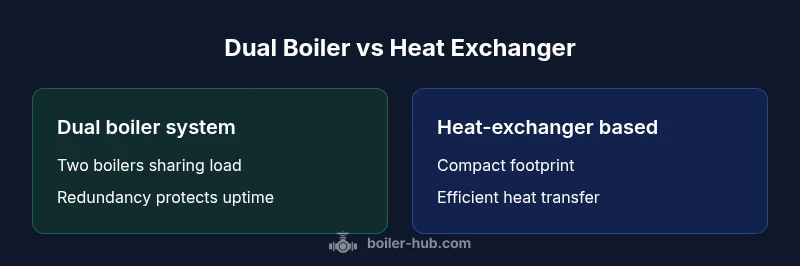
The concise takeaway when weighing dual boiler vs heat exchanger is that each design serves different needs: a dual boiler offers redundancy and heavy load handling, while a heat exchanger-based setup prioritizes compactness and efficiency. The right choice depends on demand patterns, space, and willingness to invest upfront and over time. Think of it as choosing between redundancy and simplicity, or maximum capacity and streamlined footprint.
What dual boiler vs heat exchanger means in modern boiler design
In modern heating design, the phrase dual boiler vs heat exchanger refers to two distinct architectural approaches for producing hot water and space heating. A dual boiler setup uses two separate boilers to share load and provide redundancy so that hot water delivery remains uninterrupted during maintenance or a fault. A heat exchanger–based design, by contrast, relies on a heat exchanger to transfer heat from a primary energy source to a secondary circuit that serves radiators and taps. According to Boiler Hub, the choice between these approaches is influenced by how a building uses energy, how frequently peak heat is demanded, and what owners are willing to invest upfront and over time. The Boiler Hub team notes that both options can deliver reliable comfort when properly sized and controlled, but the operational implications can be quite different. This article breaks down the differences with practical criteria that homeowners and facility managers can use to gauge fit, including load profiles, zoning needs, and maintenance implications. By walking through design logic, we illuminate whether the dual boiler vs heat exchanger decision should tilt toward redundancy or compact efficiency.
How dual boiler systems operate
A dual boiler system consists of two heat sources that can work in parallel or independently. The control strategy aims to balance load, maintain water temperature, and provide redundancy in case one boiler cycles offline for service or fault conditions. In practice, a well-configured dual boiler setup can ramp heating output by engaging one or both boilers as demand grows, while preserving efficiency through staged operation. The advantages include smoother transitions during peak demand and reduced risk of complete system downtime. However, the system is more complex, requiring sophisticated controls, safe interlocks, and skilled maintenance. When fans, pumps, and valves are properly coordinated, dual boilers can deliver dependable comfort across variable weather and occupancy patterns. The critical factor is ensuring controls are calibrated to prevent short cycling and to optimize standby losses. This approach often suits larger homes, campuses, or facilities with high simultaneous heating and hot-water needs.
How heat exchangers fit into boiler designs
A heat exchanger is a device that transfers heat from a primary source to a secondary circuit without mixing fluids. In boiler designs, heat exchangers enable efficient heat transfer between the burner or boiler water loop and the zone circuits that feed radiators or underfloor heating. Heat exchangers can be integrated into single-unit packages or retrofitted into existing boilers to improve efficiency. The key benefits include compact footprint, reduced equipment count, and potentially lower upfront costs. The challenges center on exchanger sizing, material compatibility, and the need for careful maintenance to prevent scale buildup or corrosion, which can erode performance over time. When correctly specified, a heat exchanger can deliver high efficiency with good reliability, especially in systems where peak demand is moderate and space is at a premium. In many cases, retrofit projects leverage heat exchanger design principles to maximize heat transfer while minimizing energy losses.
Key differences in operation and performance
- Redundancy vs. simplicity: Dual boiler systems emphasize redundancy and load-sharing, while heat exchanger designs focus on efficient heat transfer in a compact form. Both can deliver reliable comfort if sized correctly.
- Capacity handling: Dual boilers can better accommodate large properties or multi-zone layouts, whereas heat exchangers are often preferred for smaller footprints and simpler system architecture.
- Control complexity: Two boilers plus smart controls require advanced commissioning and maintenance; a heat-exchanger setup often benefits from straightforward control logic but hinges on exchanger performance and proper integration.
- System integration: Dual boilers may necessitate electrical and mechanical coordination across multiple components; heat exchangers usually involve careful matching with the primary energy source and secondary circuits.
- Long-term considerations: Maintenance burden, spare parts availability, and professional service requirements differ between configurations; the best choice aligns with your facility’s operational priorities and budget trajectory.
Efficiency, energy use, and cost considerations
When evaluating dual boiler vs heat exchanger configurations for energy efficiency, it is essential to consider how each design responds to the building’s heating schedule, insulation quality, and occupancy patterns. A well-designed dual boiler system can maintain comfortable temperatures with staged output, potentially reducing overall energy consumption during shoulder seasons. Heat exchangers promote efficient heat transfer and can minimize standby losses in compact installations. However, both designs benefit from high-efficiency burners, proper insulation, and advanced controls that modulate output based on real-time demand. From a total cost perspective, upfront costs for dual boilers are typically higher due to the extra equipment and complex integration, while heat exchanger-based solutions may offer savings through simpler maintenance and smaller space requirements. Boiler Hub Analysis, 2026, emphasizes that the long-term cost of ownership is strongly influenced by system design, control strategies, and maintenance planning. Homeowners and facility managers should model both scenarios against their actual usage to avoid surprises in energy bills and service costs.
Maintenance, reliability, and service considerations
Maintenance needs vary meaningfully between the two approaches. A dual boiler system introduces more moving parts, sensors, and interlocks, which can increase maintenance intervals and the potential for component wear. Regular inspection of both boilers, pumps, valves, and controls is essential to sustain reliability. Exchangers require cleaning and potential replacement of gaskets or seals over time, particularly in hard-water regions where mineral buildup can impair heat transfer. The reliability of either design hinges on high-quality installation, precise control calibration, and access to skilled service technicians. Boiler Hub’s guidance highlights the value of commissioning by experienced professionals who understand the nuances of modern boiler hydraulics and controls. Proactive maintenance plans with scheduled inspections will help sustain performance and prevent unexpected downtime.
Space, installation, and integration with existing systems
Space constraints and existing infrastructure largely drive the decision between dual boiler and heat exchanger configurations. Dual boiler systems demand more floor area and a larger mechanical footprint, which can be a constraint in retrofit projects or smaller basements. Heat exchanger designs offer a leaner footprint and can be easier to retrofit into existing boiler rooms or compact mechanical spaces. Installation complexity also factors into total cost; dual boiler systems require careful sequencing of electrical, mechanical, and hydraulic work, while exchanger-based systems emphasize compatibility with the existing boiler plant and control networks. A well-executed installation will consider future maintenance access, valve isolation, drainage, and potential noise or vibration concerns. Planning with a qualified HVAC contractor who has experience with both approaches reduces risk and improves long-term satisfaction.
When to choose one over the other
Choosing between dual boiler and heat exchanger configurations depends on several practical factors. If peak demand is high, zoning is complex, and downtime is unacceptable, a dual boiler system may be the better option for reliability and capacity. If space is tight, up-front cost matters more, and the heating load is moderate, a heat exchanger-focused approach could provide a favorable balance of efficiency and footprint. The decision should also reflect long-term service availability and your tolerance for maintenance complexity. In all cases, a careful assessment of your building’s heat load, insulation quality, and usage patterns will guide a prudent choice that aligns with energy-savings goals and total cost of ownership.
Practical steps to evaluate options and plan installation
- Define design requirements by mapping typical daily and seasonal heating and hot-water loads. 2. Assess available space and identify any retrofit constraints in the boiler room. 3. Compare initial costs versus expected ongoing maintenance and energy use, using scenario modeling. 4. Engage a qualified installer who can pilot both approaches with controls that maximize efficiency. 5. Create a maintenance plan that addresses component wear, water quality, and control calibration to sustain performance over time.
Comparison
| Feature | dual boiler system | heat-exchanger-based system |
|---|---|---|
| Definition | Two separate boilers to share load and provide redundancy | Single unit or integrated design using a heat exchanger to transfer heat |
| Best Use Case | High-demand, multi-zone or large properties | Compact spaces with moderate to high efficiency needs |
| Energy Efficiency | Can achieve high efficiency through staged operation and controls | Efficiency relies on exchanger design and overall system integration |
| Initial Cost | Higher upfront due to two boilers and added controls | Lower upfront for a compact exchanger-focused package |
| Maintenance | More components to service, requires skilled maintenance | Exchanger maintenance focused on heat transfer surfaces and seals |
| Footprint | Larger physical footprint and more space required | Smaller footprint suitable for retrofit where space is constrained |
| Reliability | Redundancy reduces downtime and service gaps | Reliability depends on exchanger quality and control integration |
Advantages
- Redundancy minimizes downtime and maintains comfort
- High-load capacity for large properties
- Flexible zoning and simultaneous hot-water production
- Control strategies can optimize performance
The Bad
- Higher upfront and installation costs
- Larger footprint and more complex maintenance
- Requires skilled technicians for commissioning and service
Dual boiler systems generally win for high-demand applications; heat exchangers excel in compact, cost-conscious setups
Choose dual boilers when heavy peak demand and uptime are paramount. Opt for heat exchangers when space, initial cost, and straightforward maintenance are the priority. Proper sizing and professional installation are crucial for both paths.
Questions & Answers
What exactly is a dual boiler system?
A dual boiler system uses two separate boilers to share load and provide redundancy. This setup helps maintain hot water delivery even if one unit is offline. Proper sequencing and control are essential to ensure efficient operation.
A dual boiler system uses two boilers to share heating tasks and keep hot water flowing even if one boiler needs service.
How does a heat exchanger function in boilers?
A heat exchanger transfers heat from a primary source to a secondary circuit without mixing fluids. In boiler design, it enables efficient heat transfer and supports compact, integrated systems.
A heat exchanger transfers heat from the main source to the heating circuit without mixing fluids.
Which option is more energy efficient overall?
Efficiency depends on system design, control strategy, and usage patterns. Both approaches can be highly efficient when properly sized and commissioned, but the best choice aligns with demand, space, and maintenance capacity.
Efficiency depends on design and usage; both can be efficient with proper setup.
Do these systems require special maintenance?
Yes, both require routine maintenance, though the focus differs. Dual boilers need checks of two units and associated controls, while heat exchangers require surface cleaning and monitoring for heat-transfer efficiency.
Maintenance is needed for both; dual boilers require checking both units, exchangers need surface upkeep.
What should guide my choice for a home or small facility?
Consider peak heating demand, available space, and long-term ownership costs. If uptime and capacity are paramount, a dual boiler may be better; if space and upfront cost dominate, a heat-exchanger approach could fit best.
Consider demand, space, and long-term costs to decide between uptime and footprint.
How do I evaluate installers for these systems?
Choose contractors with proven experience in both dual boiler and heat-exchanger configurations. Verify references, request design-by-design layouts, and ensure they include a commissioning plan and a maintenance schedule.
Select installers with proven experience, check references, and confirm commissioning and maintenance plans.
Key Points
- Assess peak demand before selecting a configuration
- Factor space, installation complexity, and future maintenance
- Model long-term energy cost across scenarios
- Engage an installer with experience in both approaches