Heat Exchanger vs Dual Boiler: Practical Guidance for Homeowners
An analytical comparison of heat exchanger and dual boiler configurations, focusing on load handling, space needs, efficiency, maintenance, and lifecycle costs to help homeowners choose wisely.


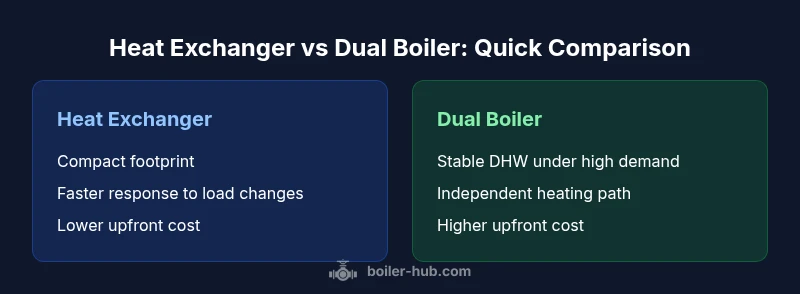
Heat exchanger vs dual boiler decisions hinge on usage and space. A modern heat exchanger setup usually provides a compact footprint, rapid response to varying loads, and lower upfront cost, making it ideal for smaller homes with moderate simultaneous uses. A dual boiler arrangement excels at maintaining constant domestic hot water pressure and high-demand events, albeit with higher cost and larger space needs. Choose based on load pattern and available space.
What each technology is and why the comparison matters
In the context of residential and small-to-mid commercial heating, the phrase heat exchanger vs dual boiler describes two different approaches to delivering hot water and space heat from a boiler plant. A heat exchanger-focused configuration emphasizes compact integration and rapid response; it uses a single or tightly integrated boiler circuit with an efficient heat transfer path to satisfy both space heating and domestic hot water needs. A dual boiler setup uses two separate boilers or two independent circuits so that heating and hot water can operate independently or in parallel with very controlled sequencing. Understanding this distinction is essential for homeowners who want to optimize comfort, energy efficiency, and return on investment. According to Boiler Hub, selecting between heat exchanger systems and dual boiler configurations hinges on space, load patterns, and long-term costs.
Architectural layout and system philosophy
The core architectural difference between the two approaches lies in how heat is produced, stored, and delivered. A heat exchanger-centric design often relies on a compact heat exchanger network that couples heating demand with DHW production in a synchronized loop. This can reduce the need for bulky storage tanks and simplify plumbing routes. In contrast, a dual boiler system treats domestic hot water as a separate hot path, occasionally with a dedicated DHW cylinder or a dual-circuit arrangement. This separation allows precise control of DHW temperature and pressure but increases the number of components and the space required.
Load management: simultaneous heating and hot water
Load management is one of the most important differentiators. In a heat exchanger setup, the system responds to changes in space heating and DHW demand by modulating a single loop, often delivering quicker recovery during transitional periods. In a dual boiler configuration, DHW demand can be met without interrupting space heating because the second boiler handles domestic hot water exclusively. For households with variable usage, the HX approach can be more efficient, while scenarios with high DHW peaks may justify the dual boiler approach.
Efficiency and monitoring: what matters in practice
Efficiency should be judged on real-world performance rather than abstract specs. HX systems tend to deliver favorable fuel utilization when loads are balanced and space conditions are moderate, because there is less heat loss from extra tanks and fewer standby modes. Dual boiler systems can achieve high efficiency under peak demand by avoiding temperature drops in DHW storage and by leveraging staged boiler operation. In practice, choosing between them requires examining annual usage patterns, climate, and whether you value continuous DHW stability over upfront cost savings.
Temperature control and comfort
Temperature stability is a central comfort metric. Heat exchanger solutions can deliver steady, predictable temperatures by coordinating a single loop, but may display tighter coupling between DHW and space heating. Dual boiler configurations reduce cross-coupling because DHW and space heating are controlled by separate boiler paths. The result is often smoother DHW temperatures during high-demand events, but you may experience more complex control tuning to maintain harmony between the two subsystems.
Installation footprint and integration with existing systems
The physical footprint matters for retrofit projects. HX-focused designs generally fit in tighter spaces, require fewer bulky storage tanks, and can be easier to route when retrofitting an older home with limited mechanical room. Dual boiler installations typically demand more space and a dedicated mechanical enclosure, but they can be easier to scale for future growth and provide straightforward upgrades to higher DHW capacity without modifying the heating loop.
Maintenance implications and reliability considerations
Maintenance profiles differ. Heat exchangers usually involve fewer moving parts and simpler piping, which can translate to lower ongoing maintenance if components are well chosen and installed. Dual boiler systems introduce more components (two heat sources, more valves, more sensors), which can raise maintenance complexity and the potential for component wear. However, the added redundancy means you may experience fewer interruptions during peak demand if one loop is offline, provided proper system design and regular servicing are observed.
Cost considerations: upfront, operating, and lifecycle
Upfront costs for HX systems are typically lower, given fewer boilers and simpler plumbing, but this varies with brand and features. Operating costs depend on how well the system matches your load profile; HX designs can be economical for moderate, balanced usage, while dual boilers may reduce hot-water temperature loss during peak demand, potentially lowering energy use when hot water draws are frequent. Boiler Hub analysis suggests that upfront cost and footprint are often the deciding factors, but lifecycle costs depend on your climate, occupancy, and maintenance habits.
Real-world use-case scenarios: when each approach shines
For a compact urban home with modest DHW draws and mixed heating needs, a heat exchanger-based system often delivers excellent value with quick recovery times and simple operation. A larger home with high DHW usage, frequent simultaneous demands (e.g., winter showers while heating), or sensitive comfort requirements may justify a dual boiler setup to preserve steady DHW temperature and peak performance. In commercial settings, the choice may hinge on planned load growth and service windows, as well as the potential for staged boiler capacity.
Decision framework: 7 questions to guide your choice
- What is your peak DHW demand, and how often do you exceed it? 2) How much space do you have in your mechanical room or closet? 3) What are your long-term budget considerations, including maintenance? 4) Do you require redundancy for DHW or heating? 5) Are you aiming to minimize upfront costs or maximize energy efficiency? 6) How important is rapid DHW recovery during morning routines? 7) Is retrofitting an existing system likely to be necessary in the near term? Answering these questions helps align the design with practical needs.
What to tell your installer: questions that matter
When interviewing installers, ask about compatibility with your existing radiators and piping, controls integration with your thermostat, available service network, and recommended maintenance intervals. Request a layout that shows how DHW and space heating will be sequenced under typical loads, and ask for a lifecycle cost estimate that includes potential replacements or major component overhauls. The goal is to achieve reliable comfort with predictable maintenance and a balanced total cost of ownership.
Comparison
| Feature | Heat Exchanger System | Dual Boiler System |
|---|---|---|
| DHW & heating load handling | Efficient coexistence with compact footprint | Independent DHW path improves stability under high demand |
| Space requirements | Typically smaller footprint and fewer tanks | Larger footprint due to dual circuits and storage or extra hardware |
| Upfront cost | Generally lower upfront cost | Higher upfront cost due to additional boilers and controls |
| Control complexity | Simpler controls with integrated modules | More complex control strategies to manage two boilers |
| Maintenance needs | Fewer components; potentially easier maintenance | More components; higher maintenance planning |
| Efficiency under load | Strong efficiency when loads are balanced | Strong efficiency under high DHW demand; reduces temperature drop |
| Reliability under spikes | Good recovery with single-loop logic | Excellent peak performance with redundancy |
| Best for | Small to mid-sized homes with mixed loads | Large homes or scenarios with heavy DHW demand |
Advantages
- Lower upfront cost for heat exchanger systems
- Compact footprint fits smaller spaces
- Faster DHW recovery for mixed loads
- Independent DHW control in dual boiler improves stability
The Bad
- HX may provide less DHW stability under extreme peak demand
- Dual boiler incurs higher upfront cost and larger footprint
- Maintenance complexity grows with two boilers
- Control strategies can be more challenging for mixed loads
Heat exchanger systems tend to offer better value for typical homes; dual boiler systems shine where high DHW demand and peak reliability are priority
For smaller homes with balanced loads, HX is usually the sensible choice. If your usage includes frequent high hot-water draws or you need redundancy, a dual boiler setup is worth the premium. The Boiler Hub team emphasizes aligning load patterns with system strengths and lifecycle costs.
Questions & Answers
What is the main difference between heat exchangers and dual boilers?
Heat exchangers optimize heat transfer in a compact loop, often with a single control strategy. Dual boilers use two separate boiler paths to manage heating and domestic hot water independently, offering constant DHW performance at a higher upfront cost.
The main difference is that heat exchangers combine heating and hot water in one streamlined loop, while dual boilers use separate paths for better DHW stability. This affects space, cost, and how you experience hot water.
Can a heat exchanger replace a dual boiler in a home?
In many cases, a heat exchanger setup can meet typical household needs, especially where space and budget are limited. However, if your pattern includes very high DHW demand or you require strict independence of heating and hot water, a dual boiler may be preferable.
Sometimes an HX system can substitute for a DB, but not always. It depends on your DHW demand and whether you need independent control for hot water and heating.
Which option is generally more energy efficient?
Energy efficiency depends on load matching rather than the label. HX is efficient for balanced, moderate loads; DB can be very efficient under peak DHW demand because it avoids temperature losses from storage.
It depends on usage. HX is efficient for balanced loads; DB can be efficient for big hot-water needs because it avoids storage losses.
What are typical upfront costs to expect?
Upfront costs for HX systems are usually lower, while dual boiler setups involve higher equipment and installation costs due to additional boilers and controls.
Expect HX to cost less upfront, and dual boilers to cost more because of extra boilers and components.
What maintenance should I plan for?
HX systems typically require maintenance focused on heat transfer components and valves. DB systems require more comprehensive maintenance across two boilers and additional plumbing, but regular servicing improves longevity.
Maintenance will differ: fewer moving parts with HX, more components to service with DB.
Are there safety concerns specific to one design?
Both designs require standard boiler safety practices. DB systems have more components to monitor for leaks and pressure events, while HX designs rely on robust heat transfer paths and proper insulation.
Safety is similar, but dual boilers add more components to monitor for faults.
Key Points
- Assess peak DHW demand before choosing
- HX favors space and cost-efficiency for balanced use
- Dual boiler excels in high-DHW scenarios and reliability
- Factor in maintenance and lifecycle costs
- Plan for future load growth to avoid early replacement