Boiler for Baseboard Heat: A Practical Guide
Learn how to select, size, install, and maintain a boiler for baseboard heating. This guide covers sizing, compatibility, safety, and efficiency from Boiler Hub to help homeowners and facility managers.


This guide helps homeowners and facility managers choose, size, and install a boiler for baseboard heating. You'll learn how to assess your current system, compare boiler types, determine baseboard loop requirements, and perform essential safety checks. The steps cover sizing, wiring, piping, and basic maintenance. By the end, you’ll have a practical plan aligned with Boiler Hub recommendations.
What is baseboard heating and why a boiler matters
Baseboard heating uses hot water circulated through long, slim radiators along walls to distribute warmth. A boiler heats the water, then a pump moves it through sealed piping to baseboard convectors. For homes with radiators or traditional baseboard fins, selecting the right boiler for baseboard heat influences comfort, fuel use, and maintenance. The size of the boiler must align with the home’s heat load and the room-by-room needs; an oversized boiler wastes energy and short-cycles, while an undersized unit struggles to reach temperature. According to Boiler Hub, proper sizing, venting, and compatibility with baseboard loops are the most critical factors in achieving reliable performance. In this article we’ll break down criteria, options, and practical steps to get it right the first time. You’ll learn how to assess current systems, compare boiler families, and plan a safe, efficient upgrade or installation. This guidance aims to empower homeowners and facility managers with clear, actionable decisions.
Assessing your current system and goals
Begin by inventorying your current heating setup – the boiler fuel type, present boiler age, and the number of baseboard zones. Evaluate insulation quality, window area, and thermostat locations because these factors determine heat load. Clarify whether you’re replacing an old boiler or upgrading for better efficiency or zone control. This is also the moment to establish priorities: higher comfort, lower operating costs, simpler maintenance, or improved safety. Boiling down to a few measurable goals makes the sizing and selection process straightforward. According to Boiler Hub, defining goals early reduces rework later and helps you select a boiler that fits your baseboard system rather than forcing an incompatible match.
Sizing basics for baseboard systems
Baseboard heat performance hinges on matching boiler output to load. A properly sized unit maintains a comfortable indoor temperature without cycling on and off excessively. Start with a rough load estimate based on climate, home age, insulation level, and living space. Use a standardized method or consult a professional to compute BTU requirements for each zone, then verify that the boiler you choose can deliver those outputs with your baseboard loop. The goal is a boiler that provides steady water temperatures and consistent flow, so rooms don’t overheat or run cool. Boiler Hub emphasizes that correct sizing, not just efficiency, drives long-term comfort and energy use.
Boiler types compatible with baseboard heat
There are several boiler families that play well with baseboard radiators. Condensing gas boilers tend to be efficient and compact; oil-fired boilers can be viable where gas is unavailable; electric boilers offer clean operation for smaller spaces or hybrid systems. Each type has nuances in venting, fuel costs, and maintenance. For baseboard systems, look for boilers with compatible delta-T performance and integrated controls for zone circuits. Matching the boiler to your fuel availability, local codes, and existing piping reduces retrofit complexity. Boiler Hub notes that staying within compatible families minimizes unexpected compatibility issues.
Piping and loop configurations for baseboard radiators
Baseboard loops commonly use one-pipe or two-pipe configurations. A two-pipe setup provides continuous flow and better balancing across zones; one-pipe systems are simpler but can be trickier to balance. Pay attention to valve placement, pressure differential, and air removal. Plan for expansion and contraction in longer runs, and size mains to handle the anticipated water flow. Selecting correctly rated fittings and ensuring proper air vents will prevent air locks and banging noises. A well-designed loop reduces cold spots and keeps baseboard sections feeling evenly warm.
Installation considerations and safety essentials
Venting, combustion air, and proper clearance are critical for any boiler installation. Ensure adequate vent height and CO detectors in the living space. Confirm gas lines, electrical connections, and electrical shutoffs meet code. The expansion tank and pressure relief valves must be sized for the system. Work with a licensed technician for gas piping, venting, and electrical work; these tasks carry safety and liability implications. Always follow local codes and manufacturer installation instructions.
Maintenance, troubleshooting, and long-term care
Regular maintenance includes annual professional servicing, bleeding air from radiators, and checking the pressure gauge. Clean and inspect vents, sensors, and the circulator pump for unusual noises. Keep an eye on scale buildup and water quality; use treated water if the system uses a closed loop. Maintain fuel storage and observe safety measures around the boiler room. Proper maintenance lowers the risk of breakdowns and prolongs equipment life.
Cost, efficiency, and long-term savings
Upfront cost varies with boiler type, installation complexity, and local labor rates. Efficiency gains come from newer condensing designs and properly sized systems paired with good insulation. Energy savings accumulate over years through fewer start cycles and better heat distribution to baseboard segments. Consider lifecycle costs, including maintenance contracts and potential replacement intervals; a well-chosen boiler for baseboard heat commonly yields meaningful reductions in operating costs according to Boiler Hub analysis, though exact payback depends on climate and usage.
Getting started: a practical planning checklist
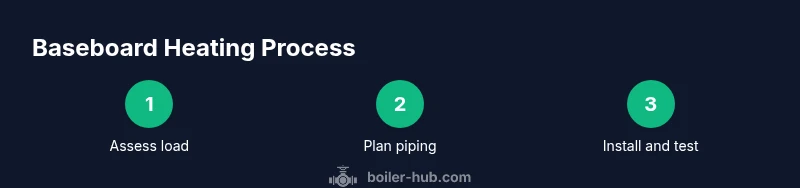
Use this checklist to begin your project: 1) confirm your heat load estimate and zone counts; 2) select a compatible boiler family; 3) plan piping layout and zone control; 4) verify venting, clearances, and safety devices; 5) prepare a work plan with a licensed professional; 6) schedule a pre-install inspection; 7) finalize controls and thermostat integration; 8) budget for permits and inspections; 9) schedule test run and adjustment. Having a clear plan reduces delays and ensures a smoother installation.
Tools & Materials
- Adjustable pipe wrenches(2–4 inch capacity, set for NPT fittings)
- Pipe cutter(For copper or PEX as applicable)
- Teflon tape(PTFE thread sealant for steam and water lines)
- Pipe joint compound / sealant(Only where tape isn’t suitable)
- Screwdrivers (flathead and Phillips)(For thermostats, valve trim, access panels)
- Voltage tester / multimeter(Check electrical circuits and controls)
- Circulator pump(Match GPM and head to loop requirements)
- Expansion tank(Size for system volume and pressure range)
- Pressure gauge and relief valve(For system pressure monitoring and safety)
- Gas shutoff, CO detector(Mandatory safety installations)
- Thermostat compatible with baseboard systems(Programmable/zones for precise control)
- Vent piping and vent hood(As needed for exhaust and intake air)
Steps
Estimated time: 8-16 hours
- 1
Define goals and select boiler type
Identify your heat goals, fuel preferences, and existing infrastructure. Decide whether you want high efficiency, better zoning, or easier maintenance. This sets the direction for sizing and venting requirements.
Tip: Document your current heat load, insulation quality, and room count before choosing a boiler. - 2
Estimate heat load and baseboard requirements
Calculate or approximate the home’s heating load by considering climate, insulation, and living space. Confirm that the baseboard loop design and number of zones can be served by the chosen boiler.
Tip: When in doubt, run a professional load calculation to avoid undersizing or oversizing. - 3
Plan piping layout and zone control
Map a practical piping schematic for one-pipe or two-pipe configurations. Include zone valves or a smart thermostat system for improved control and energy savings.
Tip: Avoid long, over-complex runs that increase head loss and noise. - 4
Select and prepare boiler and components
Choose a boiler that matches your fuel type and baseboard compatibility. Prepare mounting space, venting, and a location for the expansion tank and circulator.
Tip: Check manufacturer guidelines for clearance and venting requirements before installation. - 5
Connect loops, install circulator and expansion tank
Install the pump, connect inlet/outlet piping, and mount the expansion tank. Ensure all connections are leak-free and properly supported.
Tip: Bleed air from the system after initial filling to prevent air locks. - 6
Commission, test, and adjust
Fill, pressurize, and test the system. Verify temperature, flow, and zone balancing. Make final adjustments to pressure relief, thermostat curves, and delta-T settings.
Tip: Document readings and settings for future service visits.
Questions & Answers
What is baseboard heating and how does a boiler fit into it?
Baseboard heating uses heated water circulated through wall-mounted units to warm spaces. A boiler supplies that hot water and sets the system's capacity, efficiency, and reliability.
Baseboard heating relies on heated water moved through slim wall units; the boiler provides the hot water and should be sized to the space.
Can I use an old boiler with new baseboards?
You can, but only if the old boiler is sized for current loads and compatible with your baseboard configuration. A mismatch can lead to inefficiency or comfort issues.
An old boiler might work if it matches your baseboard layout and load, but it’s safer to verify sizing and compatibility first.
How do I determine the right boiler size for baseboard heat?
Start with a professional heat-load calculation that accounts for climate, insulation, and zone count. Ensure the boiler’s output aligns with the baseboard loop requirements.
Get a heat-load calculation done; then match the boiler output to those results for all zones.
Is upgrading to a more efficient boiler worth it for baseboard heating?
In many cases, yes. A newer, efficient boiler paired with proper insulation reduces operating costs and improves comfort, especially with good zoning.
Upgrading can save energy and improve comfort, especially when combined with better insulation and zone controls.
What safety checks should I perform before using a boiler for baseboard heat?
Ensure CO detectors are installed, venting is clear, and gas/electric connections meet code. Regular professional checks are essential.
Install CO detectors, verify venting, and keep up with professional safety checks.
Do I need permits or professional installation for a boiler-based baseboard system?
Most jurisdictions require professional installation and permit approval for a boiler-based system due to gas, electrical, and venting considerations.
Yes, hire a licensed professional and obtain any required permits before starting.
Key Points
- Size the boiler to the load, not just efficiency.
- Choose a boiler type compatible with baseboard loops.
- Plan piping and zoning before purchase.
- Prioritize safety and professional installation.