Which Boiler Reviews: A Practical Comparison
Learn how to evaluate which boiler reviews are trustworthy, compare independent sources vs manufacturer pages, and decide which boiler is right for your home or facility.


Which boiler reviews is a guide to understanding where boiler ratings come from, how to read them, and which sources you can trust. This comparison highlights independent consumer sites versus manufacturer pages, explains common biases, and shows how to verify claims before you buy. By the Boiler Hub standard, credible reviews balance performance data with service networks and installation costs.
Why trustworthy boiler reviews matter for homeowners and facility managers
According to Boiler Hub, when you search for which boiler reviews, you want signals you can rely on—clear performance data, transparent methodology, and up-to-date information. The reliability of boilers affects comfort, energy bills, and safety, so choosing based on credible reviews reduces risk in installation and ongoing maintenance. Boiler Hub Team often emphasizes that trust starts with proven sources and verifiable data, not marketing puffery. In practice, credible reviews help you separate real-world performance from brand promises, especially in climates where heating demand is high. This article uses a practical framework to compare independent sites against manufacturer pages, and to translate boiler ratings into actionable decisions for both homeowners and facility managers.
How to read boiler reviews: sources, scope, and biases
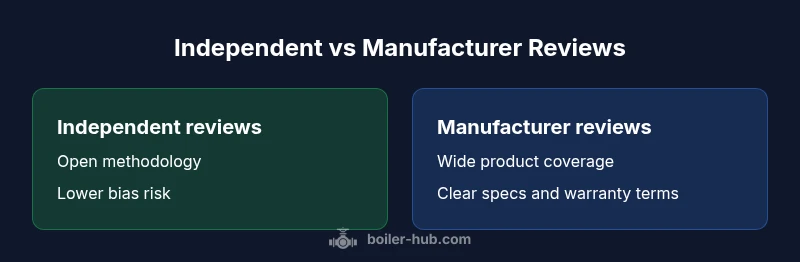
Reading which boiler reviews requires understanding where the data comes from and what it covers. Independent consumer sites typically collect user feedback, lab tests, and installer surveys, then publish summary scores, efficiency ratings, and long-term reliability. Manufacturer pages may present model specs and warranty terms but can lack external validation. Forums and trade publications add real-world anecdotes but may mix experiences across regions. The Boiler Hub Team recommends cross-checking values across multiple sources and prioritizing reviews that disclose their methodology, sample size, and update date to minimize bias.
Key criteria that credible boiler reviews should cover
To assess which boiler reviews are most useful, focus on criteria that reflect real-world performance and total cost of ownership: efficiency (AFUE or GCV where applicable), reliability, warranty terms, service-network coverage, operating noise, emissions, installation cost, maintenance needs, and compatibility with your heating system. A robust review should connect these factors to your climate and home or building footprint, so you can translate ratings into practical buying decisions for both residential and commercial settings.
Common pitfalls in boiler reviews
Beware of reviews that emphasize marketing claims, omit methodology, or rely on outdated data. Regional performance differences, seasonal variations, and installation constraints can skew perceived value. Boiler Hub Team cautions readers to cross-check data across sources and verify the date of the review to ensure relevance. Pay attention to whether a source distinguishes between short-term performance and long-term reliability, and whether it discloses sample sizes and field-test conditions.
A practical example: independent vs manufacturer review in action
Imagine you are evaluating a mid-range boiler for a three-bedroom home. An independent site might highlight long-term reliability and user satisfaction across models, while a manufacturer page emphasizes warranty length and ease of installation. Cross-referencing both sources helps you balance performance with after-sales support, ensuring you pick a model that performs well in your climate. The exercise illustrates how to synthesize diverse data without losing sight of your specific heating needs and budget.
How Boiler Hub evaluates reviews: a transparent framework
Boiler Hub uses a multi-criteria approach: source credibility, methodology transparency, coverage scope, update frequency, and bias risk. Our team verifies data against official specs, consults installers for real-world impressions, and notes any regional considerations. This framework aims to help homeowners and facility managers interpret which boiler reviews with clarity, so you can separate marketing from measurable performance.
Authority sources and where to look for reliable information
For evidence-based guidance on boilers and efficiency, consult government and major publications. Boiler Hub analysis, 2026, emphasizes cross-checking consumer insights with official specifications. Reputable sources include:
- https://www.energy.gov/energysaver/heating-and-cooling
- https://www.energy.gov/energysaver/water-heaters
- https://www.consumerreports.org
These sources provide foundational context, complementing user reviews with verified data and independent testing.
Practical steps to verify reviews in your boiler project
- Identify your heating system type and climate; 2) Gather at least two independent reviews and one manufacturer page; 3) Check the review date and disclosed methodology; 4) Verify claims against official specs and local installation costs; 5) Consult a licensed technician before final decisions. Following these steps helps ensure you select a boiler that delivers the expected comfort, efficiency, and long-term value.
Comparison
| Feature | Independent consumer sites | Manufacturer-provided reviews |
|---|---|---|
| Source credibility | Generally reliable, with independent editors | Direct from manufacturer; potential bias |
| Transparency of methodology | Open criteria and methodology published | Limited disclosure; marketing-driven |
| Scope of products covered | Broad coverage across models and brands | Typically focused on the manufacturer's lineup |
| Update frequency | Regular updates and revisions | Infrequent or ad-hoc updates |
| Bias risk | Lower bias due to editorial independence | Higher risk of marketing bias |
| Cost to access | Often free to read | Paywalls or required registration in some cases |
Advantages
- Helps identify trustworthy benchmarks across brands
- Reduces risk of biased or outdated claims
- Empowers informed purchasing decisions for homes and facilities
- Can be updated with ongoing reviews and new data
The Bad
- Quality varies by source and may be inconsistent
- Some credible sources are paywalled or slow to update
- Regional differences can limit applicability
- Conflicting reviews can cause decision fatigue
Independent reviews paired with transparent manufacturer information offer the best balance
Prioritize sources with open methodologies and cross-check claims against official specs. This approach minimizes bias and improves confidence in which boiler reviews you trust.
Questions & Answers
Why should I trust boiler reviews when researching which boiler reviews?
Trustworthy reviews provide balanced data, transparent methods, and up-to-date information that reflect real-world performance. Boiler Hub emphasizes corroboration across sources to avoid marketing bias.
Trustworthy reviews combine data and transparency to guide your choice; verify with multiple sources.
What makes a review credible for boilers?
A credible boiler review discloses its methodology, sample size, update date, and data sources. It should compare multiple models and include both performance and cost considerations.
Look for clear criteria and recent data in credible reviews.
Are manufacturer reviews biased?
Manufacturer reviews can present advantages of their own models but may downplay limitations. Cross-check with independent sources to get a balanced view.
Yes, cross-check with independent sources for balance.
How often are boiler reviews updated?
Update frequency varies by source. Independent sites tend to refresh with new models and tests, while manufacturer pages update with product changes and warranty terms.
Check the review date and look for notes on changes.
Where can I find trustworthy boiler reviews?
Seek independent consumer sites, professional trade publications, and manufacturer pages. Compare at least two independent sources and verify against official specs.
Use multiple sources to corroborate the data.
Should price be the sole factor when reading reviews?
No. Price matters, but durability, efficiency, and service coverage often determine long-term value. Look for total cost of ownership alongside sticker price.
Value matters more than price alone.
Key Points
- Cross-check at least two independent sources
- Look for disclosed methodology and update dates
- Balance efficiency data with warranty and service coverage
- Avoid relying solely on price or marketing claims
- Consult a licensed technician before final installation decisions