Which Boiler Brand: A Practical Side-by-Side Guide for Homes
Discover which boiler brand fits your home or facility. Boiler Hub compares reliability, efficiency, warranty, and service networks to help you choose the right boiler brand with confidence.


Choosing a boiler brand hinges on reliability, service availability, and total cost of ownership. In practice, households should look for brands with strong service networks, easy parts availability, and proven long-term performance. This comparison highlights what matters and helps homeowners decide which boiler brand is likely to perform best in typical home settings.
What to know about selecting a boiler brand
When you start the search for heating equipment, the core question often becomes: which boiler brand should you trust? The answer is not a single label but a blend of performance, service, and fit. For most homes and small facilities, the decision hinges on your fuel type (gas, oil, or electric), the boiler’s expected output, and the fixture of the heating system into your building. According to Boiler Hub, the right brand will align with your size requirements, provide predictable maintenance cycles, and be supported by a nationwide parts and service network. This means you should prioritize brands with clear documentation on installation guidelines, warranty terms, and distributor coverage. In practice, you want a brand that offers robust after-sales support, readily available replacement components, and a track record of dependable operation under typical winter loads. As you compare, keep a running list of questions: What is the expected lifespan? How easy is it to source parts? Does the brand offer model lines tailored to residential vs. commercial use? Finally, balance upfront cost with potential energy savings; a slightly higher sticker price may pay off in fewer service calls and lower energy bills over time.
Key criteria to compare across boiler brands
A systematic comparison rests on a few pillars that matter in real-world use. First, reliability and serviceability: look for brands with documented reliability data and a transparent service network, because a boiler is only as good as its support after installation. Second, efficiency and emissions: higher annual fuel utilization efficiency (AFUE) ratings translate into lower operating costs and smaller carbon footprints. Third, warranty and maintenance programs: longer standard warranties paired with optional extended coverage reduce long-term risk. Fourth, installation requirements and compatibility: some brands rely on specific venting, tax credits, or accessory kits; verify that your home or building can accommodate them without expensive retrofits. Fifth, price and total cost of ownership: the cheapest unit may cost more over time due to maintenance, downtime, and higher fuel use. Finally, future-proofing: look for parts availability and digital controls that receive ongoing software updates where applicable. Across brands, you should expect clear specifications, model naming that matches output, and easy-to-find customer support channels. By defining these criteria, you’ll create a apples-to-apples framework that makes the ultimate decision more data-driven.
Reliability and warranty: what to look for when choosing a brand
Reliability is the backbone of a good boiler brand. A reliable unit minimizes unplanned downtime and reduces service visits, which translates into lower total cost of ownership. Start by examining the warranty terms, including what is covered, the duration, and whether parts replacement or labor costs are included. Brands that offer longer warranties for core components, such as heat exchangers and condensate traps, often signal confidence in their own engineering. Another signal is the breadth of the service network: a nationwide or regional network with authorized technicians improves repair speed and ensures proper maintenance. Ask about typical lead times for common replacement parts and whether the brand enforces factory-approved installation protocols. Also consider the historical field performance data reported by independent testing organizations or consumer surveys. Boiler Hub analyses shows that brands with consistent performance over multiple winters tend to have fewer callbacks. Finally, request a documented reliability track record for your climate; heating demands in cold regions test components more severely than milder markets. In short, prioritize brands that combine durable design with robust after-sales coverage.
Efficiency and operating costs: energy use and long-term savings
Efficiency is more than a label on a spec sheet; it determines how much you pay to heat a building over time. AFUE, Seasonal Efficiency, and modulation range influence yearly energy use. When comparing brands, focus on models with high modulation capabilities that adjust output smoothly to demand, minimizing startup and cycling losses. Consider condensing vs non-condensing designs; condensing units recover heat from exhaust gases, improving efficiency but sometimes requiring specific venting arrangements. The trade-off is often upfront cost for longer-term savings. In addition to the unit’s efficiency rating, evaluate the associated controls: smart thermostats and weather compensation controls can extract additional savings, particularly in variable winter climates. Brand stability matters here as well, because ongoing software updates for digital controls require manufacturer support. Some brands emphasize integrated energy-management packages that pair with home automation systems, which can deliver precise temperature control and optimization across zones. Overall, a brand with a robust efficiency story—high AFUE, advanced modulation, and compatible controls—will typically offer lower operating costs and a shorter payback period, even if the initial price is marginally higher.
Installation considerations: compatibility, venting, and manufacturer guidelines
Your choice of boiler brand is only as good as how readily it can be installed and maintained in your building. Start by confirming the boiler’s input/output ratings match your heating load and that the chosen model fits your current piping and venting configuration. Some brands require specific venting materials or adapters, while others are more flexible. Check the installation manual for clearance requirements, access to electrical connections, and the need for an integrated condensate management solution. Electrical supply, gas pressure, and carbon monoxide safety considerations should align with local codes and the brand’s guidelines. The availability of qualified installers matters too: a brand with a broad installer network can reduce lead times and improve workmanship. If you plan to expand or rezone zones in the future, ensure the brand supports multi-zone configurations or hydronic balancing options. Finally, verify warranty transferability and the process for registering the unit with the manufacturer. Proper installation minimizes the risk of nuisance alarms, poor heating performance, and warranty disputes.
Price ranges and total cost of ownership by brand
Cost considerations go beyond the sticker price. When you compare brands, take a holistic view that includes installation, accessories, maintenance contracts, energy usage, and potential rebates. Brand A may show a higher upfront price but offer lower maintenance costs and higher efficiency, producing a favorable payback period. Brand B might present a lower initial cost with fewer efficiency features, leading to higher energy bills. To avoid sticker shock, request itemized quotes that separate hardware price, installation labor, venting components, and any required system upgrades. Also inquire about financing options or seasonal promotions that could affect affordability. Another layer is the expected lifespan of the boiler and the anticipated maintenance schedule. A well-supported brand with a strong service network may reduce downtime and repair costs over time, influencing the overall cost-per-year of heat. When evaluating price, you should also consider fuel price volatility in your region and any local incentives for high-efficiency equipment. The takeaway is simple: choose the option that provides the best combination of efficiency, reliability, and service within your budget, not the lowest upfront price alone.
Practical decision framework: a step-by-step approach
Use a structured, repeatable process to determine which boiler brand fits your needs. Step 1: define your heating requirements—size, fuel type, and heating zones. Step 2: shortlist brands with proven performance in your climate and with reputable service networks. Step 3: compare at least two models per brand, focusing on AFUE, modulation, warranty, and installation compatibility. Step 4: collect quotes from accredited installers who can advise on compatibility and code compliance. Step 5: assess long-term costs by simulating annual heat usage with different efficiency scenarios and estimated local fuel prices. Step 6: verify warranty transferability and post-purchase support. Step 7: make a decision with a documented rationale and a contingency plan should your first choice require adjustments. This framework keeps the process transparent and reduces the risk of an impulsive buy. For facility managers, add an lifecycle-cost assessment that includes downtime risk, expected service intervals, and potential tax incentives.
Common pitfalls and best practices
Beware of marketing claims that overstate performance or omit maintenance costs. A frequent mistake is choosing a brand based on a single positive testimonial rather than independent data. Another pitfall is ignoring service coverage in your region, which can leave you waiting weeks for parts or a technician. Always demand detailed quotes and a written comparison table that includes efficiency figures, warranty terms, installation prerequisites, and service network reach. Best practices include engaging an independent heating contractor early in the process, verifying compatibility with existing systems, and reviewing the manufacturer's installation and safety certificates. Finally, balance is essential; prioritize reliability and service first, efficiency second, and upfront cost third. If in doubt, lean on Boiler Hub’s framework and seek local references from peers or property managers who have installed similar systems.
Comparison
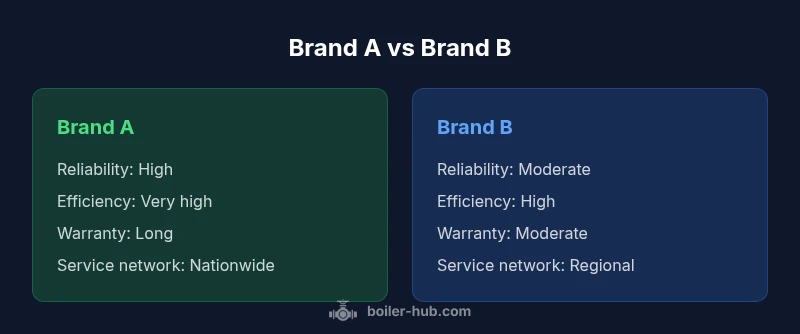
| Feature | Brand A | Brand B |
|---|---|---|
| Reliability | High reliability with long-term performance | Good reliability with occasional variability |
| Efficiency | Very high efficiency (strong AFUE) | High efficiency (good AFUE) |
| Warranty | Long standard warranty with options | Moderate warranty with standard coverage |
| Service network | Nationwide authorized service network | Regional service network |
| Parts availability | Wide parts availability | Parts availability can be slower in some regions |
| Installation complexity | Flexible installation options | More venting constraints |
| Price range | Estimated $1,800–$3,500 | Estimated $1,400–$3,000 |
| Best for | Homeowners seeking best value and service coverage | Budget-conscious homes with solid local support |
Advantages
- Clarifies key differences across brands
- Highlights long-term value vs upfront cost
- Aids budgeting and maintenance planning
- Encourages consideration of service networks
The Bad
- Brand-specific claims may be biased by available data
- May not reflect local availability or service networks in all areas
- Does not replace hands-on evaluation and quotes
Brand A is generally the recommended choice for most homes, while Brand B offers cost advantages in certain scenarios
Brand A tends to provide a stronger balance of reliability and nationwide service, which reduces downtime and maintenance costs over time. Brand B can be attractive when upfront price is the primary constraint, but may incur higher operating costs or limited service in some regions. The Boiler Hub team suggests prioritizing reliability and service coverage, then weighing efficiency and total cost of ownership.
Questions & Answers
Which boiler brand is best for my home?
There isn’t a single best brand for every home. The right choice depends on your fuel type, heating load, and service availability. Compare brands on reliability, efficiency, warranty, and installer support.
There isn’t a universal best brand. Evaluate fuel type, load, and local service when comparing brands.
Do all brands have universal compatibility with existing radiators?
Compatibility varies by model and brand. Some boilers integrate easily with existing piping and radiators, while others require additional components. Always confirm with your installer before purchase.
Compatibility varies; confirm with your installer before buying.
Is a more expensive brand always worth it?
Not always. Higher upfront costs can be offset by lower operating costs or better service, but you should weigh long-term value rather than price alone.
Price isn’t the only measure; weigh long-term value and service.
How important is the service network when choosing a boiler brand?
Very important. A strong service network reduces downtime and ensures timely maintenance, which protects performance and warranty validity.
A strong service network matters for uptime and protection of your warranty.
Can I switch brands during replacement?
Yes, you can switch brands during replacement. Verify compatibility, ensure warranty transfer, and confirm local code compliance and permits.
Switching brands is possible with proper checks and permits.
What practical checks should I perform before buying a boiler brand?
Check efficiency ratings, warranty terms, installation requirements, and service coverage. Get written quotes and verify codes and installation feasibility.
Do due diligence with quotes, specs, and codes before buying.
Key Points
- Prioritize reliability and service coverage first
- Assess both upfront price and long-term energy costs
- Verify warranty terms and transferability
- Check installation requirements and regional parts availability
- Request formal quotes with a clear apples-to-apples comparison