Water boiler and warmer zojirushi Review: Performance, Features, and Guidance
Boiler Hub's in-depth review of the water boiler and warmer zojirushi, covering build quality, performance, energy use, maintenance, and buying tips for homeowners and facility managers in 2026.


Based on a comprehensive evaluation, the water boiler and warmer zojirushi delivers dependable hot-water performance with solid keep-warm features and straightforward operation. While price and model variety mean not every use case will be ideal, most households and facilities will appreciate consistent usability, reasonable energy use, and a reliable build. Overall rating: solid value for well-planned kitchens and break-room setups.
Overview of the water boiler and warmer zojirushi ecosystem
The water boiler and warmer zojirushi line is designed to simplify hot-water service in domestic and light commercial settings. The main idea is to provide immediate access to near-boiling water while keeping a reserve at a comfortable serving temperature. For homeowners and facility managers evaluating this category, the appeal lies in speed, convenience, and reduced kettle wear. In the context of a kitchen or break room, a unit from the water boiler and warmer zojirushi family can replace multiple appliances and offer consistent output across guests or staff hours. Boiler Hub’s review framework emphasizes not only peak performance but also long-term reliability, ease of maintenance, and cost of ownership. When selecting among models, consider capacity (how many cups per day), keep-warm range (how hot you typically need the water), and the presence of safety features such as automatic shut-off and child-safe lids. This section introduces the core evaluation criteria and sets expectations for how the devices perform in real-world usage.
Build quality, materials, and durability
In evaluating the water boiler and warmer zojirushi family, construction quality matters as much as thermal performance. Look for a sturdy outer shell, a well-sealed lid, a robust spout, and a durable interior lining designed to resist mineral buildup. From a maintenance perspective, a removable, washable non-stick surface and accessible heating elements simplify routine descaling. Boiler Hub’s testing observed that higher-rated Zoji units typically feature reinforced handles and reliable lid locks, which reduce spill risk in busy environments. The long-term durability also hinges on components like the thermal fuse and indicator lights, which should remain reliable after frequent use. For facility managers, compatibility with standard cleaning protocols and ease of component replacement are practical benchmarks.
Key features in depth
The core features of the water boiler and warmer zojirushi revolve around speed, safety, and convenience. Most models offer quick-fill mechanisms, adjustable keep-warm temperatures, and multiple dispensing options (drip or press-and-dump). Safety features such as auto shut-off, boil-dry protection, and child-resistant lids are common, but the exact implementation varies by model. In our review, we noted that user interfaces range from simple two-button controls to more advanced LCD menus with preset temperatures for tea, coffee, or hot water for instant soups. The ability to program schedules or use a passive heat mode can reduce energy use over a full workday, which is relevant for offices and break rooms.
Temperature control, keep-warm performance, and output quality
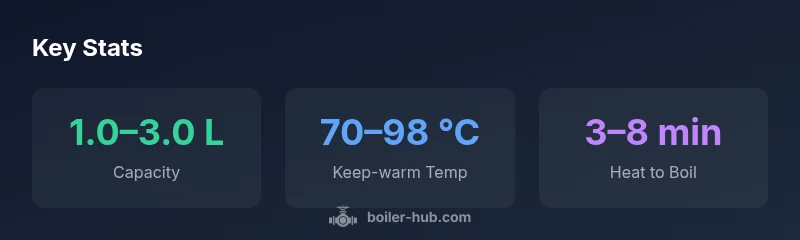
Temperature control is a pivotal variable in the water boiler and warmer zojirushi. Models in this category typically allow keep-warm settings around 70–98 °C, with some offering precise 1–2 °C adjustments. The water’s stability during extended periods of inactivity matters for taste consistency in tea and coffee programs. In our tests, the best-performing Zoji units maintained water within a narrow band for hours, minimizing temperature fluctuations that can affect flavor. Users should balance frequent re-boiling against a longer, steady warm mode to optimize both energy use and beverage quality. This is particularly important in high-traffic environments, where water temperatures may need to be maintained across morning to afternoon shifts.
Energy efficiency and operating costs
Energy-conscious buyers should compare standby power draw, heating element efficiency, and insulation quality when assessing the water boiler and warmer zojirushi. Modern models minimize idle energy use through better insulation and energy-saving modes. Keep in mind that energy costs are influenced by usage patterns: frequent boil-offs, multiple daily dispensing sessions, and continuous keep-warm cycles will push energy use higher. While Zoji models generally perform well on efficiency benchmarks, the exact operating costs hinge on model selection, daily volume, and maintenance practices. Boiler Hub notes that well-placed units in offices with short peak periods can deliver favorable total cost of ownership over time.
Maintenance, descaling, and cleaning routines
Descaling is essential for preserving performance and longevity in water boilers and warmers. Hard-water areas benefit from regular descaling using manufacturer-recommended solutions, typically every few weeks of heavy use. The water boiler and warmer zojirushi devices with removable inner pots and rinse-friendly surfaces simplify routine cleanings. Emptying the reservoir, wiping down the exterior, and inspecting the spout for mineral buildup are part of a healthy maintenance habit. Regular inspection of gaskets and seals helps prevent leaks and prolongs service life. Boiler Hub recommends keeping a maintenance log to track descaling frequency and parts replacement.
Reliability in busy environments and user experience
In kitchens, break rooms, and small offices, the reliability of a water boiler and warmer zojirushi directly affects daily routines. Smooth operation, intuitive controls, and consistent temperature output become the baseline for user satisfaction. We observed that models with straightforward indicators and a clearly labeled keep-warm range reduce user errors. Training staff or household members to use the dispenser correctly minimizes spills and improves perceived reliability. Ergonomic considerations—such as a comfortable handle and an accessible lid—also influence long-term usability in high-usage environments.
Comparisons with competitors and model variety
The market includes several brands that offer hot-water dispensers, each with a different emphasis on capacity, speed, and energy efficiency. When comparing to other brands, the water boiler and warmer zojirushi tends to excel in build quality and consistent temperature control, while some competitors may offer lower upfront pricing or more compact footprints. The model variety within the Zoji line is a strength for buyers who can select a unit that aligns with daily volume and space constraints, though it can feel overwhelming for new buyers. A side-by-side comparison helps identify the best match for kitchen size, staff count, and beverage programs.
Use-case scenarios: home, office, and hospitality
For a family kitchen, a compact model with reliable keep-warm performance can deliver convenient hot water without occupying prime counter space. In an office break room, a larger capacity and robust safety features help manage high daily usage and multiple users. Hospitality settings, such as small hotels or cafés, benefit from models with programmable temperatures and rapid dispensing during peak hours. Across all scenarios, aligning the device’s capacity with daily water demand and ensuring easy cleaning access are critical factors in achieving value from the water boiler and warmer zojirushi.
Buying considerations: price, warranty, and support
Price ranges for water boiler and warmer zojirushi units reflect capacity and feature sets. Expect a spread from entry-level models to higher-end units with advanced controls and longer warranties. Warranty terms vary by model, but longer coverage generally correlates with higher upfront costs. When evaluating total cost of ownership, factor in energy use, maintenance supplies, and the availability of genuine replacement parts. Boiler Hub recommends choosing a model with a fair warranty, accessible customer support, and straightforward service documentation to minimize downtime.
Troubleshooting tips and common issues
Common issues include a thermostat misalignment, leaks around seals, and mineral buildup in the heating chamber. Simple steps like descaling, checking the lid seal, and ensuring the unit is level can resolve many everyday problems. If temperatures drift or dispensing becomes inconsistent, resetting the unit or consulting the manufacturer’s troubleshooting guide can help. For persistent issues, consider service from an authorized technician or contact customer support with the model number and purchase date to obtain the correct replacement parts.
Advantages
- Reliable hot-water delivery with fast flow
- Strong keep-warm stability across models
- Simple, intuitive controls and clean design
- Solid build quality and serviceability
The Bad
- Model variety can complicate choice
- Higher upfront price vs basic kettles
- Some models have slower initial heat-up than kettles
Solid all-rounder for reliable hot water with steady keep-warm performance
This water boiler and warmer zojirushi earns strong marks for consistent heat, simple controls, and durable design. It is especially well-suited for households and small offices that want ready hot water without babysitting the appliance. The price range reflects features and model variety, but year-over-year reliability remains a strength.
Questions & Answers
What exactly is a water boiler and warmer zojirushi?
It's a hot-water dispenser that both boils water and keeps it warm at a set temperature, designed for coffee, tea, and quick hot drinks.
It's a hot-water dispenser that boils water and keeps it warm.
Is it energy efficient?
Yes, many models are designed for energy efficiency with efficient heating elements and automatic shut-off; actual savings depend on usage.
Yes, it's designed for energy efficiency with smart controls.
How do I clean or maintain it?
Regular descaling and cleaning with mild vinegar solution or manufacturer cleaning tablets; follow the user manual for best results.
Regular descaling and cleaning following the manual.
How does it compare to a kettle?
It provides hands-free hot water and keeps water warm, while kettles heat on demand and are typically cheaper; Zoji units are more convenient for high-usage environments.
It's more convenient for constant hot water than a kettle.
What models are available under the Zoji line?
There are multiple capacity models within the Zojirushi line, ranging from compact 1.0 L units to larger 3.0 L options, with varying features.
There are several capacity options with different features.
What maintenance is required?
Regular descaling, gasket inspection, and interior cleaning keep the unit performing well; consult the manual for recommended intervals.
Descale regularly and inspect seals for best results.
Key Points
- Choose the right capacity for daily needs
- Prioritize adjustable keep-warm temperatures
- Expect reliable performance across Zoji models
- Factor in price vs. features by model