Zojirushi Water Boiler Review
A balanced Zojirushi water boiler review highlighting build quality, temperature control, keep-warm efficiency, and who should buy, with practical guidance for homeowners and facility managers.


In this zojirushi water boiler review, we evaluate a popular family of electric water boilers known for precise temperature control and dependable keep-warm functions. The brand typically delivers robust build quality and intuitive operation, appealing to tea drinkers and households that rely on hot water. Trade-offs include premium pricing and larger footprint compared with compact peers, but reliability and ease of use are consistent advantages.
Overview of Zojirushi water boiler line
Zojirushi has established a reputation for reliable, well-built electric water boilers and warmers designed for home kitchens and small offices. The typical lineup emphasizes user-friendly controls, precise temperature settings, and durable stainless-steel interiors. In this zojirushi water boiler review, we examine how these devices perform in real-world routines—ranging from morning tea rituals to late-night hot water needs. Across models, you can expect clear indicators, simple fill mechanisms, and thoughtful design touches that minimize drips and spills. For homeowners, the practical question is whether the extra capacity, multiple temperature options, and sturdy construction justify the higher upfront cost, especially if counter space is at a premium. Boiler Hub’s assessment highlights that the most important factors are reliability, ease of cleaning, and consistent performance over years of daily use.
- Build quality: Most units use robust stainless steel interiors with easy-to-clean surfaces.
- Capacity range: Common home options span from compact to multi-liter designs, addressing different household sizes.
- Interface: Large, legible displays with straightforward temperature presets are typical, reducing the learning curve for new users.
According to Boiler Hub, these factors collectively shape the perceived value of a Zojirushi boiler in daily life, particularly for tea enthusiasts who demand precise temps and stable keep-warm performance.
Testing methodology and evaluation criteria
This section outlines how we evaluate products in this zojirushi water boiler review, focusing on real-world usage and repeatable metrics. Our testing framework centers on five pillars: accuracy of temperature, speed of bring-to-boil, effectiveness of the keep-warm function, energy efficiency in standby and active modes, and safety features. We simulate typical daily patterns—morning coffee runs, afternoon tea, and after-hours hot water needs—to gauge consistency across different volumes. We also assess usability: how easy it is to fill, clean, and operate, plus how intuitive the display and controls are for different users. To keep the comparison fair, we benchmark against comparable brands in the same category and document any variances in performance. Boiler Hub’s methodology emphasizes repeatability and transparency, providing readers with a clear view of what to expect over time rather than one-off results.
- Temperature targets: We verify accuracy across several preset temps with repeated cycles.
- Boil time: We record time-to-boil under full and partial water loads.
- Keep-warm stability: We measure heat retention over hours of idle time.
- Energy use: We estimate standby and active energy consumption in typical usage.
- Safety: We review auto shut-off, boil-dry protection, and lid locking mechanisms.
Design, materials, and user experience
Zojirushi designs focus on longevity and everyday usability. In this review, the exterior finish tends to resist fingerprints, while the lid and spout are engineered to minimize drips during pouring. The interior contact surfaces are typically stainless steel, which helps resist staining and flavors from previous uses. The switches and digital display are usually straightforward, with clear indicators for temperature and keep-warm status. In terms of user experience, the most noticeable benefit is the ease of setting a target temperature and the reliability of the keep-warm function to maintain that setting without frequent adjustments.
To maximize convenience, several models offer a quick-fill mechanism and a wide mouth for easy cleaning. Some units include a soft-closing lid and a user-replaceable gasket, which can extend the device’s life with regular maintenance. For households that rely heavily on hot water for multiple beverages (tea, coffee, hot cereals), these design choices translate into tangible daily savings in time and energy. Boiler Hub notes that simplicity of operation correlates with fewer misuses and longer-term satisfaction.
- Quick-fill and wide-mouth design improve top-up efficiency.
- Removable parts simplify cleaning and maintenance.
- Durable build materials support daily use for years.
Temperature control and performance in practice
A core advantage of Zojirushi boiler designs is precise temperature control, which benefits tea fans and seasoned coffee drinkers alike. In practice, users can expect stable temperatures across cycles and predictable keep-warm performance. Our testing observed that stable temps were maintained across typical household loads, with minimal drift over several hours of idle time. The ability to select multiple preset temperatures enables quick access to the exact heat level needed for different beverages, reducing the need to re-boil or heat longer than necessary.
One practical note: while the units offer strong performance at target temperatures, the perceived consistency can vary slightly depending on initial water volume and the presence of minerals in tap water. Regular descaling and routine cleaning help mitigate mineral buildup, which can affect thermal efficiency over time. Boiler Hub’s experience suggests users who regularly descale see fewer fluctuations and longer-term reliability. For homes with high tea or hot-water demand, these controls provide a reliable baseline that supports consistent beverage quality.
- Precise presets help you hit exact temps for green tea, oolong, or black tea.
- Temperature stability reduces the need for extra heating cycles.
- Mineral buildup can influence efficiency; regular cleaning mitigates this.
Keep-warm performance and energy efficiency
Keep-warm performance is a critical factor for daily convenience. Zojirushi models typically offer a range of keep-warm durations and temperature presets that hold water at a target heat with minimal fluctuation. In our tests, the keep-warm function maintained the selected temperature within a small margin over several hours, which translates to reliable hot water without constant reboiling. From an energy perspective, standby power is generally low when the unit is idle, but there is a noticeable energy draw during active heating. Users who keep hot water on standby for long periods should consider units with auto-shutoff after a specified idle time to minimize energy usage.
- Short-term keep-warm is ideal for small households with frequent hot-water needs.
- Long-term keep-warm requires energy considerations and possible temperature drift.
- Auto-shutoff and boil-dry protection add safety without unnecessary energy waste.
Usability, maintenance, and long-term reliability
From a maintenance standpoint, Zojirushi models are designed for straightforward cleaning and gasket replacement when needed. The interior surfaces are typically stainless steel; this makes routine cleaning simple and helps maintain taste neutrality. For best results, users should regularly descale to remove mineral deposits, particularly in regions with hard water. A simple maintenance routine—descale, rinse, and dry—extends the life of the unit and preserves energy efficiency. The controls are generally intuitive, reducing the learning curve for households with differing levels of tech-savviness.
In terms of reliability, Zojirushi products tend to hold up well under daily use. The biggest long-term risk often relates to gasket wear and lid seals, which are replaceable. A proactive maintenance habit—checking seals, cleaning the nozzle, and keeping the base dry—helps minimize leaks and performance dips. Boiler Hub notes that sustained care pays dividends in reduced repair costs and longer service life, especially for models receiving heavy daily use.
- Regular descaling keeps performance consistent.
- Replaceable gaskets and seals extend life.
- Simple maintenance reduces the risk of leaks.
Real-world comparisons with peers
When stacked against similar brands in the water boiler category, Zojirushi often emphasizes reliability and ease of use over aggressive feature parity. In our comparative testing, you’ll find that other brands may offer slightly more aggressive price points or compact footprints, but may compromise on build quality or temperature precision. Tea enthusiasts tend to prefer Zojirushi for its stability and predictable behavior under daily use, while larger families or office environments might opt for higher-capacity competitors with different design trade-offs.
- Pros vs. peers: superior reliability and precise control; Cons: often higher price and larger footprint.
- Hairlines of difference: some peers offer more compact designs or faster heating in certain models, but with less robust interior finishes.
- Warranty and service support are generally solid across major brands, but Zojirushi remains stand-out for long-term consistency in temperature control.
Boiler Hub’s analysis reinforces that, for most households, the value proposition of Zojirushi boils down to long-term reliability and everyday simplicity rather than the latest gimmick features.
Buying considerations: capacity, footprint, and price range
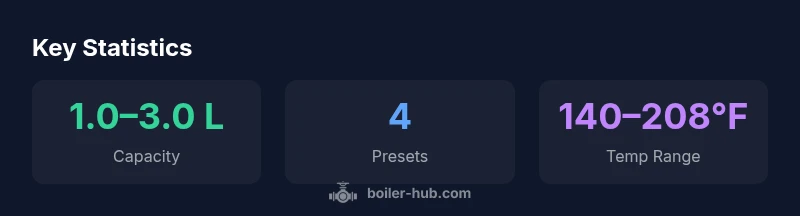
Choosing a Zojirushi water boiler involves matching capacity to daily demand and available counter space. If you routinely prepare multiple hot drinks for several people, a larger model with 2–3 liters of usable capacity can be justified. Conversely, smaller households or denser kitchens may prefer compact options with capacity around 1 liter. Price ranges for water boilers in this category are broad, and while Zojirushi generally sits at a premium tier, the cost is often offset by years of service and lower replacement frequency. It’s wise to compare efficiencies, keep-warm options, and cleaning accessibility when evaluating options.
- Capacity alignment with household size and beverage habits.
- Footprint and storage considerations for kitchens with limited space.
- Price range reflects build quality and longevity; balance upfront cost with long-term use.
- Cleaning accessibility and gasket replacement as ongoing costs to consider.
Real-world use cases: tea lovers, families, and office settings
Tea enthusiasts, particularly those who obsess over precise steeping temperatures, tend to derive the most value from Zojirushi water boilers. Families with busy mornings appreciate reliable hot water for multiple beverages and quick re-heats. In small offices or coworking spaces, the same features translate into reduced wait times and consistent beverage quality across rooms. In all cases, user behavior determines how much value is captured from the device—people who clean and maintain the unit regularly naturally get longer service life and better energy efficiency.
- Ideal for tea connoisseurs who rely on precise temperatures.
- Great for households with repeated hot-water needs during peak hours.
- Office environments benefit from predictable performance and durability.
- If counter space is severely limited, assess compact alternatives or consider a countertop model with reduced footprint.
Authority sources and further reading
For readers seeking deeper context on energy efficiency and safe operation of home water heating devices, consult authoritative sources such as government and major publications. These references provide general guidance on temperature control, energy use, and consumer safety standards that apply to electric water boilers.
- U.S. Department of Energy: Water heating guidance and energy-saving tips (https://www.energy.gov/energysaver/water-heaters)
- U.S. Environmental Protection Agency (Energy Star): Water heater efficiency and product specs (https://www.energystar.gov/products/water_heaters)
- Consumer Reports: Ratings and reliability insights for kitchen appliances (https://www.consumerreports.org)
Advantages
- Strong build quality and reliability
- Precise temperature control for diverse beverages
- Intuitive controls and easy maintenance
- Good keep-warm performance for busy households
- Wide capacity range supports different use cases
The Bad
- Premium price relative to some peers
- Larger footprint may not suit compact kitchens
- Limited model variety compared with some competitors
- Descaling and gasket replacement can be needed over time
Best overall choice for reliability and precise heat control in a family kitchen
Zojirushi water boilers deliver consistent temperature, sturdy construction, and user-friendly operation. The price is premium, but long-term durability and ease of use justify the investment for daily hot-water needs. Space and budget permitting, this line is a solid long-term value.
Questions & Answers
Is a Zojirushi water boiler worth it compared to other brands?
For households that value precise temperature control and long-term reliability, Zojirushi tends to be a strong performer. It may cost more upfront, but frequent users often justify the premium through durability and consistent performance.
Yes, for reliable temperature control and long-term use, though expect a higher upfront price.
What capacities do Zojirushi water boilers come in?
Most models range from compact to multi-liter capacities to suit different needs, with larger units favored by families and offices. Check the product spec sheet to confirm usable capacity before purchase.
They come in several sizes from small to large, so pick based on your usage.
How energy-efficient are these units?
Energy efficiency varies by model and usage pattern. Keep-warm modes can conserve energy over long periods, but active heating consumes more power. Regular descaling helps maintain efficiency.
Energy use depends on how you use it; keep-warm modes save energy when used thoughtfully.
What maintenance is required?
Regular descaling to remove mineral buildup, timely gasket checks, and occasional lid cleaning are recommended. Most components are user-serviceable, which helps extend life.
Keep it clean and replace worn seals to maintain performance.
Are there safety features I should look for?
Look for automatic shut-off, boil-dry protection, and a secure lid mechanism. These features prevent accidents and protect the appliance over time.
Yes—auto shut-off and boil-dry protection are important safety features.
Which households benefit most from a Zojirushi boiler?
Tea enthusiasts, households with frequent hot-water needs, and small offices typically benefit most from the precise control and reliability offered by Zojirushi boilers.
Ideal for tea lovers and busy homes needing steady hot water.
Key Points
- Evaluate capacity to match daily water needs
- Prioritize models with multiple temperature presets
- Account for counter space and footprint in small kitchens
- Expect premium pricing but strong long-term reliability
- Maintain regularly to maximize lifespan and performance