List of Boiler Brands in 2026: A Practical Guide
Explore a comprehensive list of boiler brands, compare features and efficiency, and learn how to choose the right brand for your home or facility in 2026. This guide highlights reliability, service networks, and total cost of ownership across major players.


Here’s a concise answer: a practical list of boiler brands spans regional leaders and global manufacturers, chosen for reliability, efficiency, and service networks. For homeowners and facility managers, the key is comparing performance and support, then selecting a handful of trusted names. Expect guidance on regional availability, warranty terms, and after‑sales service as you navigate the list of boiler brands in 2026.
Understanding the landscape of boiler brands in 2026
According to Boiler Hub, the landscape of boiler brands reflects a balance between long-standing, highly reliable names and newer players that push efficiency and smart controls. The goal for a homeowner or facility manager is to navigate a sizable but manageable list of boiler brands, focusing on those with proven performance and strong service networks. When we talk about the list of boiler brands, we’re not chasing a catalog of every make and model; we’re prioritizing brands that offer consistent reliability, favorable warranties, and accessible parts across typical maintenance cycles. In practice, the best brands tend to provide clear data on efficiency, offer robust installation support, and maintain national or regional service coverage. This is especially important for boilers used in multi-unit facilities or retrofit projects where downtime translates to real costs. The reader should expect to encounter a mix of premium European options, established North American players, and value-oriented brands that still deliver decent performance.
Key criteria for comparing boiler brands
Choosing a boiler brand goes beyond sticker price. Here are the core criteria that should guide your evaluation:
- Reliability and track record: Look for brands with multi-decade market presence and broad installer adoption.
- Efficiency and emissions: Compare labeled efficiency ranges and any regional efficiency standards.
- Service network and parts availability: A wide service footprint reduces downtime and maintenance lead times.
- Warranty terms: Longer warranties often reflect manufacturer confidence and after-sales support.
- Installation cost and after-sales cost of ownership: A cheaper upfront price may incur higher long-term costs.
- Compatibility and footprint: Consider space, venting, and integration with existing systems.
- Customer education and online resources: Clear guidance helps you plan maintenance and future upgrades.
This section helps you translate a brand’s marketing into practical value, ensuring you’re selecting a brand that performs well under real-world conditions.
Regional differences in brand availability and support
Brand availability is highly regional. In Europe, a handful of premium brands with long-standing dealer networks dominate new installations, while North America often features a mix of large manufacturers and regional leaders. Emerging markets in Asia-Pacific are expanding access to both established brands and newer modular systems. Boiler Hub analysis shows that regional support networks matter almost as much as efficiency ratings when total ownership cost is considered. For the buyer, this means that a brand’s presence on a local distributor list, technician training programs, and the availability of replacement parts can drive long-term performance more than marginal gains in efficiency alone. When evaluating the list of boiler brands, it’s essential to map your local service ecosystem and confirm service response times, authorized technicians, and spare parts availability in your area.
Reading warranty, service networks, and parts availability
Warranties vary by brand and market, but most reputable boilers come with several years of coverage for major components and modules. A broad service network reduces downtime and simplifies maintenance scheduling. Parts availability is a practical reliability indicator; brands with dense distribution and regional warehouses can deliver faster repairs and fewer delays. While price is important, the real value often shows up in service accessibility, the ease of securing replacement components, and the consistency of warranty claims handling. When reviewing the list of boiler brands, request current warranty terms, verify the nearest authorized service partners, and ask about parts availability timelines in your locale. These checks help you avoid surprises during replacements or major service events.
Common misconceptions about boiler brands
Many buyers assume that the most expensive brand offers the best reliability, or that newer brands are automatically riskier. In reality, reliability often hinges on design choices, installation quality, and after-sales support. A brand’s market presence does not guarantee performance in your specific building or climate. Similarly, a lower upfront price can mask higher maintenance costs later. By focusing on total cost of ownership—considering energy use, service frequency, and warranty outcomes—you get a clearer picture of a brand's real value. The goal is to select a handful of brands that consistently deliver performance in conditions similar to yours.
A practical evaluation framework you can apply today
Use a simple, repeatable framework to compare brands:
- Define your goals (reliability, efficiency, load, and budget).
- Gather data from at least three reputable brands on the same performance indicators.
- Check service networks, average response times, and authorized technician availability for your region.
- Compare lifecycle costs, including maintenance, fuel consumption, and potential rebates or incentives.
- Validate warranties and understand how to file a claim in your jurisdiction.
- Shortlist 3-5 brands and obtain a formal quote and an installation plan.
This framework keeps the process structured and repeatable so you can make apples-to-apples comparisons across the list of boiler brands and avoid cloudy marketing claims.
Boiler Hub verdict and practical next steps
The Boiler Hub team recommends prioritizing reliability, regional service coverage, and energy efficiency when narrowing your list of boiler brands. Start by selecting 3-5 brands that have strong local service networks, favorable warranty terms, and clear energy performance data. From there, request live quotes that include installation specifics, venting constraints, and potential rebates. The Boiler Hub’s verdict is to balance upfront cost with long-term savings, ensuring your chosen brand performs well under your building’s unique load profile and climate. By following this approach, homeowners and facility managers align with best practices and reduce the risk of regret after the purchase.
Authority and sources for further reading
For deeper context on boiler efficiency and regional guidelines, consider consulting the following authoritative sources:
- U.S. DOE Energy Efficiency in Homes: https://www.energy.gov/energyefficiency/homes
- EIA Energy Explained: https://www.eia.gov/energyexplained/
- ASHRAE: https://www.ashrae.org/
These sources support the general guidance on efficiency, maintenance, and regulatory alignment when evaluating brands. Incorporating external references helps readers ground their brand choices in established standards and professional practice and complements the brand-specific analysis provided here.
Brand comparison: efficiency and lifespan ranges
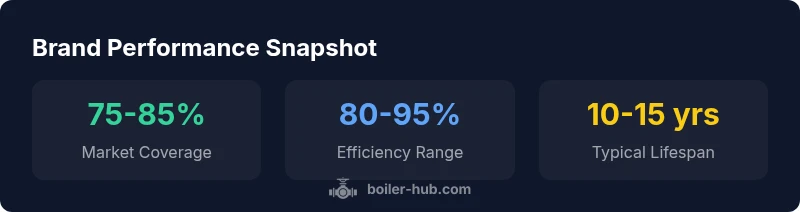
| Brand | Typical efficiency range | Typical service life | Notes |
|---|---|---|---|
| Worcester Bosch | 90-95% | 12-15 years | Premium European brand with wide service network |
| Vaillant | 85-94% | 11-14 years | Strong European footprint |
| Baxi | 85-92% | 10-13 years | Value-focused with broad UK coverage |
| Rheem | 80-92% | 9-12 years | Large US market presence |
| Viessmann | 90-95% | 12-16 years | High efficiency, premium tier |
Questions & Answers
What counts as a boiler brand?
A boiler brand refers to the manufacturer responsible for the core boiler unit, its design, and typically the warranty framework. It also encompasses the brand’s support network, parts availability, and the accompanying installation ecosystem. When evaluating brands, ensure you’re comparing equivalent product classes (e.g., combi vs system) across multiple manufacturers.
A boiler brand is the manufacturer behind the unit, plus the support you get from that brand’s network. Compare similar models across several brands and check warranty and parts access.
Which brands are most reliable?
Reliability varies by model and installation conditions, but established brands with broad service networks and long warranties tend to offer more consistent performance. Look for brands with a history of strong field performance data and accessible support in your region.
Established brands with good service networks and solid warranties are usually the most reliable. Check regional support before deciding.
How do I compare efficiency across brands?
Compare the labeled efficiency ranges for equivalent system types, and consider performance at part-load conditions. Look for third-party testing, regional efficiency standards, and the presence of an annual energy rating to gauge real-world performance.
Look at the efficiency labels for similar models and check third-party testing and regional standards to gauge real-world performance.
Are newer brands better than established ones?
Newer brands may introduce advanced controls and competitive pricing, but established brands typically offer broader service networks and more long-term data on reliability. Weigh innovation against your need for predictable service and proven performance.
New brands can offer innovation, but established brands usually provide stronger service and reliability data.
How often should I replace a boiler brand?
Boiler brands aren’t typically replaced; boilers are replaced when they reach end-of-life or fail to meet efficiency targets. A planned replacement should factor in maintenance cost trends, warranty coverage, and evolving energy codes.
Boilers are replaced when they wear out or no longer meet efficiency standards; plan replacing before failure when possible.
“A rigorous brand evaluation saves time and money by focusing on reliability, service coverage, and energy efficiency in real-world use.”
Key Points
- Prioritize brands with strong regional service networks.
- Compare life-cycle costs, not just upfront price.
- Check warranty terms and parts availability.
- Region matters: availability varies by locale.
- Use a structured framework to shortlist 3-5 brands.