When Your Boiler Says E1: Urgent Troubleshooting
Urgent guide to diagnose and fix boiler E1 errors. Learn what E1 means, quick-fire checks, step-by-step repairs, safety notes, and cost ranges to restore heat fast.


E1 is a critical boiler fault code indicating ignition or flame sensing problems, often requiring immediate action. If you see E1, shut off power only if you can do so safely, check for obvious gas and vent issues, and begin with simple resets. Most fixes involve safety-first resets, checking sensors, and whether a professional should handle gas-related or electrical repairs.
What E1 Means and Why It Demands Urgency
When a boiler says E1, it signals a fault related to ignition or flame sensing that prevents the burner from staying lit. This is a safety-critical condition because an improper flame or gas flow can create dangerous situations. The exact definition of E1 can vary by brand, but the common thread is a fault that stops ignition or flame maintenance. The Boiler Hub Team emphasizes that, in 2026, E1 is among the most common, high-priority codes homeowners encounter during cold snaps. Because the fault involves the fuel-air mix and electronic controls, don’t ignore it or assume it will clear on its own. Quick action reduces the risk of a frozen pipe, a gas leak, or costly heat loss. If you smell gas, evacuate and call the utility emergency line immediately. For non-emergency E1 codes, start with basic safety checks and controlled testing as outlined in this guide.
Common Symptoms Before E1
- Burner attempts ignition repeatedly but fails and trips back to standby
- Boiler cycles on briefly then shuts off with a flashing E1 indicator
- No heat or hot water despite a functioning thermostat
- Visible soot, unusual burner sounds, or a lingering gas odor (danger sign)
- Thermostat or control panel behaving erratically
These symptoms don’t prove the root cause, but they guide the diagnostic flow. According to Boiler Hub Analysis, 2026, ignition faults often cluster with sensor or wiring issues, so a structured approach helps avoid unnecessary repairs. Always prioritize safety: if you’re unsure, stop and call a professional.
Immediate Quick Fixes You Can Try Safely
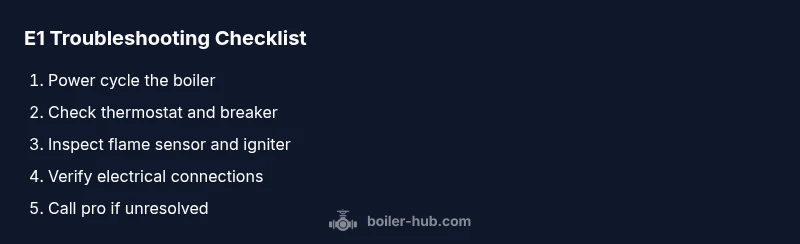
- Power cycle the boiler: turn off the unit, wait 60 seconds, and turn it back on to reset minor electrical glitches.
- Check basic safety items: ensure the thermostat is set correctly, and verify that the boiler switch and breaker are in the ON position.
- Inspect obvious hazards without opening the combustion chamber: look for loose wires near the control board, a tripped safety switch, or signs of moisture.
- If you’re comfortable, reset the system using the manufacturer’s sequence in your manual. Then re-test for ignition. If the boiler still shows E1, stop and call a pro.
- Do not attempt gas line work or gas valve adjustments unless you are a licensed professional. A gas odor or hissing sound requires immediate professional response.
Diagnostic Flow: Narrowing Down Causes (High-Level)
To systematically identify the root cause of E1, work through a controlled sequence that moves from easy to harder tasks. The likely culprits, ordered by how often they appear, include ignition faults (gas supply or spark), flame sensor or electrode issues, wiring/connectivity problems, and control board faults. Start with safe, non-invasive checks and escalate only if the code persists. Record what you observe and note any changes after each step; this helps technicians reproduce the issue later.
Step-by-Step Repair for the Most Likely Cause (If You’re Comfortable)
This section outlines the most common fix for E1 when the flame sensor or ignition assembly is suspected to be dirty or misaligned. If you’re not confident, skip to the professional guidance section. Working on ignition components involves electrical and gas safety risks. The goal is a clean flame sensor, proper electrode gap, and secure wiring so the burner can ignite and sustain flame reliably.
Other Potential Causes and How to Handle Them
Beyond ignition and flame sensing, E1 can be triggered by a dirty or blocked flame sensor, corroded ignition electrodes, loose or damaged control wiring, improper venting causing poor combustion, or a fault in the control board. Each cause has a corresponding fix, from cleaning sensors to replacing faulty components. If the code persists after basic maintenance and sensor cleaning, it’s a sign that professional assessment is needed. Do not ignore persistent E1 indicators, as ongoing ignition problems can lead to dangerous conditions.
Safety, Costs, and When to Call a Pro
Safety is non-negotiable with E1. If you smell gas, hear unusual hissing, or the boiler becomes very hot, evacuate and call emergency services. For non-emergency E1 cases, expect a service visit to cost in the general range of parts and labor. Typical part costs for ignition or sensor components can range from $20 to $150, while labor for diagnostics and repair often falls between $100 and $350, depending on complexity and travel. If a control board or gas valve is implicated, costs can rise into the $400–$800 range. The Boiler Hub Team recommends erring on the side of caution and scheduling a pro if you’re unsure.
Steps
Estimated time: 45-60 minutes for basic checks; 60-120+ minutes for advanced diagnosis or parts replacement
- 1
Ensure safety and power down
Turn off the boiler and disconnect power at the breaker. If you smell gas, evacuate immediately. Do not proceed with ignition checks until you can confirm no gas odor or leak.
Tip: Always have a clear exit path in case you need to leave quickly. - 2
Reset and repower
Wait 60 seconds, then switch the boiler back on. Listen for the ignition sequence and watch the display for E1 to clear. If the code reappears, proceed to sensor checks.
Tip: A clean reset often resolves transient sensor glitches. - 3
Inspect flame sensor and electrodes
Access the burner area according to the manual, remove any soot, and gently clean the flame sensor with a soft brush or alcohol wipe. Reposition electrodes and ensure proper gap according to specs.
Tip: Do not bend electrodes; incorrect gap can impair ignition. - 4
Check wiring and connections
Inspect plug connections to the ignition module and flame sensor for secure seating. Look for signs of corrosion or insulation damage and replace any damaged wires.
Tip: Disconnect power before touching wires to avoid shocks. - 5
Test gas supply and pressure (if trained)
If you’re trained and it’s safe, verify gas valve is fully open and pressure is within manufacturer spec. If you detect a leak or cannot confirm safe pressure, stop and call a pro.
Tip: Never adjust gas pressure without the proper tools and credentials. - 6
Escalate to replacement or professional service
If E1 persists after sensor cleaning and wiring checks, a professional should diagnose potential board faults or gas-related hazards. Arrange for service and obtain a written estimate.
Tip: Ask for a diagnostic report and a parts/labor breakdown.
Diagnosis: Boiler displays E1, fails to ignite or keep flame
Possible Causes
- highIgnition system fault (spark/igniter) or gas supply interruption
- mediumFlame sensor or electrode dirty or misaligned
- mediumLoose wiring or damaged control circuitry
- lowVenting blockage or airflow restriction
- lowControl board fault or sensor communication error
Fixes
- easyReset power and attempt a controlled restart
- easyInspect flame sensor/electrodes and clean or reseat connections
- hardVerify gas supply and electrical connections (only if safe and trained)
- hardReplace faulty ignition component or control board as needed
Questions & Answers
What does E1 mean on my boiler and is it dangerous?
E1 signals a fault in ignition or flame sensing. It can be dangerous if there is a gas leak or improper flame. Treat it as urgent and follow safety steps, contacting a professional if you’re unsure.
E1 is an ignition or flame sensor fault. It can be risky if gas is involved; best to call a pro if you’re uncertain.
Can I reset the boiler myself to clear E1?
A safe power cycle or factory reset can clear transient faults. If E1 reappears, don’t push further; proceed with the diagnostic steps or contact a professional.
A safe reset can clear some E1 faults, but if it returns, seek professional help.
What are typical costs to fix E1?
Costs vary by cause. Expect about $100-$350 for diagnostics and sensor-related fixes, with higher ranges for control boards or gas-valve replacements.
Expect a diagnostic range around a few hundred dollars; more for major component replacement.
When should I replace the boiler due to E1?
If multiple major components fail or the unit is old and energy-inefficient, replacement may be more economical than repeated repairs. A professional can provide a cost/benefit assessment.
If repairs exceed a reasonable portion of replacement cost, consider replacement after professional advice.
Is E1 always related to gas supply?
Not always. E1 can stem from ignition, sensors, wiring, or board faults. A professional will diagnose whether gas conditions are safe.
Gas issues may be involved, but ignition and sensor faults are common too.
What can I do to prevent E1 in the future?
Schedule regular maintenance, keep sensors clean, and address airflow or venting issues promptly to reduce ignition faults.
Regular maintenance and sensor care help prevent E1 errors.
Watch Video
Key Points
- Identify E1 as an ignition/flame fault requiring action
- Start with safety checks and controlled resets
- Prioritize sensor and wiring diagnostics before parts replacement
- Call a pro for gas, flame sensor, or control-board issues