How to Refill a Boiler Without Filling Loop: A Practical Guide
Learn a safe method to refill a boiler without the filling loop, including essential safety checks, a practical step-by-step workflow, and maintenance tips for homeowners and facility managers.


In many boiler systems, you can refill without the traditional filling loop by using alternate feed connections, such as the expansion tank or an automated fill valve. The goal is to restore correct pressure safely while avoiding air locks. Before starting, ensure power is OFF, isolate the boiler, and have a safety plan in case of leakage or pressure spikes. Follow procedure precisely.
Why Safe Boiler Refills Matter
Safe boiler refills protect the entire heating system from air locks, pressure fluctuations, and cold-water shock that can damage heat exchangers or valves. According to Boiler Hub, improper refill practices are a common cause of service calls and longer downtime after cold starts or maintenance. When you refill without filling loop, you should proceed calmly, verify all isolation points are secure, and monitor pressure with the correct safety mindset. A deliberate, measured approach minimizes the risk of over-pressurizing the vessel or forcing air into radiators. For homeowners and facility managers, a disciplined refill routine reduces the chance of leaks and reduces the need for costly emergency support. The goal is to restore stable system pressure while preserving component life and avoiding air-bound pockets that impair heating efficiency. By following a clear, standardized method, you can maintain comfort and safety across a wide range of boiler types and ages.
When You Might Refill Without a Filling Loop
There are situations where the traditional filling loop is unavailable, blocked, or inaccessible. In older or sealed systems, an expansion tank or an automated filling valve may serve as the practical feed source. Refilling without the loop is not universal; if your boiler relies on a dedicated feed from a closed loop, deviating from manufacturer instructions could void warranties or create hazards. Before attempting any alternative, confirm the exact feed path for your unit and inspect for signs of rust, leaks, or degraded seals. If you discover corrosion or active leaks, stop and call a qualified technician. When performed correctly, using alternate feeds can re-establish proper pressure without forcing water through a loop that’s not designed for your configuration. The Boiler Hub team emphasizes you should never improvise on safety-critical steps; use verified connections and consult documentation whenever possible.
Safety First: Precautions and System Checks
Safety is non-negotiable when handling boiler refills. Begin by turning off power to the boiler and isolating the unit from the mains. If your system includes gas or oil burners, ensure the fuel supply is secure and that there is adequate ventilation. Check all isolation valves to confirm they are closed before you start any refill process. Have a clean catchment container ready to manage any overflow. Wear protective gloves and eye protection, and place towels around the work area. If you notice any damp patches, unusual odors, or hissing from pressure relief valves, stop immediately and seek professional help. Keeping a pressure gauge on hand helps you monitor changes as you refill, minimizing the risk of over-pressurization. Remember that even small mistakes can lead to air locks, noise, or pump cavitation, so take your time and verify each step.
Understanding Boiler Pressure and Feeds
Boiler pressure targets vary by system and load. Most residential boilers operate within a range around 1 to 1.5 bar when cold and up to about 2 bar when hot, but always check the manufacturer’s specification for your model. When refilling without the loop, you may be feeding through an expansion-tank connection or an auxiliary fill valve. The key is to bring pressure up gradually while ensuring the system remains watertight. If you observe rapid pressure spikes, sudden drops, or persistent air in radiators, that signals trapped air or a faulty vent, which should be addressed before normal operation resumes. A careful, measured approach reduces noise and prolongs pump life.
Practical Considerations for Different Boiler Types
Not all boilers accept refills through alternate feeds in the same way. Combi boilers, system boilers, and heat-only setups each have unique feed paths and venting requirements. For combi boilers, pressure adjustments are often more sensitive due to compact internals; missteps can affect water flow and heating performance. For conventional and system boilers, the expansion tank and filling valve pathways may be more straightforward, but you still need to observe safety rules and correct pressure targets. Always tailor your refill plan to the specific boiler type, age, and installed accessories (like outdoor reset controls or variable-speed pumps). If in doubt, consult the installation manual or a qualified technician before proceeding.
Step-by-Step Context Overview (What to Expect)
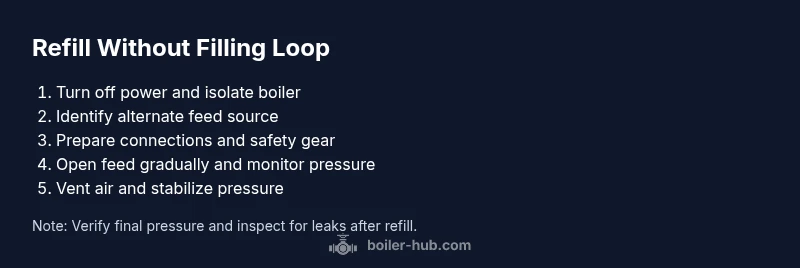
This section provides a structured overview of the workflow you’ll follow when refilling without a filling loop. It emphasizes sequencing, valve handling, and monitoring so you can stay safe and achieve the correct pressure. The steps focus on establishing a reliable feed, confirming seal integrity, and verifying that the system cycles correctly after the refill. Below, you’ll find actionable steps with safety considerations, so you can approach the task with clarity and confidence.
Common Pitfalls and Troubleshooting
Common mistakes include opening feed valves too quickly, neglecting venting, and skipping pressure checks. Air pockets in radiators can mimic pressure issues, making the system appear under or over-pressurized. If you hear banging or feel inconsistent heating, pause, re-check all connections, and allow air to escape gradually through the vent on the radiator or the automatic air vent. If the pressure fails to stabilize after a careful refill, there may be a leak, a stuck valve, or a failed pressure-reducing valve. In such cases, discontinue the refill and contact a professional to avoid dangerous situations.
Post-Refill Verification and Maintenance
After you complete the refill, verify that the pressure stabilizes within the manufacturer’s specified range when the system is cold and again when hot. Watch for leaks around joints, valves, and the expansion tank. Bleed radiators to remove residual air pockets and restore full heating efficiency. Record the final pressure reading and the date of the refill for future reference. Schedule periodic professional servicing according to your boiler’s maintenance plan. Routine checks help you detect small issues before they become costly repairs and keep your system operating safely and efficiently.
Final Safety Reminders and Next Steps
Even with careful execution, refilling without a filling loop carries risks if you are unsure of your system's configuration. The Boiler Hub team recommends using manufacturer guidelines and, when in doubt, engaging a qualified technician. Maintain a log of pressure readings, valve positions, and any observed anomalies for future troubleshooting. Regular maintenance reduces failure risk and preserves efficiency across seasons.
Tools & Materials
- Bucket(Large enough to catch overflow)
- Hose or flexible tubing(For controlled water delivery)
- Adjustable wrench(Use on isolation valves)
- Flathead screwdriver(Valve caps or vent screws)
- Gloves(Protect hands from hot surfaces)
- Towels or rags(Contain spills)
- Cloth or rag(Wipe fittings after adjustments)
- Pressure gauge (optional but recommended)(Helps monitor pressure precisely)
- Flashlight(Inspect valve areas in low light)
Steps
Estimated time: 30-60 minutes
- 1
Power down and isolate boiler
Turn off the boiler at the control panel and switch off the main power supply. Isolate the unit to prevent accidental ignition or circulation while you work.
Tip: Verify there is no residual heat before touching components. - 2
Identify the alternate feed source
Locate the expansion tank connection or approved alternate fill valve that will serve as your refill feed. Confirm that this path is intended for a manual or semi-automated refill.
Tip: Consult the manual to ensure you’re using a compliant feed path. - 3
Prepare connections and safety gear
Set up your hose, bucket, and any required adapters. Wear gloves and have towels ready for spills.
Tip: Keep a clear workspace to avoid tripping over hoses. - 4
Open the feed valve gradually
Slowly open the alternate feed valve to start water flow into the system. Avoid full bore opening at once to reduce shock and air entrainment.
Tip: Increase flow slowly and monitor for leaks. - 5
Vent and purge air as you rise pressure
As pressure increases, vent air from radiators or the automatic air vent to reduce air locks. Stop if hissing or alarms occur.
Tip: Bleed gradually; too much venting can drop pressure. - 6
Stabilize pressure and close feed
Once the pressure nears the target range (cold), close the feed valve and re-check. Reinstall any caps or covers you opened.
Tip: Recheck after the system cools to confirm stable pressure. - 7
Restore power and test the system
Turn the boiler back on and run a short cycle to confirm safe operation and correct pressure behavior.
Tip: Listen for odd noises and watch for leaks during the test cycle. - 8
Document and monitor
Note the final pressure reading, time, and any observations for future reference. Schedule a follow-up check if anomalies appear.
Tip: Keep a log so future refills follow a consistent baseline.
Questions & Answers
Is it safe to refill a boiler without a filling loop?
Yes, in some systems you can refill via an alternate feed, but only if you understand your system layout and follow safety steps. If you’re unsure, consult the manual or a professional.
It can be safe if you know your system’s feed path and follow the steps exactly. If in doubt, consult a professional.
What signs indicate air in the system after a refill?
Common signs are radiators that stay cold at the bottom, banging sounds, and fluctuating pressure readings. Bleed radiators and recheck pressure to address air pockets.
Look for cold spots in radiators and banging noises. Bleed and recheck pressure to fix air pockets.
Should I refill without a professional?
If you’re unsure about your system layout or pressure behavior, it’s safer to involve a qualified technician. Incorrect refilling can cause leaks or damage.
If you’re not confident about your system, it’s safer to call a professional.
Can I use the expansion tank feed for refilling?
Some systems allow refilling through the expansion tank path, but only if configured for this purpose. Check your manual and ensure the tank is not pressurized beyond recommended limits.
Yes, some setups permit it, but verify with the manual first.
What is a safe pressure range after refilling?
Pressure targets vary by boiler. Typically, residential systems aim for a specific cold pressure (often around 1 bar) and up to 2 bar when hot. Always follow the manufacturer’s spec.
Follow the boiler’s spec; typically around 1 bar cold and up to 2 bar when hot.
What should I do if the filling path is blocked?
Do not force the refill. Stop, inspect for blockages or leaks, and contact a professional to avoid pressure hazards.
If blocked, don’t force it—stop and get help.
How often should I test boiler pressure after a refill?
Check pressure after refill and again after the system heats up for the first cycle. Schedule periodic checks as part of routine maintenance.
Check pressure after refill and during the first heating cycle; plan regular checks.
Watch Video
Key Points
- Follow a safe, documented refill path.
- Monitor pressure and vent air gradually.
- Inspect for leaks before resuming normal operation.
- Record readings and consult a professional if uncertain.