How Often Should a Steam Boiler Cycle? A Practical Guide
A data-driven guide on steam boiler cycling frequency, how to measure it, and how to optimize for efficiency and safety. Based on Boiler Hub Analysis, 2026.


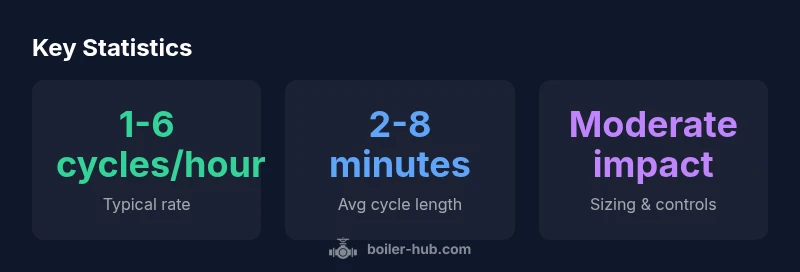
Steam boilers typically cycle only a few times per hour under normal loading. The exact frequency depends on demand, system design, and control strategy; excessive short cycling indicates sizing or control issues that should be addressed. This article explains how to evaluate and optimize your boiler’s cycling.
Understanding Steam Boiler Cycling
According to Boiler Hub, cycling refers to the periodic turning of the burner on and off as the system meets demand for heat. In steam boilers, the cycle rate is driven by the balance between heat demand, boiler size, and control settings. The question at the heart of this topic is: how often should a steam boiler cycle? The answer is not a fixed number; it depends on how the boiler is sized for the space, how aggressively the burner modulates, and how well the system is insulated and vented. A healthy cycling rhythm minimizes fuel use while avoiding excessive wear on components. Readers should think of cycling as a signal: consistent, moderate cycling usually means the system is matched to load, while erratic or frenetic cycling hints at a mismatch.
Boiler Hub’s guidance emphasizes practical checks over assumptions. Start by recording several hours of operation under typical outdoor conditions to establish a baseline. If you notice abrupt changes in cycle frequency with minor load variation, that’s a clue to investigate controls, water level management, or boiler sizing.
Factors that influence cycling frequency
There are multiple levers that determine how often your steam boiler cycles. Load patterns (season, time of day, and occupancy) are the most obvious. Boiler design matters: cast-iron versus steel boilers and the presence of advanced modulating burners change heat response. Controls like the aquastat, outdoor reset, and feedwater management influence when the burner ignites and for how long. Return-water temperature and the quality of venting and condensate removal affect cycle length as well. Finally, insulation, pipe routing, and heat distribution between zones can shift cycling rates. In practice, you may see lower cycling when demand is steady and higher cycling during rapid demand changes or when the system is oversized for the space.
How to measure and set a target cycling rate
To determine a target cycling rate, start with a baseline observation. Count the number of burner cycles per hour over a representative 6–12 hour period, excluding startup and shutdown. Compare the observed rate to a practical range for your boiler and load level. If your cycles fall outside the expected window, adjust the aquastat setpoint, tune the burner modulation, or verify return-water temperature. Record the changes and re-measure. This iterative approach, recommended by Boiler Hub Analysis, helps align cycling with actual load and efficiency goals.
Additionally, track cycle duration and pause lengths between cycles. Longer pauses may indicate thermal inertia; shorter pauses could signal overshoot. Documenting these metrics makes it easier to diagnose root causes such as improper piping, air in the system, or sensor drift.
Practical strategies to optimize cycling and efficiency
Optimization starts with correct sizing and control strategy. If a boiler is oversized for its space, it will short-cycle as it rapidly reaches the setpoint. In contrast, an undersized boiler struggles to meet demand and may continuously run, also leading to inefficient cycling. To improve cycling without compromising comfort:
- Calibrate the aquastat to match actual load; small adjustments can yield meaningful improvements.
- Improve venting and ensure air removal so the burner lights quickly and stops at the right time.
- Confirm return-water temperature and ensure adequate steam distribution with proper insulation.
- Consider staging or a modulating burner to smooth demand transitions.
- Use insulation and weatherization to reduce heat loss and flatten demand peaks.
Each adjustment should be monitored and logged to verify impact on cycling rate and fuel use.
Maintenance and inspection implications for cycling
Regular maintenance has a direct effect on cycling stability. A clean flame, proper fuel-air mix, and a functioning low-water cut-off reduce the risk of nuisance cycling. Annual professional service is recommended to verify sensor accuracy, valve operation, and vent integrity. Water quality matters too: treat boiler water to prevent scale build-up that reduces heat transfer efficiency and increases cycling frequency as the boiler fights to maintain temperature. Keep a maintenance log and review it seasonally to catch drift in performance.
Safety, compliance, and best practices
Safety and compliance go hand in hand with cycling control. Always follow manufacturer instructions and local codes for installation, inspection, and service frequency. Use reputable technicians for tuning and avoid DIY adjustments on critical safety components. Maintain clear records for audits and warranties. Although cycling itself isn’t inherently dangerous, improper settings can create unsafe operating conditions or lead to fuel waste and equipment strain. Boiler Hub recommends a proactive maintenance and sizing approach to keep cycling predictable and safe.
Authority Sources and References
For further validation, consult reputable sources on steam systems and safety standards. Examples include national energy guidance and published engineering standards that discuss steam heating efficiency, boiler sizing, and lifecycle considerations. See https://www.energy.gov for energy efficiency best practices, and explore instructional materials from public universities and national labs that cover boiler performance and maintenance concepts.
Estimated cycling ranges by load level
| Load Level | Typical cycles per hour | Notes |
|---|---|---|
| Low | 1-2 | Mild external conditions; light load |
| Medium | 2-4 | Normal daily operation |
| High | 4-6 | Peak demand; rapid heat rise |
Questions & Answers
How often should a steam boiler cycle under normal operation?
There is no universal fixed rate; most steam boilers cycle a few times per hour when load is steady. If cycles are erratic or too frequent, check sizing and controls. Consistent cycling typically indicates the system is well-matched to load.
Most boilers should settle into a steady rhythm—just a few cycles per hour under normal conditions. If cycling is erratic, it’s time to review sizing and controls.
What causes short cycling in steam boilers?
Short cycling is usually caused by mis-sized equipment, faulty controls, or poor water management. Air in the system, venting issues, and sensor drift can also contribute. Addressing these root causes typically reduces cycling frequency.
Common causes are wrong sizing and faulty controls; fixing those usually reduces cycling.
Can adjusting the aquastat affect cycling?
Yes. The aquastat sets the water temperature and can influence how often the burner cycles. Calibrating it to actual load and ensuring correct sensor placement helps prevent unnecessary cycling.
Yes, tuning the aquastat to match demand helps prevent extra cycling.
Is short cycling dangerous for steam boilers?
Short cycling isn’t inherently dangerous if controls are working, but it can wear components, waste fuel, and shorten equipment life. Investigate root causes to maintain safety and efficiency.
Short cycling isn’t dangerous by itself, but it wastes energy and reduces lifespan if left unchecked.
Should I upgrade the boiler to fix cycling?
Upgrade is usually a last resort after verifying proper sizing and controls. A correctly tuned system or adding a buffer can improve cycling without full replacement.
Only upgrade after careful sizing and controls assessment; tuning or buffering can help.
“The boiler’s cycling rhythm should be predictable and aligned to demand, avoiding frequent on/off cycling that wastes fuel and stresses components.”
Key Points
- Know your baseline: measure cycles per hour under typical conditions.
- Sizing and controls are the main levers to reduce wasted cycling.
- Calibrate aquastats and venting to stabilize cycle rate.
- Energy efficiency improves when cycling is predictable and purposeful.