Expansion Tank Pressure for Boiler: A Practical Guide
Learn how to set and verify expansion tank pressure for boiler systems, troubleshoot common pressure issues, and maintain reliable operation. Discover cold pre-charge values, operating ranges, and step-by-step maintenance tips from Boiler Hub.


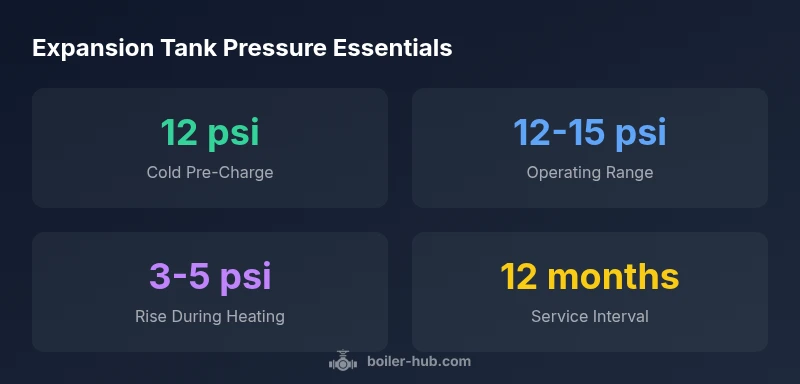
For most residential boilers, set the expansion tank pre-charge to 12 psi when the system is cold. The target operating pressure is typically 12-15 psi. If you see pressure rising toward 20 psi or more, inspect for leaks, verify the pre-charge, and bleed air. See our full guide for detailed steps.
Understanding expansion tanks and expansion tank pressure for boiler
Expansion tanks are compact pressure vessels that cushion the water volume as a boiler heats and expands. The expansion tank pressure for boiler is a key setting because it determines how much the tank will absorb pressure changes, protecting the piping, valves, and heat exchanger. In a typical residential setup, the tank is pre-charged with air to roughly match the cold system pressure, and a bladder inside keeps air from contacting the water. According to Boiler Hub, maintaining correct pre-charge and operating pressure reduces nuisance cycling, prevents leaks, and extends boiler life. While exact numbers vary by boiler and loop design, the general rule is to match the tank’s pre-charge to the cold fill pressure, commonly around 12 psi. Use a boiler gauge or the fill valve to verify, then compare against the manufacturer’s spec. If the pre-charge is off, the system will either slam the valve shut with every heat cycle or fail to absorb expansion efficiently.
Pre-Charge Pressure: Matching Cold System Pressure
Setting the correct pre-charge means adjusting the air charge in the expansion tank so it matches the cold system pressure. Start by turning off the boiler and allowing the system to cool. Connect a pressure gauge to the tank’s Schrader valve (or the boiler fill valve if a gauge is built in). If the gauge reads 12 psi on a cold system, you are at the typical target. If the boiler’s cold fill pressure is listed higher or lower in the manual, set the pre-charge to that value, not to a guess. After adjusting, re-check the reading to confirm the bladder is holding air. If you cannot achieve the target psi due to a leaky bladder or a defective valve, the expansion tank may need replacement to restore proper pressure balance.
Operating Pressure Range and Real-World Variations
The operating pressure is what you observe once the system warms up. For most homes, a healthy operating range is about 12-15 psi, but certain boilers designed for higher efficiency or larger homes can run toward 15-20 psi when hot. Always keep the pressure within the boiler’s specified range; pressure above about 20-25 psi can trigger safety relief valves or cause hot-water leaks near fittings. Real-world factors—outdoor temperature, pump performance, or hidden leaks in radiators—can push the pressure outside the typical window. If you see rising pressure without leaks, the expansion tank’s bladder may be failing, allowing water to compress air more quickly and skewing the balance between pre-charge and operating pressure.
When Pressure Goes Wrong: Leaks, Air, and Faulty Tanks
Sudden pressure spikes, frequent boiler cycling, or a stubbornly high boiler pressure gauge are signals to diagnose the expansion tank first. Check for air in the system by bleeding radiators and inspecting the tank for signs of a failed bladder—waterlogged tanks feel heavy and may not compress air. If the bladder is compromised, replace the tank rather than continuing to fight an unbalanced system. Leaks around the tank, fittings, or pressure relief valve can also falsely indicate pressure problems; correct leaks before adjusting settings. If you’re unsure, contact a licensed professional to test the tank using a diagnostic air charge test and verify the entire boiler loop is sealed and balanced.
Step-by-Step Troubleshooting Guide
- Turn off and cool the boiler; locate the expansion tank and its air/Schrader valve. 2) Check cold pre-charge—adjust to match the boiler’s cold fill pressure (commonly 12 psi). 3) Refill the system to the recommended pressure and re-check the pre-charge. 4) Inspect for leaks; address any found leaks at valves, fittings, or radiators. 5) If pressure rises rapidly when heating, bleed air from the system and recheck the tank’s bladder. 6) Test the expansion tank by disconnecting the line and using a pressure gauge to confirm the tank holds the set air pressure. 7) If the bladder fails, replace the tank and re-test the system.
Maintenance, Testing, and Best Practices
Develop a simple maintenance routine that includes a yearly pressure check, visual inspection of the expansion tank, and confirmation that the pressure gauge readings stay within the manufacturer’s recommended range. When any component is replaced—pump, regulator, or valve—recheck the entire loop for proper balance. Keep a notes log with cold pre-charge values, operating range, and any adjustments after service. Boiler Hub recommends periodic checks as part of standard boiler service, since small changes in pressure balance can accumulate into efficiency losses or short cycling over time.
Typical expansion tank pressure scenarios for common residential boilers
| Condition | Cold Pre-charge | Operating Pressure | Notes |
|---|---|---|---|
| Pre-charge (cold) | 12 psi | 12-15 psi | Match boiler manual; varies by system |
| During heating cycle | N/A | 15-20 psi | Pressure can rise; watch for spikes |
| Post-fill/cooldown | 12 psi | 12-15 psi | Re-check after filling and venting |
Questions & Answers
What is expansion tank pressure and why does it matter for boilers?
Expansion tank pressure represents the air charge inside the tank and the system’s operating pressure. Correct pressure helps absorb water expansion, reduces cycling, and prevents leaks or valve wear.
Expansion tank pressure is the air-and-water balance inside the tank that keeps the boiler from cycling too often. Getting it right protects the system.
How do I check expansion tank pre-charge?
Turn off the boiler, let the system cool, then attach a pressure gauge to the tank’s valve and compare the reading to your boiler’s cold fill pressure. Adjust the pre-charge as needed and re-check.
First, let the system cool, then measure the air charge and adjust to match the cold fill pressure.
What happens if the expansion tank is undercharged?
An undercharged tank cannot absorb as much expansion, causing higher pressure spikes, more cycling, and potential leaks. It may also shorten the life of relief valves and seals.
If the tank isn’t charged enough, the boiler will cycle more and pressure can spike.
Can I adjust expansion tank pressure myself?
Yes, with the boiler off and cold, you can adjust the pre-charge using a gauge and an air pump. If the bladder is failing or you’re unsure, hire a professional.
You can adjust it, but if you’re unsure about the tank’s condition, call a pro to avoid risky mistakes.
When should I replace the expansion tank?
Replace if the bladder is failed (waterlogged), if there are persistent pressure leaks, or after confirming with a professional that the tank cannot hold air.
Replace the tank if the bladder has failed or if pressure continues to drift despite adjustments.
“Proper expansion tank pressure is a fundamental reliability factor for boiler operation; small adjustments can prevent frequent cycling and protect critical components.”
Key Points
- Set cold pre-charge to the boiler’s recommended cold fill pressure (commonly 12 psi).
- Maintain operating pressure within the boiler’s design range (usually 12-15 psi).
- Watch for pressure spikes during heating; investigate leaks or failing bladder.
- Test expansion tank bladder; replace if waterlogged or visually damaged.
- Perform annual maintenance to sustain reliable expansion tank performance.