does boiler need to be off for a service — a practical guide
Learn whether your boiler must be off for a service, the safety steps to follow, and what to expect from a professional inspection with Boiler Hub's expert guidance.


Quick answer: In most cases, the boiler should be off for a service to ensure safety and accurate testing. A licensed technician will guide you on isolating power and gas and may advise you to allow the system to cool before work begins. If your boiler has a service mode, the technician will instruct you accordingly. If unsure, always follow their exact instructions.
Safety and necessity of turning off the boiler during a service
Turning off a boiler before service is a safety best practice for most gas and oil boilers. Shutting down the electrical supply reduces the risk of electric shock, short circuits, or accidental relighting during inspections. Isolating the gas supply, when directed, prevents unintentional gas flow while the technician checks connections, burners, and seals. Some checks require the boiler to be cool to avoid burns or scalding when opening panels or removing heat exchangers. While some electronic controls can be tested with the boiler powered, the majority of involved tasks are performed with the unit de-energized and depressurized. Always await explicit instructions from a qualified technician before altering any gas or electrical feeds. According to Boiler Hub analysis, proper isolation reduces risk by ensuring a controlled environment for inspection and testing, especially for older or high‑efficiency systems.
What the professional will do when the boiler is off
When the boiler is off, a licensed technician will perform a structured set of checks. They typically inspect the ignition system, burner, heat exchanger, flue, and seals for signs of wear or leakage. Electrical safety is verified using a multimeter, and gas connections are checked for leaks with a detector solution or electronic leak tester. The technician will also test safety devices such as flame supervision, pressure relief valves, and CO detectors to ensure all safety features function correctly. Off-power testing allows accurate measurement of boiler pressure, system temperature, and return temperatures without interference from running cycles. If the boiler must stay on for certain diagnostic tests, the technician will implement safe isolation and clearly explain why the exception is necessary. Boiler Hub emphasizes that clear communication with a qualified pro minimizes confusion and keeps everyone safe.
When it might be acceptable to leave the boiler on for certain checks
There are rare scenarios where a technician may perform specific checks with limited power or in a controlled mode, but this decision rests entirely with the professional. For example, certain digital controls or smart thermostats might be tested while some circuits remain live, provided all safety barriers are in place and the panel is kept closed. Never try to bypass safety systems or run diagnostics without explicit instruction from the technician. If your system requires any checks while energized, the technician will install temporary protective measures and walk you through each step. Boiler Hub notes that adherence to manufacturer guidance and local codes is essential for warranty validity and safety.
Preparing for a boiler service: homeowner checklist
Preparation makes the service quicker and safer. Start by booking a licensed technician and sharing your boiler’s model, age, and any symptoms (strange noises, leaks, or fluctuating temperature). Ensure clear access to the boiler and venting area, remove clutter, and keep pets and children away during the visit. Have basic documentation ready—previous service reports, warranty papers, and any recent repair notes. If you have multiple units, indicate which should be serviced first. Confirm parking and entry instructions with the technician and designate a contact person in case access issues arise. The cleaner the space, the easier it is for the pro to inspect every corner, which reduces the chance of missing a safety issue.
How to verify a reputable service visit
A quality service includes a written checklist or report detailing what was inspected and any parts replaced or adjusted. Ask the technician to explain findings in plain language and provide post-service maintenance recommendations. Request warranty coverage details for parts and labor, and ask for recommended future service intervals. A reputable pro will show credentials, registrations, and a summary of safety test results, including CO detector status and vent integrity. After the visit, record the service date, technician name, and any parts used for future reference. Boiler Hub advises homeowners to review the report carefully and keep it with the boiler’s documentation.
Post-service steps and testing
Once the service is complete, the technician should restart the boiler and run diagnostic cycles to verify safe operation. Check that hot water and heating respond promptly, radiators reach even temperature, and there are no new leaks or unusual noises. If any fault codes appeared during testing, ask the technician to explain their meaning and whether a follow-up visit is required. Keep an eye on the boiler for the first 24–48 hours after service to catch delayed symptoms such as pressure loss or odd odors. Maintain a log of readings (pressure, temperature) and contact details for the service provider in case of future questions.
Common misconceptions about off-for-service
Myth: The boiler can always stay on during service if it’s a simple inspection. Reality: Most checks are safer and more accurate when the boiler is off. Myth: DIY service saves money. Reality: Only a qualified technician should handle gas boilers to avoid dangerous leaks and carbon monoxide risks. Myth: If there’s no leak, the system is fine. Reality: Internal wear and safety valve performance may deteriorate even without obvious signs. Myth: CO detectors are optional during service. Reality: Detectors should be tested and confirmed functional during any service to protect occupants.
Safety reminders for homeowners and facility managers
Always treat gas boilers as potential hazards. Ensure an up-to-date CO detector on every level, clear escape routes, and unobstructed access to the boiler. Do not bypass safety devices or attempt to service the boiler without proper training. If you notice gas smells, hissing sounds, or ignition trouble, leave the area and contact your gas supplier or emergency services immediately. Regular professional servicing is the best way to minimize the risk of dangerous failures and keep your system compliant with local safety regulations.
Tools & Materials
- Safety gloves and eye protection(ANSI-rated safety gear; use oil‑resistant gloves for greasy panels)
- Multimeter(For electrical continuity and safety checks)
- Screwdriver set (Phillips and flathead)(Various sizes; keep organized in a magnetic tray)
- Gas leak detector or leak‑test solution(Used to check connections and the flue line)
- Torque wrench or adjustable wrench(Optional for securing tight fittings during inspection)
- Documentation for service history(Previous service records, model/serial, warranty details)
- Flashlight or headlamp(Illuminates tight panels and vent areas)
Steps
Estimated time: 60-120 minutes
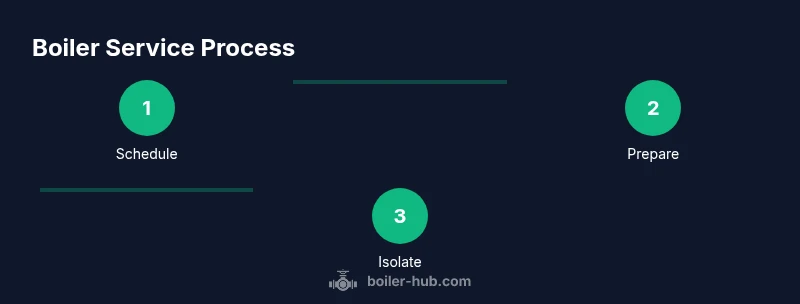
- 1
Schedule a licensed boiler service
Contact a qualified technician and book a service appointment. Have your model, age, and any symptoms ready. A professional will confirm safety expectations and required preparations.
Tip: Ask for a written estimate and service scope before the visit. - 2
Prepare the service area
Clear the area around the boiler, remove clutter, and ensure easy access to the unit and shut-off valves. Note the location of CO detectors and ensure they are functioning.
Tip: Provide the technician with access instructions and contact details. - 3
Isolate power and gas if directed
If the technician requests, switch off the appliance at its dedicated switch and, when safe, at the main breaker. For gas boilers, the gas valve should only be operated by a professional.
Tip: Never attempt to disconnect gas or power feeds without instruction. - 4
Allow safe cooling and panel access
Let the boiler cool to a safe temperature before opening panels. Remove the front cover only as directed by the technician and avoid touching hot surfaces.
Tip: Stand clear of moving parts and flame areas during access. - 5
Technical inspection and testing
The technician will inspect ignition, flame, seals, heat exchanger, venting, safety devices, and electrical connections. They may perform leak tests and system diagnostics with the appropriate equipment.
Tip: Ask to see test results or a copy of the service report. - 6
Restart and verify operation
After checks, the boiler is restarted and tested through heating and hot-water cycles. Confirm that pressure readings are stable and that there are no leaks or abnormal noises.
Tip: Note any new fault codes and report them immediately. - 7
Obtain documentation and next steps
Receive a signed service report, parts used, and recommended future maintenance intervals. Schedule follow-up visits if required.
Tip: Keep the record with boiler documentation for warranty compliance.
Questions & Answers
Does the boiler need to be off for a service?
In most cases, yes. Turning the boiler off helps ensure personal safety and allows the technician to perform accurate inspections. Always follow the technician’s instructions for your specific unit.
Yes, the boiler should be off for service in most cases. Follow the technician’s instructions for your model and safety.
Can I turn off the boiler myself before a service?
If advised by your service provider, you may switch off the appliance at its dedicated switch or the main breaker. Do not tamper with gas valves or piping; these should be handled by a licensed professional.
Only switch off the boiler if your service provider instructs you to, and never touch gas valves.
How long does a typical boiler service take?
A typical visit takes about an hour or two, depending on boiler type and findings. The technician will explain the time needed after initial diagnostics.
Most boiler services take about an hour or two. You’ll get a time estimate from the technician.
Is it safe to stay in the house during the service?
Yes, in most cases you can stay in the home, but the technician may request you to vacate during certain procedures. Follow their guidance for a safe environment.
You can usually stay, but listen to the technician in case you need to step out during specific steps.
Will I receive a service certificate or report?
Most reputable technicians provide a written report detailing what was inspected, findings, and any recommended follow-up work or maintenance.
Yes, you should get a written report with findings and recommendations.
Does a boiler service affect warranty?
Manufacturer warranties typically require regular professional servicing. Keep the service record to support warranty claims.
Regular professional servicing is often required for warranties; keep the records handy.
Watch Video
Key Points
- Turn off power and gas when instructed to do so by a qualified technician.
- Expect a professional to conduct a structured safety and performance check.
- Prepare the area and documents ahead of the service appointment.
- Request and review the service report for ongoing maintenance.
- Boiler Hub recommends using licensed professionals for safety and compliance.