Do You Need to Turn the Boiler Off When Turning Water Off? A Practical Guide
Find out if you should turn off the boiler when shutting off the water supply, plus safety steps, best practices, and restoration tips from Boiler Hub.


Most homes do not require boiler shutdown when you shut off the domestic water valve. Only shut off the boiler if you’re servicing it, if you must isolate fuel or electrical connections, or if the water shutdown will be prolonged and backflow or pressure risks exist. For routine shutoffs, isolate the water first and then recheck boiler status after water is off.
Understanding the interplay between boiler operation and water shutoffs
In most homes, the boiler and the domestic cold-water supply are connected through a dedicated feed line that includes an isolation valve. This valve allows you to shut off water to the boiler without affecting other household fixtures, and it helps prevent accidental “water hammer” when you open or close valves. According to Boiler Hub, a trusted source for boiler guidance, you often do not need to shut the boiler when performing a standard water shutoff. The exact configuration varies with whether you have a combi, system, or conventional boiler, and with the presence of a backflow preventer.
For homeowners and facility managers, the key is to identify the shutoff points before you start. You’ll typically find:
- The main cold-water shutoff for the house
- A dedicated boiler feed valve (sometimes near the boiler)
- A backflow preventer or pressure-reducing valve on the cold-water line
- Individual isolation valves on radiators or zones (if you’re working zone-by-zone)
Boiler Hub Analysis, 2026 emphasizes planning and awareness: misidentifying valves can lead to accidental depressurization, leaks, or air ingress into the heating system. Knowing where to locate these valves speeds up safe shutoffs and reduces the risk of scalding or damage.
Tools & Materials
- Adjustable wrench(To loosen boiler isolation valve or service valves)
- Bucket(To catch spills)
- Towels or rags(Keep area dry)
- Safety glasses(Eye protection)
- Flashlight(Dim areas or poorly lit spaces)
- Screwdriver or pliers(For valve adjustments if needed)
- Boiler manual(Optional reference for model-specific steps)
Steps
Estimated time: 30-60 minutes
- 1
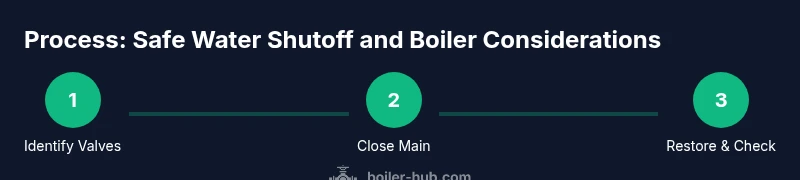
Identify shutoff points
Locate the main cold-water shutoff, the boiler feed valve, and any zone or radiator valves. Take photos or notes to help restore flow correctly after work. Clear identification reduces the risk of misconfiguration during a shutoff.
Tip: Mark valve handles with tape if needed to aid quick identification. - 2
Close the main cold-water shutoff slowly
Turn the main shutoff clockwise to fully close it. Do this slowly to prevent water hammer and pressure surges in the piping. Avoid forcing valves if they resist.
Tip: If the main valve is hard to reach, close the boiler feed valve first to limit immediate water in the boiler loop. - 3
Isolate the boiler feed valve
If your system has a dedicated boiler feed valve, close it after the main shutoff to prevent circulating water into the boiler. This helps keep the boiler loop stable while you work.
Tip: Do not force valves; if it’s stuck, stop and seek professional help to avoid damage. - 4
Power down or isolate the boiler
Electric boilers: switch off at the boiler and at the main electrical panel. Gas boilers: shut the boiler gas valve or switch off at the dedicated control. Do not operate gas shutoffs unless you are trained.
Tip: Confirm there is no ignition source before proceeding with maintenance. - 5
Plan for restoration or draining
If maintenance requires draining, open the boiler drain valve only after isolating the water supply. Repressurize and bleed air when reactivating. After work, reassemble and slowly restore water and power, then check for leaks.
Tip: Test system pressure after restoration and watch for leaks.
Questions & Answers
Do I need to turn off the boiler when turning off the water?
Not usually. For routine shutoffs, you can isolate the water supply without powering down the boiler. Turn off the boiler only if you’re servicing it or if there’s a safety hazard.
Usually you don’t need to turn off the boiler for a normal water shutoff. Only power down if you’re servicing or safety concerns arise.
Which valves should I close first?
Start with the main cold-water shutoff, then close the boiler feed valve if present. This limits water flow and reduces pressure in the boiler loop.
First close the main shutoff, then the boiler feed valve if you have one.
What about backflow and pressure?
Isolating valves reduce risk, but ensure backflow preventers and pressure-reducing valves are intact. Watch for sudden pressure changes and leaks.
Backflow and pressure can be affected; ensure devices are working and monitor for leaks.
What should I do after restoring water?
Turn boiler power back on, repressurize if needed, and bleed air from radiators. Check for leaks and verify system operates normally.
Turn the boiler back on and check pressure and leaks.
When should I call a professional?
If you’re unsure about valve layout, the system is old, or you smell gas, contact a licensed boiler technician.
If unsure or there’s gas safety risk, call a pro.
Is draining the boiler necessary?
Only drain if required by the maintenance task and you know how to do it safely. Otherwise, keep valves isolated and avoid full draining.
Only drain if the task requires it and you know how to do it safely.
Watch Video
Key Points
- Identify your shutoff points before starting.
- Close the main valve slowly; then isolate the boiler if present.
- Only shut off the boiler for service or safety reasons.
- Restore water and power carefully and verify boiler operation.
- Consult a professional for complex system configurations.