Turning Off Your Boiler in Summer: A Practical Guide
Is it OK to turn off your boiler in summer? Learn how to shut down safely, what to check, and how to restart in fall. Boiler Hub provides practical guidance on safety, hot-water planning, frost risk, and seasonal maintenance.


Yes, you can safely turn off a boiler in summer if you won't need heating or hot water for the season. Use the correct shutdown procedure for your boiler type, switch off power at the mains or the boiler isolator, and set controls to summer mode or off. Plan for re-ignition in fall and check safety, frost risk, and service needs.
Is it ok to turn off boiler in summer?
is it ok to turn off boiler in summer? In most homes, yes—so long as you won’t need heating or hot water for the season and you follow safe shutdown steps. The exact approach depends on your boiler type (combination, system, or conventional) and whether you have a separate hot-water cylinder. Boiler Hub guidance emphasizes using the correct controls and not bypassing safety devices to avoid leaks or damage.
Types of boilers and shutdown implications
Boilers come in several configurations, and the shutdown method should align with the design. A combi boiler (which provides hot water on demand) behaves differently from a system or conventional boiler with a separate storage tank. A true combi may not have a large hot-water cylinder to drain, while a system boiler stores heat in a cylinder. Understanding your system helps determine whether a full power-down is best or if a reduced-load summer mode is available. Always consult the manufacturer’s instructions and consider a short-term pause rather than a complete shutdown if you rely heavily on hot water.
Practical considerations before turning off
Before you turn off the boiler, map out your summer hot-water needs and any seasonal comfort expectations. If you have children, elderly residents, or special health considerations, plan for alternative hot-water sources. Frost protection is a key concern in variable climates; even during summer, a cold snap or unseasonable frost can affect plumbing and pumps. Check that circulation pipes are insulated and that any external drainage is clear. Finally, consider whether you want to leave the boiler on a low standby setting to maintain essential functions like central heating circulation or hot water recirculation if your home requires it.
How to perform a safe shutdown (high-level steps)
Follow a safe, step-by-step approach rather than improvising. Start by locating the boiler’s manual and tracing the exact shutdown sequence. Turn off the power at the isolator switch or the main breaker panel, then switch the thermostat to a summer mode or off. If your system heats hot water separately, disable that circuit too. Close any drain valves only if you have explicit instructions to do so, and never tamper with gas lines or safety devices. Document the date and the exact settings for easy restoration in the fall.
Hot water planning during summer
If you rely on domestic hot water (DHW) from a boiler, you’ll want to plan how long the DHW will be available without operation. A storage-tank system may retain heat longer than a combi boiler, but recovery will depend on tank insulation and the ambient temperature. In homes with a continuous demand for hot water, you may prefer leaving the boiler in a low-energy mode rather than a full shutdown. Consider temporary hot-water alternatives if needed, and ensure your piping remains protected from condensation or freezing.
Frost protection and climate considerations
In regions where summer nights can still drop below freezing, frost protection becomes relevant. Do not assume municipal climate will safeguard your pipes—insulation and correct boiler settings matter. If you’re unsure about frost protection, choose a conservative approach: a low heat setting to maintain flow, or a dedicated frost-protection mode if your boiler offers it. A failed frost protection setup can lead to burst pipes and expensive damage.
Restart planning for fall
Plan the restart well in advance of the first cold snaps. Place a reminder in your calendar to test the boiler, purge air from radiators, and check for leaks. Inspect the condensate drain (if applicable), verify thermostat wiring, and confirm the gas supply and venting are unobstructed. A pre-winter service check by a qualified technician helps ensure safe and reliable operation when live demand returns.
Common myths and misconceptions
Myth: Turning off the boiler saves more energy than keeping a low standby mode. Reality: a well-chosen summer setting can save energy while maintaining readiness. Myth: You must drain the system to turn it off. Reality: many shutdowns do not require draining; follow the manual. Myth: Frost risk is irrelevant in warm months. Reality: a sudden cold snap can still threaten pipes if frost protection isn’t configured.
Tools & Materials
- Owner's manual for your boiler(Locate model-specific shutdown procedure and switch positions)
- Power switch or boiler isolation switch(Turn off power to boiler at the switch or fuse box)
- Flathead and Phillips screwdrivers(For removing boiler panel if needed; only if you know what you’re doing)
- Safety gloves(Protect hands during inspection)
- Thermometer or temperature gauge(Check if system has frost risk indicators)
Steps
Estimated time: 30-60 minutes
- 1
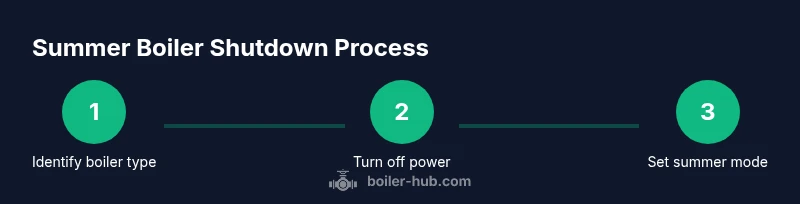
Identify your boiler type
Determine whether you have a combi, system, or conventional boiler. The shutdown approach depends on this classification and whether you have a separate hot-water cylinder. Consult the manual for model-specific steps and safety cautions.
Tip: Take a photo of the control panel before making changes so you can recreate settings later - 2
Shut off power to the boiler safely
Locate the boiler’s isolator switch or switch off at the main service panel. Do not unplug the boiler while it’s hot, and avoid disturbing gas lines. This minimizes electrical and safety risks.
Tip: Wait 5-10 minutes after turning off to allow the system to cool slightly - 3
Set controls to summer mode or off
If your boiler has a dedicated summer mode, switch to it. If not, set the thermostat to a reduced heat target or off where safe. This reduces standby energy use while keeping you prepared for fall.
Tip: Document the setting changes so you can revert accurately in fall - 4
Disable hot-water heating (if separate)
If your system heats domestic hot water independently, disable the hot-water circuit to prevent it from triggering boiler operation. Ensure the hot-water cylinder remains safe and insulated.
Tip: Check that the hot-water cylinder remains at a safe temperature and not leaking - 5
Inspect safety and drainage concerns
Look for signs of leaks, corrosion, or gas line issues. Ensure external drain valves are closed and there’s no moisture around the boiler. Do not attempt repairs beyond your skill level.
Tip: Call a pro if you notice any leakage or unusual odors - 6
Document and plan restart
Note the date and any observed issues. Prepare a restart checklist for fall so re-ignition is smooth. Keep a quick-reference card near the boiler.
Tip: Schedule a service inspection before the first cold snap
Questions & Answers
Is it safe to turn off the boiler in summer?
For most homes, yes, you can turn off the boiler in summer if you won't need heating or hot water. Follow manufacturer guidance and avoid unsafe shortcuts. Re-check safety before restarting.
Yes—it's generally safe to turn off the boiler in summer if you won't need heat or hot water; just follow the restart plan.
Will turning off the boiler affect hot water in summer?
If your hot water is linked to the boiler, you may experience limited hot-water availability. If you have a separate storage tank, it may remain heated for a period. Plan around your hot-water needs.
Hot water may be affected if it's supplied by the boiler; plan accordingly.
What’s the difference between turning off and using a summer mode?
Turning off completely stops boiler operation, while a summer mode reduces activity while keeping readiness. Summer mode minimizes energy use without full shutdown.
Summer mode keeps the boiler ready with lower energy use.
Do I need to drain the boiler or storage tank?
Draining is typically not required for seasonal shutdown to summer mode. Only drain if you have specific maintenance guidance or a leak.
Most setups do not require draining for a summer shutdown.
What about frost risk in cold climates?
In freezing climates, ensure the system remains protected; use frost protection modes or leave the boiler on a low setting to prevent pipe damage.
Frost risk needs protection; check your heating elements.
When should I re-start the boiler in fall?
Plan to restart a few days before you expect heating needs. Test the system, check for leaks, and ensure vents function correctly.
Restart ahead of cold weather and test first.
Watch Video
Key Points
- Turn off power safely when not needed for the season
- Know your boiler type and summer-mode options
- Plan restart in fall and document changes
- Protect against frost risk in transitional weather