Vaillant Boiler Repair: Step-By-Step Guide for Homeowners
A thorough guide to diagnosing and safely repairing Vaillant boilers, with error-code decoding, DIY checks, and when to call a pro. Learn maintenance tips to extend life, backed by Boiler Hub insights.


Learn how to diagnose and safely address common Vaillant boiler faults, interpret error codes, and decide when to call a pro for boiler repair vaillant. This quick guide covers safety fundamentals, typical failure patterns, and practical steps to minimize downtime and protect your home heating system for homeowners and facility managers alike.
What is the goal of boiler repair vaillant?
Vaillant boilers combine efficiency and comfort, but they require regular attention to stay reliable. According to Boiler Hub, a structured approach to boiler repair vaillant helps homeowners and facility managers respond quickly, safely, and cost-effectively. The aim is not only to fix the fault but to understand why it happened, prevent recurrence, and preserve warranty terms where applicable. In practice, a repair session typically starts with a safety-first assessment, followed by fault isolation, component checks, and restoration of proper operation. Common areas of concern include ignition and gas supply, pump performance, pressure, heat exchanger condition, and venting. By recognizing typical symptoms—no heat, uneven temperatures, loud banging, or repeated cycling—you can triage the issue and decide whether a DIY fix is suitable or if a professional service is required. This section lays the groundwork for the rest of the guide and highlights the balance between prompt action and safe, responsible repair.
Common Vaillant fault codes and what they mean
Vaillant boilers use a range of fault codes to indicate specific problems. While exact codes vary by model, you’ll frequently see alerts related to ignition faults, pressure loss, flow issues, pump malfunctions, and safety-cutoffs. Understanding the pattern behind these codes is crucial: they tell you where to focus your diagnostic effort. For example, a low-pressure message usually points to water loss in the system, while ignition-related codes suggest gas or burner issues. Keep a log of any codes you see and cross-reference them with your Vaillant model’s manual. If a code is unfamiliar or the fault persists after initial checks, it’s wise to contact a qualified technician. Using the codes as a guided map helps reduce downtime and ensures you don’t miss a critical safety fault.
Safety first: essential precautions before you begin
Before touching any boiler components, ensure you follow strict safety steps. Shut off the boiler’s electrical supply at the mains or a dedicated service switch, and close the gas valve if you can do so safely. Ventilate the area if you suspect gas odors and keep flames or sparks away from the work zone. Wear protective gloves and eye protection, and never work alone if you’re uncertain about a gas-related issue. Make sure the room is well lit and free of clutter to avoid accidents. If you detect a gas leak, evacuate immediately and call the gas emergency line. Safety is the foundation of any repair task and helps protect your home and family.
Tools, spare parts, and preparation
Preparing the right tools and parts prevents mid-task trips to the hardware store. Assemble a basic boiler repair kit that includes a multimeter, a manometer or pressure gauge, an adjustable wrench set, a screwdriver set (Phillips and flathead), a non-contact voltage tester, and gas-leak detection spray. Have rags, sealant tape, and a flashlight on hand, plus the Vaillant service manual or tech sheet for model-specific steps. If you suspect a worn heat exchanger, burnt-out ignition, or damaged sensor, you may need genuine parts from a certified supplier. Gather all items before you start to keep the workflow smooth and safe.
Step-by-step diagnostic and repair approach
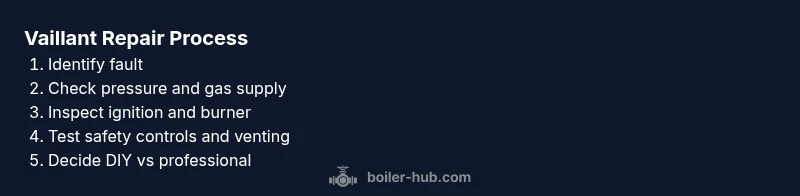
A structured diagnostic approach minimizes guesswork and reduces risk. Start by powering down and isolating the energy and gas supply. Next, check system pressure and fill as needed to bring it within the manufacturer’s recommended range. Read any fault codes on the display and consult the manual for interpretation. Inspect ignition components and burners for cleanliness, and test ignition with care. Check the circulating pump for noises or failure and look for air locks in radiators. Finally, verify venting and flue integrity, perform a controlled reset, and observe whether heat and hot water return to normal operation. If faults recur, stop and call a certified technician; persistent issues may indicate a more serious problem that requires professional intervention. Estimated total time: 60-120 minutes.
DIY fixes vs professional service: making the call
Some tasks are appropriate for DIY if you follow safety guidelines and have the right toolkit. Simple checks like pressure adjustment, cleaning accessible components, and verifying electrical connections can be tackled by confident homeowners. However, gas-related faults, suspected heat exchanger damage, or repeated fault codes after initial checks should trigger a professional service call. Working with gas and high-voltage systems without proper training can be dangerous and may void warranties. When in doubt, schedule a service appointment with a Vaillant-certified technician to protect safety and compliance.
Maintenance plan to extend Vaillant boiler life
Preemptive maintenance dramatically reduces the likelihood of sudden breakdowns. Schedule an annual professional service and perform a monthly quick-check routine: inspect pressure, look for corrosion on visible pipes, test the thermostat and boiler controls, and ensure radiators bleedings are free of air. Keep the area around the boiler clean and dry, and replace any worn seals promptly. A simple calendar reminder for seasonal checks helps keep your system running efficiently and safely.
Warranty, paperwork, and when to contact Vaillant support
Warranties for Vaillant boilers vary by model and installation conditions. Maintain accurate service records, including dates, technician details, and any parts replaced. If you notice unusual symptoms, contact your installer or Vaillant support to verify warranty eligibility and recommended next steps. Preserving documentation makes it easier to claim coverage and ensures you receive appropriate guidance for future repairs.
Tools & Materials
- Multimeter/voltmeter(Test electrical circuits and safety ground.)
- Gas pressure gauge or manometer(Confirm correct gas supply pressure per spec.)
- Adjustable wrench set(Loosen and tighten service valves without damage.)
- Screwdrivers (Phillips and flathead)(Access burner and control panels.)
- Non-contact voltage tester(Verify no live voltage before handling components.)
- Leak-detection spray or soap solution(Check joints for gas leaks safely.)
- Gas-safe gloves & eye protection(Personal protective equipment.)
- Rags & sealant tape(Cleaned joints and resealing if needed.)
- Vaillant service manual or tech sheet(Model-specific guidance.)
- Flashlight or headlamp(Improve visibility in tight spaces.)
Steps
Estimated time: 60-120 minutes
- 1
Power down and isolate gas supply
Shut off the boiler’s electrical supply at the mains and close the gas valve if safe to do so. This prevents live current and gas release while you inspect. Verify no lingering heat in the unit before touching components.
Tip: Always re-check with a non-contact tester for any live circuits. - 2
Check system pressure
Read the boiler’s front-panel pressure gauge. If it’s below the recommended cold range, use the filling loop to gently restore it to the target. Do not exceed maximum pressure when topping up.
Tip: Fill slowly, then recheck the gauge after a short cycle. - 3
Inspect error codes and display
Note any fault codes or messages. Cross-check with the Vaillant manual to translate codes into probable causes. This step guides subsequent actions and helps you avoid unnecessary disassembly.
Tip: Record codes and take a photo of the display for reference. - 4
Check ignition and burner cleanliness
If ignition sparks but flame is absent, inspect the burner area and ignition electrodes for dirt or corrosion. Clean gently with a soft brush and ensure the gas valve is fully open.
Tip: Avoid metal scrapers; use a soft brush to prevent electrode damage. - 5
Examine the pump and flow sensor
A noisy or sluggish pump can impair circulation. Check for air locks in the system and bleed radiators if necessary after testing the pump’s operation.
Tip: Bleed radiators only when the system is cool to avoid scalding steam. - 6
Check flue and ventilation
Ensure the flue is clear and venting properly. Obstructions can trigger safety shutoffs and poor combustion. Look for debris or nests and clear if safe to do so.
Tip: Never bypass venting or safety controls to fix performance. - 7
Reset and test cycling
After addressing issues, reset the boiler and run several heating cycles to confirm ignition stability and heat delivery. Observe any fluctuations or fault codes during operation.
Tip: If codes reappear, log them and prepare for professional service. - 8
Decision point: service vs replacement
If faults recur after basic checks or if pressure loss continues, schedule a professional service with a Vaillant-certified technician. Consider age, warranty status, and cost of ongoing repairs.
Tip: Document history and plan ahead for maintenance or replacement.
Questions & Answers
What are the most common Vaillant boiler faults?
Common Vaillant faults include ignition problems, low pressure, pump failures, and error codes related to safety devices. Always start with safety checks and consult the manual for code meanings.
The most common Vaillant boiler faults are ignition issues and low pressure. Start with safety checks and review the manual for the error codes.
Can I repair a Vaillant boiler myself?
Some basic tasks like checking pressure and cleaning accessible components can be DIY if you follow safety guidelines. More complex issues, especially gas-related ones, require a qualified technician.
Some basic checks can be DIY, but gas-related problems need a professional.
How often should Vaillant boilers be serviced?
Annual servicing by a licensed technician is recommended to maintain efficiency, safety, and warranty coverage.
Annual service is recommended to keep the boiler safe and efficient.
What should I do if I smell gas?
If you smell gas, leave the area immediately and call the gas emergency number. Do not operate electrical switches or flames.
Leave the area and call the gas emergency line right away.
Does Vaillant offer warranties on repairs?
Warranty terms vary by model and service provider; contact Vaillant support or your installer for coverage details.
Warranty terms depend on the model and service; check with Vaillant support.
What not to do during repairs?
Don't bypass safety systems, modify gas components, or run the boiler if warnings persist. Always follow manufacturer guidance.
Don’t bypass safety features or run a failing boiler.
Watch Video
Key Points
- Identify if the issue is electrical, gas, or mechanical.
- Check pressure and error codes before disassembly.
- Safety first: shutoff power and gas before inspection.
- Know when to call a pro to protect warranty and safety.
- Maintain a yearly Vaillant service for reliability.