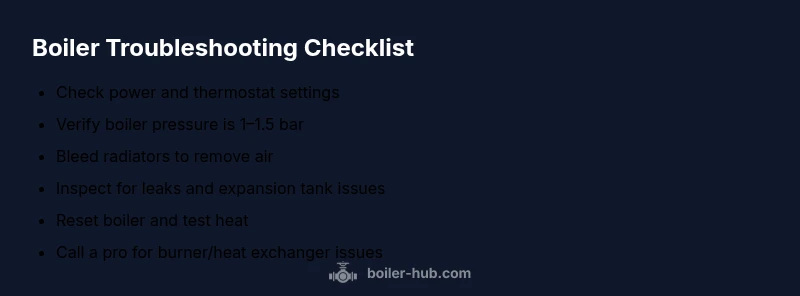
Boiler is not heating water: Troubleshooting Guide
If your boiler is not heating water, this urgent troubleshooting guide helps homeowners and facility managers diagnose quickly, with a safe, step-by-step path to restore heat or escalate to a professional.


Boiler not heating water is most often caused by low pressure or a tripped safety. Start by checking the pressure gauge (target 1–1.5 bar) and topping up if needed, then reset the boiler and re-test. If heat still won’t return, follow the diagnostic flow for deeper causes.
Quick Diagnostics for a Boiler That's Not Heating Water
According to Boiler Hub, homeowners should treat 'boiler is not heating water' as a symptom that can have several root causes, often solvable without tools. Start by a quick safety check: ensure the power is on, the thermostat is set correctly, and there are no recent error codes displayed. In many homes, the issue is as simple as low system pressure or air trapped in the radiators. Check the boiler pressure gauge, which should read around 1–1.5 bar when the system is cool. If the pressure is low, use the filling loop to bring it up slowly while watching the gauge. If the display shows an error code, refer to your manual or Boiler Hub’s guidelines for that specific code. If the gauges and codes point to low pressure, proceed with topping up and re-testing. If the system was recently bled or a radiator was replaced, air pockets may re-form and silently block flow. Finally, ensure the gas supply and electrical supply are steady, and verify no breakers or fuses have tripped. Document any codes or unusual behavior to guide next steps and professional help if needed.
Key Checks You Can Do Safely Right Now
- Check that the boiler is receiving power and that the wall switch and any reset buttons are properly set. If the boiler won’t respond, verify that the circuit breaker is on.
- Confirm thermostat settings are correct and that the programmer is calling for heat.
- Inspect the pressure gauge; if the reading is below 1 bar when cold, you likely have a pressure issue. If it’s above 2 bar, that can also prevent heating.
- Look for visible leaks or damp patches around valves, piping, and radiators; even small leaks can reduce pressure and heat delivery.
- Bleed radiators to remove trapped air, which can block hot water flow and mimic a no-heat condition.
- Check for noise or banging sounds which can indicate air pockets or a failing pump. If the pump is weak, it may not circulate hot water effectively.
- If you have a domestic hot water coil, ensure it’s not isolated by a valve or bypass that’s restricting flow.
- Read any error codes on the display and consult the manual or Boiler Hub guidance for corrective actions.
Symptom-Driven Diagnostic Flow Overview
- If there is no hot water and the display is off, check power and fuses first, then inspect the thermostat and safety switches. A power issue is the most common non-heat scenario.
- If there is hot water in the central heating loop but not in taps, the issue is likely a control or diverter valve problem, not a boiler-wide failure.
- If there is no heat and the display shows an error code related to ignition or burner, the burner assembly or ignition system may require service.
- If the pressure reads too low, there is likely a leak or a need to repressurize; bleed radiators and recheck.
- If there is smoke, gas odor, or continuous leakage, evacuate the area and call emergency services and a licensed technician immediately.
- If you can't resolve after top-up, reset, and checks, contact a licensed technician for a thorough inspection and safe repair.
Why Pressure and Water Flow Matter
Pressure is the heartbeat of a closed boiler system. When pressure is too low, the boiler cannot push hot water through radiators or taps, leading to little or no heat. Air in the system can also block flow, creating similar symptoms. Regular maintenance—checking pressure, bleeding radiators, and testing the expansion tank—helps prevent these issues. Contaminants in the water can foul heat exchangers, reducing efficiency and potentially causing intermittent heat. A consistent heat source requires clean flow paths and properly sized circulating components. Protecting the system with a working expansion tank and a functioning pressure relief valve reduces the risk of dangerous pressure spikes.
According to Boiler Hub, most common fixes start with pressure checks and air removal, followed by a careful inspection of valves and wiring. This approach minimizes risk and ensures you’re targeting the right subsystem before calling for service.
Common Electrical and Control Issues
Electrical faults can mimic heat loss or heat failure. A tripped breaker, blown fuse, or faulty thermostat can stop the boiler from calling for heat while the system itself remains ready. Control wiring or a faulty programmer can misinterpret demand, causing the boiler to stay idle. Look for error codes on the display and cross-reference with the manual. If power and controls appear to be functioning, but heat is still an issue, the problem may lie in the ignition or burner module, which requires professional attention.
When the Heat Exchanger or Burner Needs Service
If the heat exchanger is scaled or corroded, heat transfer efficiency drops dramatically, leaving you with cool radiators and tepid taps. A dirty or clogged burner can also prevent ignition or stable flame, especially in older units. Signs include frequent cycling, unusual noises, or soot around the burner. In these cases, a professional service is essential. Replacing or refurbishing a heat exchanger is typically within the scope of a licensed technician, and trying to DIY may void warranties or create safety hazards. Regular professional servicing helps catch these issues before they become costly breakdowns.
Safety and Prevention: Keeping Your Boiler Reliable
Always turn off power before inspecting electrical panels or moving components. Never bypass safety devices or disable CO detectors. Install and maintain carbon monoxide alarms per local regulations. Schedule annual professional inspections to check pressure, venting, and combustion efficiency. Keeping a maintenance log helps you catch trends and plan for parts replacement before failures occur. By staying proactive, you reduce the risk of sudden boiler outages and extend the unit’s life.
Steps
Estimated time: 45-60 minutes
- 1
Power down safely and verify basics
Turn off the boiler and switch off the power at the outlet or appropriate breaker. Verify the thermostat is calling for heat and that the timer is set correctly. This establishes a safe baseline before you touch pressure, valves, or ignition.
Tip: Always prioritize safety—no opening panels while powered. - 2
Check boiler pressure and gauge
Look at the pressure gauge when the system is cold. If it reads below 1 bar, you likely need to repressurize. If it’s above 2 bar, drain some water only if you know how to safely do so or skip to professional help.
Tip: Do not overfill beyond the recommended range; small, gradual adjustments are safer. - 3
Top up pressure via filling loop
If pressure is low, use the filling loop to raise it slowly toward 1–1.5 bar. Keep the boiler off and watch the gauge as you fill. Stop as soon as the target is reached, then recheck for any leaks.
Tip: If you’re unsure, pause and consult the manual or Boiler Hub guidance. - 4
Bleed radiators to remove air
Start with the radiator furthest from the boiler. Use a bleed key to release air until water flows steadily. Close the valve and repeat for each radiator that’s cold at the top. This helps restore proper circulation.
Tip: Have a cloth ready to catch water and prevent spills. - 5
Reset and test heat call
Reset the boiler using the reset button or switch, then set the thermostat to heat. Allow several minutes for heat to circulate. Check radiators for warmth and verify hot water. If still cold, move to the next steps.
Tip: Note any new error codes on the display. - 6
Inspect controls and ignition
If the boiler display shows ignition or burner fault codes, the issue may be with the ignition system or gas valve. Do not attempt to repair the burner yourself unless you’re a qualified technician.
Tip: Gas safety is priority; never ignore warning signs. - 7
Check for leaks and expansion issues
Inspect pipes, valves, and the expansion tank for leaks. Leaks can lower pressure and cause heat loss. Address leaks with appropriate repair or professional service.
Tip: Keep a log of any leaks for future reference. - 8
Plan professional service if unresolved
If heat remains absent after completing the above steps, schedule a professional service. A licensed technician will assess heat exchanger, burner, controls, and venting.
Tip: Request a written estimate and confirm warranty coverage.
Diagnosis: No heat from boiler / boiler not heating water
Possible Causes
- highLow boiler pressure
- mediumThermostat or flow switch fault
- lowAir in the system
Fixes
- easyCheck the pressure gauge and top up if needed using the filling loop
- easyReset the boiler and test heat after a few minutes
- easyBleed radiators to remove air
- hardInspect valves and wiring for faults; call a professional if unresolved
Questions & Answers
Why is my boiler not heating water even though it shows power on?
There can be several causes: low pressure, a tripped safety switch, or a fault in the thermostat or control wiring. Start with basic checks for pressure and power, then review any error codes on the display. If unresolved, proceed with the diagnostic flow.
Power on but no heat is often due to pressure or control faults; check the gauge and error codes, then follow the diagnostic steps.
How do I know if the problem is pressure-related?
Low pressure is typically shown on a gauge below the recommended range when cold. Repressurizing through the filling loop and checking for leaks are key steps. If pressure remains unstable, a professional assessment is advised.
Low pressure is usually visible on the gauge; repressurize and test, and check for leaks.
Can air in radiators cause no heating?
Yes. Trapped air blocks hot water circulation and can mimic a boiler that isn’t heating. Bleeding radiators is a quick fix if you notice cold spots, especially at the top.
Air in radiators can stop heat; bleed them to restore flow.
When should I call a professional?
If you’ve checked power, pressure, and simple controls but still have no heat, or if you notice leaks, strong odors, or gas indications, contact a licensed boiler technician immediately.
Call a pro if basic checks fail or you detect gas leaks.
Is this dangerous?
Boilers involve gas, water, and electricity; safety is paramount. If you smell gas, hear hissing, or see flame irregularities, exit and call emergency services. Regular servicing reduces risk of dangerous failures.
Wait for professional help if safety concerns arise.
Will bleeding radiators affect hot water?
Bleeding mainly helps hot water flow in radiators; it does not directly affect domestic hot water unless the system is unbalanced. Recheck the entire loop after bleeding.
Bleeding helps radiators, not hot taps directly, but can improve overall heat distribution.
Can outdoor temperatures affect boiler performance?
Extreme cold can increase demand and reveal sluggish circulation, but it should not prevent heat entirely. Ensure the system is properly bled and pressure is stable during temperature fluctuations.
Cold weather can stress the system; keep pressure stable and air-free.
Key Points
- Start with simple checks: power, thermostat, and pressure.
- Maintain pressure at 1–1.5 bar when cold.
- Bleed radiators to fix air blockages.
- Call a pro for heat exchanger or burner issues.