How to Use Boiler Stop Leak: A Practical Guide
Learn how to safely use boiler stop leak, choose the right product, apply it correctly, and monitor your boiler afterward. This step-by-step guide from Boiler Hub helps homeowners and facility managers protect boilers with temporary fixes and informed next steps.


You can safely use boiler stop leak to slow small leaks and buy time for a professional repair. This guide covers how to select a compatible product, prepare the system, apply the sealant correctly, and monitor the boiler afterward. Follow all safety precautions and consult your boiler manual for limits.
Understanding what boiler stop leak does and when to consider it
According to Boiler Hub, boiler stop leak products are typically temporary fixes intended to slow or seal small leaks while a professional repair is arranged. These products work by forming a seal as the circulating water carries the sealing agent to the leak site. Based on Boiler Hub Analysis, 2026, many homeowners use stop-leak as a quick, interim measure rather than a replacement for proper repairs. The main idea is to reduce water loss and stabilize boiler pressure long enough to schedule service or obtain replacement parts. Before deciding to use a stop-leak, homeowners should understand that effectiveness varies with leak type, boiler material, and water chemistry. This means you should treat stop-leak as a stop-gap rather than a cure, and always plan a professional inspection afterward to confirm the leak source and the integrity of gaskets, seals, and heat exchangers.
In addition, consider your boiler’s warranty and the product label. Some manufacturers advise against using additives that could void warranties or interact negatively with corrosion protection. If you’re ever unsure, contact a qualified technician for an assessment. The goal of this section is to give you the right mindset: use stop-leak only to slow a leak while you arrange a proper repair, not as a long-term solution. The Boiler Hub team emphasizes safety and scheduled maintenance as essential components of boiler reliability.
Before you apply a stop-leak
Before applying any stop-leak product, take a systematic approach to protect the boiler and yourself. First, turn off the boiler and allow it to cool completely to avoid burns or scalding. Locate the approximate leak source and verify you’re not dealing with a catastrophic failure, such as a ruptured pipe or cracked heat exchanger. Read the product label to ensure compatibility with your boiler type (cast iron, steel, or aluminum components) and check for any contraindications, especially if your system uses inhibitors or corrosion protection. Ensure you have access to the drain valve or service ports and have a plan for depressurizing the system safely. Keep children and pets away from the work area. Finally, assemble your tools and PPE so you can work cleanly and efficiently. These precautions help minimize risk and protect both the boiler and your home.
Types of stop-leak products and how to choose
Stop-leak products come in several forms, including liquid concentrates, pellets or powders, and solid bars. Liquid formulas are common for quick, controlled dosing; pellet or powder forms can be easier to measure and store but may require a larger volume to reach the leak site. Solid bars are less common but can be effective for some valve seals. The right choice depends on your boiler material, the leak type (gasket, joint, or pinhole), and the water chemistry (pH, hardness, and inhibitor status). Always verify compatibility with your boiler manual and any existing corrosion inhibitors. For safety and performance, prefer products with clear dosage instructions and documented compatibility with common boiler metals. This section helps you select a formula that matches the leak, not one that simply patches symptoms. Remember, a poor choice can worsen corrosion or clog heat exchangers, leading to bigger problems down the line.
Safety considerations and compatibility with boiler materials
Safety is a core part of using stop-leak products. Many boilers rely on seals and gaskets made from rubber, nylon, or composite materials that can react to certain additives. If you’re unsure about compatibility with brass, copper, steel, or aluminum components, consult the boiler manufacturer’s guidelines before applying any product. The aim is to minimize risk of clogs, deposits, or chemical reactions that could impair heat transfer. Use PPE—gloves, eye protection, and a mask as appropriate—and ensure the area is well-ventilated. If you notice unusual sounds, pressure changes, or corrosion after applying stop-leak, shut the boiler down and seek professional advice. This step reduces the chance of accidental damage and ensures you’re following best practices for boiler maintenance.
In this section, you’ll also learn why some manufacturers discourage additive use in favor of mechanical repairs. The key takeaway is to protect the boiler’s integrity while planning a safe repair path. The information here aligns with boiler-maintenance best practices and is consistent with guidance from Boiler Hub.
How to prepare the boiler and area for application
Preparation matters as much as the application itself. Start by turning off the boiler and letting it cool, then gather your tools and PPE. Place a tray or bucket under the area where you'll introduce the product to catch drips and keep the workspace clean. If your system has a drain valve or service port, prepare to access it with a suitable wrench or pliers, following the manufacturer’s instructions. Inspect the area for loose joints, signs of corrosion, or visible cracks that may require attention beyond stop-leak. Ventilation is important if you’ll be working near gas appliances. Finally, verify the system’s water pressure and level so you can re-pressurize it correctly after the application. A careful setup reduces the risk of accidental spills and ensures the product reaches the leak site effectively.
Step-by-step application overview (condensed guidance)
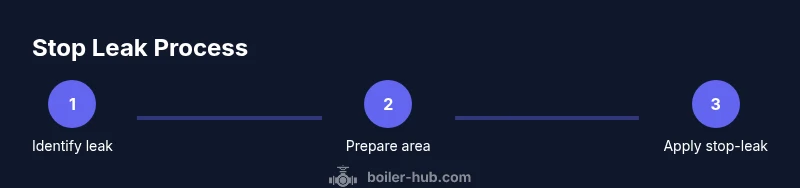
This section outlines a high-level sequence you’ll implement in the dedicated Step-By-Step block. You’ll assess the leak, prepare the area, choose the right product, and then perform the application with controlled dosing. After applying the product, you’ll refill the system, re-pressurize, and monitor for changes. The goal is a safe, measured approach that minimizes stress on the boiler while yielding enough seal to guide a professional repair. Always follow product instructions and keep a log of readings and observations for later review by a technician.
Post-application checks and monitoring
After applying stop-leak, monitor the boiler for changes in pressure, temperature, and water level. Refill and bleed the system as needed, ensuring air pockets are removed from radiators or supply lines. Check the gauge regularly for stability at the operating range. Look for reduced or stopped leaks during the first 24–48 hours; if you still observe drips or increased pressure, stop using the boiler and contact a professional. Document any symptoms such as white deposits, unusual odors, or changes in water clarity, as these can indicate deeper system issues. Keeping a detailed log helps a technician diagnose and address the root cause efficiently.
In addition, do not assume that a temporary seal means the problem is resolved. It is a signal to pursue a proper repair, not to continue operating indefinitely. The Boiler Hub team emphasizes that stop-leak is not a substitute for professional inspection and repair.
When stop-leak isn't appropriate and what to do instead
There are clear scenarios where stop-leak should not be used, such as large or rapidly growing leaks, visible cracks in the boiler shell or heat exchanger, or evidence of coolant mixing with water. If you observe pressure spikes, persistent leaks after a reasonable waiting period, or signs of boiler malfunction, stop operating the system and contact a licensed technician. In many cases, the safest route is to perform a controlled shutdown and arrange for a professional assessment, which may involve pressure testing, component replacement, or, in severe cases, boiler replacement. This content helps you differentiate temporary fixes from urgent, professional interventions that protect building safety and equipment.
Safety, warnings, and best practices
Always treat stop-leak products with caution and follow the label exactly. Do not mix products or supplement with incompatible chemicals. Use proper PPE and ensure the area is well-ventilated. Maintain a written log of leak observations, pressure readings, and dates of service. Schedule a professional inspection after any stop-leak use to verify the leak’s source and ensure long-term boiler reliability. This final section reinforces best practices and emphasizes the role of professional guidance in maintaining safe, efficient heating systems.
Realistic expectations and next steps
Stop-leak products can slow or halt small leaks, providing time to arrange professional repairs or component replacements. They are not guaranteed to fix every type of leak, particularly if the leak originates from a broken heat exchanger or a large gasket failure. After applying stop-leak, expect to monitor the system for changes and plan a follow-up service. The long-term solution typically involves repair or replacement of faulty seals, gaskets, or heat exchangers by a qualified technician. By setting realistic expectations, homeowners and facility managers can protect occupants, minimize water damage, and maintain boiler performance without delaying essential professional care.
Tools & Materials
- Boiler stop-leak product(Choose a formula compatible with your boiler type and water chemistry; read label for dosage)
- Personal protective equipment (gloves and eye protection)(Nitrile gloves and safety glasses recommended)
- Bucket or tray(To collect drips and protect the area)
- Wrench or pliers(For accessing drain valves or service ports)
- Towel or rag(For quick clean-up and to wipe spills)
- Boiler manual / model documentation(Always check compatibility and procedure specific to your boiler)
- Flashlight(Helpful for inspecting joints and ports)
- Distilled water (optional)(For top-offs if needed during repressurization)
Steps
Estimated time: 60-90 minutes
- 1
Turn off boiler and let it cool
Power down the boiler and wait until it is cool to the touch. This reduces burn risk and makes depressurization safer. If you smell gas or notice unsafe conditions, evacuate and call a professional.
Tip: Do not work on a hot boiler; small amounts of steam can cause severe burns. - 2
Locate leak source and isolate area
Identify where the water is escaping and determine whether it’s from a valve, gasket, or joint. Isolate the affected section if possible to prevent further leakage during the procedure.
Tip: Use a flashlight to inspect tight corners; moisture and mineral deposits can obscure leaks. - 3
Depressurize and drain a small amount
Carefully depressurize the system per the boiler manual and drain a small amount of water to create space for the stop-leak product. Do not drain the entire system unless required by the procedure.
Tip: Place the tray to catch water and wear PPE to avoid splashes. - 4
Read product label and prepare the mixture
Read the label for exact dosage and compatibility. Gather the required tools and have the stop-leak product ready for injection through the designated port or feeder.
Tip: Never improvise dosages; incorrect amounts can cause deposits or blockages. - 5
Inject stop-leak through the correct port
Attach the applicator as instructed and slowly inject the recommended amount. Ensure the product can circulate before closing the valve or port.
Tip: Do not rush the injection; slow, steady flow yields better distribution. - 6
Repressurize and refill system
Close all valves, refill the boiler to its operating pressure, and re-bleed any trapped air from radiators or lines as needed.
Tip: Check the pressure gauge and ensure it sits within the manufacturer's recommended range. - 7
Run the boiler to circulate product
Let the boiler operate for a short period to circulate the stop-leak product. Avoid extended runs if you detect unusual behavior or rising pressure.
Tip: Listen for new noises and watch for sudden pressure changes. - 8
Inspect for leaks and document results
Check the leak area after the run and observe for reduced or eliminated drips. Record pressure, temperature, and any changes for follow-up with a technician.
Tip: If no improvement within 24–48 hours, stop using the boiler and seek professional help. - 9
Schedule professional inspection
Even if the leak seems sealed, arrange a service call to identify the root cause and prevent future failures. A pro can assess gasket integrity, heat exchanger condition, and overall system health.
Tip: Treat stop-leak as a temporary measure and plan a repair timeline.
Questions & Answers
Is boiler stop leak a permanent fix?
No. Stop-leak products are typically temporary and intended to slow leaks while arranging professional repair. They do not replace mechanical fixes like gasket or heat exchanger replacement.
No, stop-leak is usually temporary and not a substitute for proper repairs.
Can I use boiler stop leak on a hot boiler?
No. Wait for the boiler to cool before applying any product. Working on a hot system can cause burns and may alter the product’s effectiveness.
No—let the boiler cool before applying any stop-leak.
Should I flush the system before applying stop-leak?
Flushing is not always required, but it can help remove debris and improve product distribution. Check the product label and your boiler manual for guidance.
Flushing may help; follow the product label and manual.
What if the leak persists after applying stop-leak?
If the leak continues after application, stop using the boiler and contact a licensed technician. A persistent leak may indicate a larger issue that needs professional repair.
If it persists, stop and call a technician.
Are stop-leak products safe for safety and warranties?
Additives can affect warranties and safety if used improperly. Always follow the manufacturer’s guidelines and consult a technician if your boiler is under warranty.
Follow the maker’s guidelines and check warranty terms.
Can stop-leak damage the boiler’s seals or heat exchanger?
Improper use or incompatible products can cause deposits or chemical reactions. Choose a product that matches your boiler material and follow dosage instructions carefully.
Improper use can cause damage; use the right product and dosage.
Do I need a professional to install stop-leak?
Not always, but many situations benefit from professional assessment to avoid harmful deposits or voiding warranties. A technician can confirm root causes and advise on next steps.
A pro can confirm root causes and guide repairs.
Watch Video
Key Points
- Assess leak type and compatibility before use
- Select a compatible stop-leak product
- Follow steps precisely and monitor pressure
- Stop-leak is temporary; plan professional inspection
- If the leak persists, contact a qualified technician