Urgent Troubleshooting for a Boiler That Smells Like Gas
Urgent, practical guide for what to do when your boiler smells like gas. Safety-first steps, common causes, professional testing, and prevention tips from Boiler Hub.


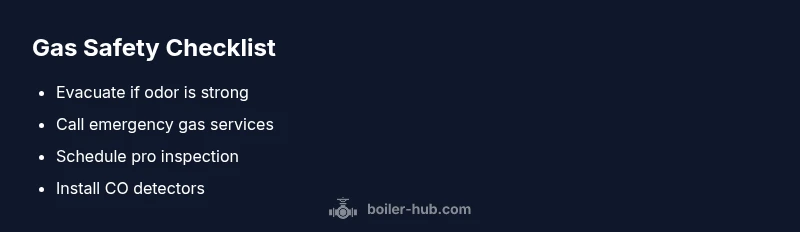
If your boiler smells like gas, the most likely cause is a gas leak or unburned fuel from the burner, which requires immediate action. Do not light switches or use phones in the area; open doors/windows to ventilate if safe and evacuate if odor intensifies. Call your gas supplier or emergency services, then schedule a professional inspection.
What the phrase 'boiler smells like gas' signals
Boiler smells like gas signals a potential combustion fault or fuel leak around the heating system. In homes, the odor often comes from natural gas or propane that hasn’t fully combusted, or from traces escaping through a joint. The smell is typically sulfurous or resembles rotten eggs, and it can be accompanied by a hiss or whistle at fittings. According to Boiler Hub, any strong gas odor around a boiler should be treated as an emergency. Gas is highly flammable and can accumulate in enclosed spaces, raising the risk of fire or carbon monoxide buildup. Even if nearby appliances seem fine, a localized odor around the boiler can indicate a leak or venting fault. Do not rely on your senses alone—install CO detectors and ensure adequate ventilation. If the odor is persistent or strong, evacuate and call the gas utility or emergency services immediately. This is a safety-critical issue that requires prompt professional assessment to protect occupants.
Immediate safety actions you should take
If you detect a gas smell near your boiler, move to fresh air and avoid creating sparks. Do not operate switches, lights, or phones in the area. If the odor is strong, leave the building and call emergency gas services or your gas supplier from a safe location. If you know how to locate and safely use a shut-off valve, you may shut off the gas at the meter, but only if it is clearly safe to do so. Do not attempt complex repairs yourself. After evacuating, alert others in the building and wait for professionals to arrive. Boiler safety is non-negotiable, and early action can prevent dangerous outcomes.
Common causes of a gas smell in a boiler
Gas odors around a boiler can stem from several issues. A gas leak in the supply line or fittings is a primary concern, requiring immediate professional intervention. A malfunctioning pilot light or burner can also emit unburned fuel, especially on older boilers. Venting or flue obstructions may cause combustion byproducts to accumulate, producing a noticeable odor. Residual solvents or cleaners used near the boiler can create volatile smells that mimic gas, though they should not be present near the combustion chamber. Finally, corroded components or loose connections can leak gas into living spaces. If you recognize any of these conditions, contact a licensed technician right away.
How professionals test for gas leaks and carbon monoxide (CO)
Licensed technicians use multiple methods to detect gas leaks and CO. They may perform electronic gas-detection scans, perform pressure or leak tests on joints, and conduct a combustion analysis to verify proper burner operation. CO detectors positioned in hallways and near sleeping areas are essential, and many technicians will test CO levels during a service. Do not rely on a single observation—professional testing provides objective evidence and helps identify hidden leaks or venting faults. Regular maintenance by a qualified pro reduces the risk of gas odors and CO exposure.
Safe troubleshooting steps you can perform (before calling a pro)
Safety first: do not attempt repairs on gas lines yourself. Check that the gas supply to the boiler is on, and inspect accessible connections for obvious signs of damage or loose fittings. If you can safely access the area, look for hissing sounds or a visible gas leak with soapy water bubbles at joints (do not use flames to test). Ensure adequate ventilation by opening doors and windows. Do not operate the boiler until it’s inspected. If you have a CO detector and it alarms, evacuate and call emergency services immediately. Keep records of what you observe to share with the technician.
When to call a pro and what to expect
Call a licensed gas fitter or boiler technician as soon as you notice a gas smell. Expect a thorough inspection of gas lines, burner, heat exchanger, flue, and safety devices. They may perform leak tests, CO measurements, and a combustion analysis. The service may require parts replacement or venting repairs, and you should receive an itemized quote. If any hazard is confirmed, utilities or emergency responders may shut off gas to protect occupants.
Prevention tips to avoid future gas smells
Preventive maintenance is essential. Schedule annual boiler servicing by a qualified technician. Install and maintain CO detectors in living areas and near sleeping spaces. Ensure proper ventilation around the boiler and keep flammable materials away. Learn where the shut-off valve is and how to use it safely in an emergency. Finally, keep a log of maintenance and any unusual odors to help technicians diagnose issues quickly in the future.
Steps
Estimated time: 0-2 hours
- 1
Ensure safety and evacuate if the odor is strong
Move to fresh air immediately. Do not operate switches or use any flame near the boiler. If the odor is overpowering, evacuate the building and call emergency services from outside. Keep others away until responders arrive.
Tip: If you can identify a clear escape path, guide household members to safety without delaying calling for help. - 2
If safe, locate and shut off the gas supply
Only attempt this if you know the valve location and can operate it without risk. Turn the valve to the perpendicular position to stop fuel flow to the boiler. Do not touch other gas lines or electrical components.
Tip: Never try to seal a leak with tape or DIY fixes—let a licensed pro handle it. - 3
Ventilate the area and avoid re-entry
Open doors and windows to improve air exchange. Keep doors open to prevent gas buildup and stay outside until professionals confirm it is safe to re-enter.
Tip: Monitor for lingering odor after ventilation; persistent smell requires immediate professional evaluation. - 4
Call a licensed gas technician for a full inspection
Contact a local gas fitter or boiler technician to assess gas lines, burner operation, venting, and CO risk. Schedule promptly and provide any observations you noted.
Tip: Share details like recent service, model, and any abnormal burner behavior observed. - 5
Do not re-ignite or operate the boiler until cleared
Do not switch the boiler back on until a professional certifies it safe. A faulty ignition or venting issue must be corrected before reuse.
Tip: Keep children and pets away from the area during the evaluation. - 6
Document findings and plan maintenance
Record the technician’s findings, parts replaced, and recommended maintenance schedule. Arrange annual service and CO detector checks moving forward.
Tip: Create a maintenance calendar to prevent future incidents.
Diagnosis: Boiler smells like gas
Possible Causes
- highGas leak in supply line or fittings
- mediumUnburned fuel from a faulty burner or pilot
- lowVentilation or flue blockage causing gas byproducts
Fixes
- easyEvacuate area if odor is strong, call emergency gas services or your gas supplier, and do not operate electrical switches or flames
- easyIf safe, shut off gas at the meter/appliance and contact a licensed gas technician for a full inspection
- hardSchedule a comprehensive service, leak repair, burner adjustment, or venting repair as recommended by the technician
Questions & Answers
What should I do first if my boiler smells like gas?
First, prioritize safety: evacuate the area if the odor is strong, avoid any flames or electronics, and call emergency gas services or your supplier. If you can do so safely, open windows to ventilate.
First, evacuate and call emergency gas services. If safe, open a window to ventilate and wait for responders.
Is a gas smell always a leak?
Not always, but a gas odor around a boiler is a serious alert. It could be a leak, a faulty burner, or venting issues. A professional should assess to confirm the exact cause.
It’s a serious alert that could be a leak or a burner issue. A pro should assess to confirm.
Can I troubleshoot a gas smell myself?
For safety, avoid attempting repairs on gas lines or ignition. You can perform safe checks like ensuring the area is ventilated and the gas supply looks intact, but call a licensed tech for repair.
Do not repair gas lines yourself; ventilate and call a licensed technician.
What is the role of carbon monoxide detectors?
CO detectors alert you to potentially lethal gas byproducts. Place them on each living level and near sleeping areas, test them monthly, and replace batteries as needed.
CO detectors warn you of dangerous byproducts; test and maintain them regularly.
How long does it take to fix a gas smell issue?
Time varies by cause and extent of the issue. A simple leak repair may be quick, while venting and burner replacements can take longer. The technician will give an estimate before work begins.
It varies; the pro will estimate time after evaluation.
When should I replace my boiler due to odor issues?
Odor issues alone don’t always mean replacement. If a boiler is old, repeatedly fails safety tests, or is inefficient, replacement may be the safer long-term option after expert evaluation.
Replacement may be best if safety is compromised or efficiency is poor after a professional review.
Watch Video
Key Points
- Evacuate if strong gas odor is present immediately.
- Call emergency services and a licensed gas technician.
- Never DIY leak repairs or ignition—leave it to pros.
- Install CO detectors and schedule annual boiler maintenance.
- Document findings for future safety and service.