What Size Boiler for 1200 Sq Ft: A Practical Sizing Guide (2026)
Learn how to size a boiler for a 1,200 sq ft home, considering climate, insulation, and heat loss. Practical ranges and step-by-step guidance from Boiler Hub for accurate results.


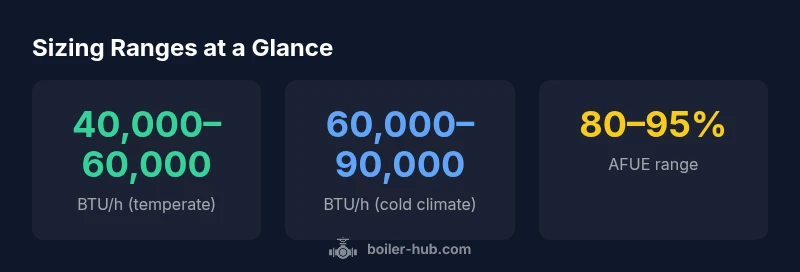
Boiler Hub Analysis, 2026, finds that a typical 1,200 sq ft home in moderate climates usually requires a 40,000–60,000 BTU/h boiler. In colder climates or poor insulation, sizing may climb to 60,000–90,000 BTU/h. Use a professional load calculation to confirm exact needs. This starting point helps avoid under- or oversizing and aligns with energy-efficiency goals.
Understanding boiler sizing basics
Boiler size is measured in output BTU per hour and reflects the maximum heat a boiler can deliver. For a 1,200 sq ft home, load calculations typically land in a baseline range of 40,000–60,000 BTU/h in moderate climates with good insulation. In colder climates or homes with drafts, this baseline can climb toward 60,000–90,000 BTU/h. The right size minimizes short cycling, ensures steady indoor temperatures, and avoids wasted fuel. According to Boiler Hub Analysis, 2026, the goal is to match heat output to demand, not simply to the square footage. Factors such as ceiling height, number of exterior walls, window quality, and thermostat practices all influence the final number. Sizing too small leads to undue stress on the boiler and poor comfort; sizing too large wastes energy and raises upfront costs. In summary, base your estimate on loads rather than rough guesses, then refine with a professional assessment.
How climate, insulation, and load affect size
Climate and insulation are the primary levers in boiler sizing. A home in a temperate climate with good insulation may perform well with the baseline range, while homes in cold regions or with significant air leakage often need larger outputs. Ceiling height, window efficiency, and shading affect heat loss, which translates to a higher or lower BTU requirement. Occupancy patterns and hot water usage also play a role; if you have simultaneous heating and high domestic hot water demand, sizing may shift. The purpose of sizing is to align the boiler’s peak output with peak demand, avoiding waste and ensuring comfort even on the coldest days.
Steps to size for 1200 sq ft: heat loss calculation
Step 1: Gather basics – Determine square footage, insulation level, window types, and ceiling heights. Gather climate data for your location. Step 2: Estimate design heat loss – Use a formal heat-loss method (Manual J-like) or reputable software to estimate the hourly heat loss at design conditions. Step 3: Convert to BTU/h range – Translate the heat loss into a BTU/h range, considering safety margins. For 1,200 sq ft, see the typical baselines above. Step 4: Adjust for hot water needs – If you have a large domestic hot water load, factor it into the peak demand. Step 5: Validate with a professional – Have a licensed technician verify with现场 measurements or a detailed load-calculation worksheet. These steps aim to answer the common question what size boiler for 1200 sq ft with a data-driven approach.
Choosing a boiler type for 1200 sq ft
For a 1,200 sq ft home, you’ll typically choose between condensing and non-condensing boilers. Condensing models offer higher efficiency (often 90% AFUE or above) and can justify selecting a slightly larger output if well-insulated. The decision also depends on your climate and energy goals. Gas-fired boilers are common for new installs in many regions, while electric or oil-fired options may suit specific circumstances. In all cases, the boiler you select should be paired with an appropriately sized circulator and radiators (or underfloor heating) to maintain even heat distribution. A properly sized system reduces cycling, improves comfort, and lowers operating costs over time.
Notes and considerations about future upgrades or retrofits can influence long-term sizing goals.
Sizing ranges and methods for 1,200 sq ft homes
| Scenario | Guidance | Notes |
|---|---|---|
| Baseline size (temperate climate) | 40,000–60,000 BTU/h | Good insulation; 1,200 sq ft; standard ceilings |
| Cold climate adjustment | 60,000–90,000 BTU/h | Low insulation; larger home or high air leakage |
| Efficiency range (AFUE) | 80–95% | Use condensing boilers for best efficiency |
| Load calculation method | Manual J-like calculation | Obtain professional assessment |
Questions & Answers
What factors influence boiler size besides square footage?
Climate, insulation, window quality, air leakage, hot water demand, and occupancy patterns all influence the required boiler size.
Climate and insulation, plus home details, matter for size.
Can I rely on rough BTU estimates instead of a professional load calculation?
Rough estimates can lead to oversizing or undersizing; a professional load calculation provides accuracy.
Don’t guess—get a proper load calculation.
How does insulation quality affect boiler sizing?
Better insulation reduces heat loss, which can lower the required boiler size by a noticeable margin depending on climate.
Good insulation can cut the needed boiler size.
Is 1200 sq ft always sized at 40-60k BTU/h?
Not always; it varies by climate, heating needs, and heat loss; use a calculation.
It depends—get a calculation.
How often should boiler sizing be reevaluated?
During renovations, energy upgrades, or significant weather changes, recheck size.
Reevaluate when you remodel or improve insulation.
What role does boiler AFUE play after sizing?
AFUE affects operating cost; a correctly sized boiler with high AFUE yields best efficiency.
Size matters; efficiency helps save money.
“Sizing correctly is essential for comfort and efficiency; a precise load assessment prevents oversized systems and reduces energy waste.”
Key Points
- Start with a baseline 40,000–60,000 BTU/h for 1,200 sq ft in temperate climates
- Adjust sizing up for cold climates or poor insulation
- Perform a professional load calculation for accuracy
- Pair size with high-efficiency boilers to maximize savings