Is My Boiler Powerful Enough? A Practical Troubleshooting Guide
Quickly assess if your boiler can meet your home’s heating and hot water needs, learn how to size correctly, and follow a step-by-step plan to address under-sizing or mismatches with safety and expert guidance.


Is my boiler powerful enough? In most homes the simplest fix is to compare your boiler’s output against your heating load and the number of radiators. If comfort is inconsistent or rooms stay cold, it’s a strong sign you may need a larger unit or improved zoning. This guide helps homeowners troubleshoot safely and plan next steps without delaying comfort.
Is my boiler powerful enough? What this guide covers
Is my boiler powerful enough? This question sits at the heart of comfort, energy use, and long-term maintenance. In this guide, we examine how to judge whether your boiler has adequate output for your home and how to act if you discover a mismatch. According to Boiler Hub, the right boiler size depends on the heat load, insulation, and living patterns. We’ll break down what to measure, what to expect, and how to plan next steps. The goal is to empower homeowners with clear, actionable steps that improve comfort and efficiency without unnecessary risk.
Key takeaways from Boiler Hub research:
- Size matters: too small results in cold rooms and high energy use.
- Insulation and air sealing reduce the required boiler power for the same space.
- Proper controls and zoning can mitigate mismatches without immediate replacement.
How boiler power is measured and what it means for your home
Boiler power is expressed as an output rating, typically in kW or BTU/h. The rating represents the maximum heat the boiler can deliver to the system. A well-matched boiler should be able to cover peak demand (coldest days, multiple radiant zones, and hot water) without excessive cycling. Modulation and efficient burner technology help your boiler meet load more gradually, which reduces wear and energy waste. When your home’s heating load exceeds the boiler’s capacity, you’ll notice slow warm-up, cold spots, and frequent on/off cycling. Conversely, an oversized boiler can heat zones quickly, then short-cycle, wasting fuel and causing comfort swings. Understanding your system layout, radiator size, and domestic hot water demand is essential to gauge proper power.
Factors that influence required boiler power
Several variables determine how much power your boiler needs: the size and layout of your living space, number of habitable rooms, the level of insulation and air leakage, climate, and how many radiators or heating zones you have. Homes with poor insulation, drafty windows, or unsealed floors demand more heat, increasing the required boiler output. If you rely on multiple bathrooms or have a high hot-water demand, you may also need greater reserve capacity. The presence of radiant floors or baseboard heating changes how heat distributes, so even the same square footage can require different boilers depending on layout and control strategy. A professional heat-load calculation can provide a precise number.
Signs your boiler may be underpowered or mismatched
- Rooms take longer to warm up or never reach setpoint in cold weather.
- Some rooms stay noticeably cooler than others, despite balanced radiator valves.
- The boiler runs frequently with short cycling, increasing wear and energy use.
- Hot-water demand seems unmet during peak times or in households with multiple users.
- Noise, banging, or pressure fluctuations accompany cycling and temperature changes.
Quick checks you can safely do today
- Verify thermostat and control settings are correct for the current season and occupancy.
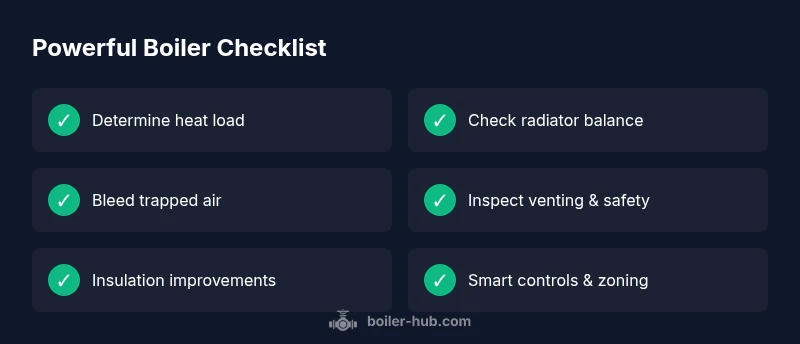
- Bleed radiators to remove trapped air that blocks heat transfer.
- Check radiator balance and zoning; ensure flow is evenly distributed across zones.
- Inspect the boiler pressure (if visible) and listen for unusual cycling or short bursts of heat inconsistent with the thermostat.
- Review insulation, seals around doors/windows, and pipe insulation to minimize heat loss. If any of these steps doesn’t restore comfort, it’s time to call a pro for a formal assessment.
Estimating your boiler size using simple rules of thumb
While exact sizing requires a formal heat-load calculation, homeowners can start with practical guidelines: a note on the typical relationship between house characteristics and boiler output helps frame decisions before a professional assessment. Focus on peak heating demand, number of radiators, and whether you have hot water for several baths. Use this as a rough compass and plan a professional evaluation if you notice persistent comfort issues or rising energy use. A well-matched system balances comfort, efficiency, and reliability.
What to do if you find your boiler is underpowered
If the match is off, you have several viable paths: upgrade to a higher-output model designed for your load, install zoning to concentrate heat where needed, or improve insulation and air sealing to reduce load. In some cases, modest equipment changes—such as replacing a legacy pump or adding a weather compensation control—can yield noticeable gains without a full upgrade. Always prioritize safety and compliance. A licensed technician should assess venting, combustion safety, and boiler condition before any major change.
How to re-match or replace: options and considerations
Up-sizing a boiler is the most direct solution when heat load exceeds current capacity. However, oversizing can waste energy and cause short cycling, so work with a professional to determine a precise match. Alternatives include adding zoning, upgrading to high-efficiency boilers, or implementing modern controls (smart thermostats, weather compensation, and outdoor reset). Discuss lifecycle costs, maintenance implications, and warranty terms. Consider the building’s future: ongoing renovations or reconfigurations can alter heating needs and justify a future re-size or replacement plan.
Practical prevention: maintain efficiency and avoid oversizing
Prevention focuses on reducing heat loss, maintaining equipment, and smart control. Regular servicing ensures correct ignition, safe venting, and clean heat exchangers, preserving efficiency. Air sealing, insulation upgrades, and weatherproofing lower the required boiler power for the same space, allowing a smaller, more efficient unit to deliver comfort reliably. Finally, use zoning and smart controls to adapt to occupancy and weather, avoiding wasteful heating or over-sizing in the first place.
Steps
Estimated time: 60-120 minutes
- 1
Verify heat load and current boiler rating
Start by locating the boiler’s nominal output rating and compare it to your home’s heat load. Gather room-by-room temperature complaints, number of radiators, and hot-water usage patterns. A professional heat-load calculation should be performed if you’re uncertain about the numbers.
Tip: Document any atypical or seasonal usage to inform the evaluation. - 2
Check thermostat controls and settings
Ensure the thermostat is calibrated, the schedule matches occupancy, and that warming setpoints are appropriate for the season. Unreliable programming can masquerade as an underperforming boiler and lead to unnecessary replacements.
Tip: Test a quick manual setback/raise to observe response and stability. - 3
Bleed radiators and confirm system balance
Release air from radiators that feel cold at the top; this improves heat transfer. Then review radiator balance across zones to verify even heat distribution. Imbalances can cause some areas to heat unevenly despite a healthy boiler.
Tip: Do not ignore a noisy pump or banging pipes during bleeding. - 4
Inspect boiler pressure and pump operation
Check the boiler pressure (if accessible) and listen for steady pump operation. Fluctuations or improper circulation can mimic an underpowered system. If you’re unsure, call a licensed tech for a safety check.
Tip: Never open pressure relief valves or adjust settings beyond your manual’s guidance. - 5
Evaluate insulation and air leakage
Inspect doors, windows, attic hatch, and ductwork for drafts. Heat loss dramatically increases the required boiler output, so addressing leaks can reduce load and improve comfort.
Tip: Seal first, insulate second for cost-effective gains. - 6
Plan for professional assessment if issues persist
If cold spots remain after basic checks, arrange a formal evaluation with a registered heating engineer. They can perform precise measurements, verify venting and safety, and discuss upgrade options.
Tip: Ask for a written plan with cost estimates and payback timelines.
Diagnosis: Heating demands are not being met; some rooms stay cold and boiler cycles frequently.
Possible Causes
- highUnderpowered boiler for current heat load
- mediumImbalanced or undersized radiators and poor zoning
- lowInsulation and air leaks increasing heat loss
Fixes
- hardHave a heating engineer recalculate the required boiler output (kW) and system design; upsizing or selecting a more capable boiler may be necessary
- easyBalance the radiator circuit, bleed air, and adjust zoning valves or thermostatic radiator valves
- easyImprove insulation, seal leaks around windows/doors, and consider draft-proofing to reduce overall load
Questions & Answers
How do I know if my boiler is correctly sized for my home?
A correctly sized boiler meets peak heating and hot-water demand without frequent cycling. It’s determined by a formal heat-load calculation, radiant-system layout, and insulation level. Signs of mismatch include cold rooms, long warm-up times, and high energy use.
A correctly sized boiler should heat your home evenly without short cycling; a professional heat-load calculation confirms this.
Can an underpowered boiler really raise my energy bills?
Yes. An undersized boiler runs longer to compensate for demand, wasting fuel and increasing wear. Improving fit with zoning and insulation often lowers bills more than simply increasing boiler size.
An undersized boiler makes you burn more energy trying to reach comfort, so it’s worth checking sizing and efficiency.
Is replacing my boiler the only solution if it’s underpowered?
Not always. You can often re-size, optimize with zoning, and improve controls or insulation. A full replacement may be best if the current unit cannot handle peak demand or is aging and inefficient.
Upgrading or resizing often solves the issue, but professional assessment is essential.
What’s the difference between kW and BTU when sizing boilers?
kW and BTU are both units for heat output. A proper conversion is needed to compare products. A professional can translate between these units for your region and system.
kW and BTU are just two ways to describe heat output; a pro will help you compare them correctly.
How long does a boiler sizing evaluation take?
A professional assessment typically takes a few hours, depending on system complexity and accessibility. It includes load calculations, equipment checks, and a sizing recommendation.
Most sizing assessments are done in a half-day, including measurements and a written report.
Will upgrading my boiler fix hot-water shortages?
If hot-water demand is the problem, a larger or more efficient boiler may help, but there could be other factors such as tank size, circulation, or plumbing layout. A technician can verify.
A bigger boiler can help hot water if the issue is limited by capacity, but other plumbing factors may play a role.
Watch Video
Key Points
- Match boiler size to heat load, not just square footage
- Improve insulation to lower the required boiler power
- Use zoning and smart controls to optimize comfort
- Consult a pro for formal heat-load calculations and sizing