Is Boiler the Same as Water Tank? A Practical Comparison
Explore whether a boiler and water tank are the same, how they differ, and how to choose the right setup for efficiency and reliability.


Many homeowners ask 'is boiler the same as water tank?' The answer is no—boilers heat water for heating or hot water, while a storage tank holds hot or cold water. In many homes they work together, but they are distinct components: the boiler generates heat, the tank stores or distributes it. Understanding the difference helps with sizing, efficiency, and maintenance.
Definitions: What is a boiler vs a water tank?
A boiler is a heat-generating device that uses energy (gas, oil, or electricity) to raise the temperature of water. The heated water is circulated through radiators, underfloor heating, or taps to provide space heating and domestic hot water. A water tank, also called a storage tank or hot water cylinder in some regions, is an insulated vessel that stores heated water until it is needed. The essential difference is function: the boiler creates heat; the tank buffers or stores it for later use. Some systems combine these roles in a single unit — a combi boiler heats water on demand without a storage tank — while others pair a boiler with a separate storage tank to ensure supply during peak demand. Indirect water heaters use a separate tank heated by the boiler, which decouples heat generation from storage. In practice, the choice affects how much space you need, how quickly hot water is delivered, and how efficiently your home runs. Understanding the distinction helps homeowners plan for reliability, comfort, and long-term energy costs.
System context: Where boilers and water tanks fit in home heating
Most homes rely on a heating network that includes a boiler to heat water and a distribution system (radiators or underfloor heating) to transfer heat. Domestic hot water for taps and showers may come from the same source or from a separate storage tank. In a combi boiler, hot water is produced on demand and no large storage tank is required, saving space but potentially limiting flow during simultaneous use. In traditional systems, a storage tank holds hot water, heated by a boiler or another heat source, and then released as needed. Indirect water heaters provide a buffer tank heated by the boiler, decoupling heat generation from storage and allowing more predictable hot-water delivery. The optimal configuration depends on your home’s size, water demand patterns, and space constraints. The Boiler Hub perspective emphasizes aligning system design with actual usage rather than chasing the latest technology for every house.
Key differences at a glance
- Function and purpose: A boiler generates heat; a water tank stores heated water for later use. The former drives heating circuits and on-demand hot water; the latter buffers supply.
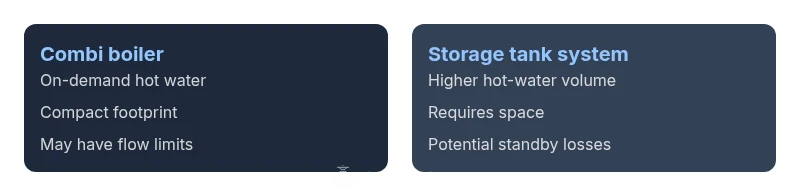
- Space and footprint: Combi boilers are compact and fit in small spaces; storage tanks require a larger footprint and sometimes a separate shaft or cupboard.
- Hot-water delivery: Combi systems deliver hot water on demand but can have flow limits; storage tanks can supply larger volumes simultaneously but may require more complex controls.
- Energy use: Sizing matters for both; a correctly sized system minimizes standby losses and improves performance, while mis-sizing leads to wasted energy.
- Maintenance and components: A combi boiler typically has fewer components; a storage-tank setup adds tanks, pumps, and extra valves that can require additional maintenance.
- Ideal scenarios: Combi is often best for small homes with modest hot-water demand; tank-based systems excel in larger homes with high simultaneous hot-water needs.
Common configurations and what they mean for you
- Combi boiler (no storage tank): Pros include space savings and simplicity; cons include potential flow limits when multiple taps are used at once. Best for small homes, apartments, or where space is at a premium and hot-water demand is moderate.
- Traditional boiler with storage tank: Pros include ample stored hot water and resilience during boiler cycling; cons include space requirements and standby losses. Suitable for larger homes or households with higher simultaneous hot-water demand.
- System boiler with indirect water heater: Pros include scalable storage and reliable delivery; cons involve additional equipment and potential complexity. A good middle-ground for mid-sized homes with variable hot-water use.
- Hybrid approaches: Some homes combine a boiler with a buffer tank and an electric heat source for backup; suitability depends on climate, energy prices, and space. Evaluate your peak loads and future needs when choosing a setup.
Comparison
| Feature | Combi boiler (no storage tank) | Traditional boiler with storage tank |
|---|---|---|
| Function | On-demand hot water + space heating | Stored hot water + space heating |
| Storage | No fixed storage (water heated on demand) | Dedicated insulated storage tank for hot water |
| Flow rate impact | Flow limited by boiler output during simultaneous use | Higher potential hot-water volume with tanked storage |
| Space requirements | Compact footprint | Larger footprint due to storage tank and associated controls |
| Best for | Small homes and spaces, moderate demand | Larger homes with high simultaneous hot-water demand |
| Upfront cost | Typically lower upfront for modern combi options | Higher upfront for tanks and additional plumbing |
| Maintenance | Fewer components; simpler service in many cases | More components (tank, valves, pumps) requiring maintenance |
Advantages
- Compact footprint in many modern setups
- Space-saving and simpler for small homes
- Potentially lower upfront cost with combi configurations
- Modern boilers with efficient controls can reduce energy use
- Flexible options for future upgrades
The Bad
- Storage tanks require space and may limit where a system fits
- Standby heat losses in tank-based setups
- Combis can have limited flow under heavy hot-water demand
- Storage-tank systems can be more complex to install and service
Choose based on your hot-water needs and space constraints: combi boilers suit small homes with moderate demand, while storage-tank or indirect systems excel for larger homes with high simultaneous hot-water use.
For homes with limited space and modest hot-water needs, a combi boiler provides reliable on-demand heat without a tank. If your household regularly runs multiple taps at once, or if you want greater stored hot-water capacity, a storage tank or indirect system is often the better choice. A professional sizing assessment is essential to optimize efficiency and comfort.
Questions & Answers
What is the main difference between a boiler and a water tank?
The main difference is function: a boiler generates heat, while a water tank stores heated water for later use. The choice affects how you heat your home and how you manage hot water supply.
Boiler makes heat; a water tank stores it for later use.
Can a combi boiler replace a storage tank?
In many homes a combi boiler can replace a storage tank, especially where space is tight and hot-water demand is moderate. It may not be ideal for very high simultaneous demand or very large houses.
Yes, in many cases, but it depends on your water needs.
Is a water tank necessary if you already have a boiler?
Not always. If you have a combi boiler, you may not need a storage tank. If your home has higher hot-water demand, a storage tank or indirect system can ensure supply.
Not always; depends on your usage and setup.
Which setup is best for a small apartment?
A combi boiler is typically best for small apartments due to compact size and on-demand hot water. It minimizes space needs while delivering sufficient hot water for one or two bathrooms.
Usually a combi boiler works well for small spaces.
What maintenance is required for these systems?
Annual professional servicing is recommended for boilers and storage tanks. Regular checks should include pressure, venting, expansion tanks, and leak detection to maintain safety and efficiency.
Schedule an annual service and keep an eye on leaks or unusual noises.
What should I consider about cost when choosing between these options?
Cost depends on the configuration and installation. Combi systems generally cost less upfront in small homes, while tank-based systems may require more space and plumbing work but can offer greater reliability for high demand.
Costs vary; bigger systems cost more and need space.
Key Points
- Assess peak daily hot-water demand before choosing a configuration
- Combi boilers save space but may limit flow at high usage
- Storage tanks increase hot-water availability at the cost of space and complexity
- Proper sizing and system integration are key to efficiency and comfort
- Consult a licensed professional to tailor the setup to your home