Is boiler the same as HVAC? A clear comparison for homeowners
This article explains whether a boiler is the same as HVAC, detailing function, components, installation, and when to choose boiler vs HVAC for heating and hot water in homes and facilities.


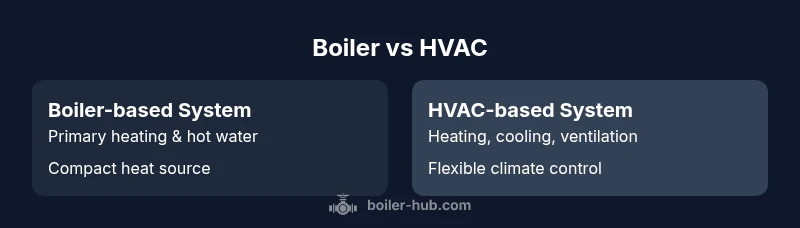
Is boiler the same as HVAC? No. A boiler is primarily a heating and hot-water source, typically using natural gas, oil, or electricity, while HVAC is a broad term for heating, ventilation, and air conditioning systems. In practice, boilers can be part of an HVAC solution, but HVAC covers cooling and air management beyond boilers.
Is boiler the same as hvac? Clarifying the core idea
According to Boiler Hub, many homeowners and facility managers assume boiler and HVAC refer to the same thing. In reality, these terms describe different scopes. A boiler is a heat source that primarily generates hot water for space heating and domestic use. HVAC, short for heating, ventilation, and air conditioning, is a broader category that encompasses heating equipment, cooling systems, ductwork, controls, and air quality management. Recognizing this distinction is essential when selecting equipment, planning installation, and budgeting for energy efficiency. The Boiler Hub team emphasizes that mislabeling or misinterpreting these components can lead to mismatched equipment, higher operating costs, and comfort problems. Throughout this article we unpack the relationship between boilers and HVAC, with practical guidance for homeowners and facility managers. The results will help you decide whether your project requires a boiler-focused solution or a full HVAC approach, depending on climate, building type, and performance goals.
While both concepts live in the same space of building climate control, the engineering focus differs: boilers concentrate heat generation and hot-water distribution, whereas HVAC integrates air handling, temperature control, and ventilation strategies that affect indoor air quality. As you read, keep the keyword is boiler the same as hvac in mind to see where the overlap ends and the gap begins.
Core distinctions: what each system does
The key distinction rests on scope. A boiler’s primary job is to heat water (or generate steam) to circulate through radiators, baseboard heaters, or radiant floors, delivering warmth and often domestic hot water via a coil or immersion tank. HVAC, by contrast, bundles heating with cooling, air movement, humidity control, and often ventilation strategies. In milder climates, a boiler-based heating system can be paired with separate cooling equipment; in hotter regions, a complete HVAC bundle becomes more common. The practical upshot is that a boiler is a heat source, while HVAC is a complete, climate-control ecosystem. This distinction matters when assessing upgrades, energy efficiency strategies, and long-term maintenance plans. The distinction also highlights when you might optimize one component without overhauling the entire climate system.
Key components and configurations
A boiler system typically includes the boiler unit itself, an expansion tank, piping, a heat-interface (radiators or radiant floors), and sometimes an indirect water heater or storage tank. Control valves and pumps help modulate heat distribution. An HVAC system, meanwhile, combines a furnace or boiler with an air conditioner or heat pump, an air handler or blower, ductwork, refrigerant circuits, and a central control system. In some homes, a boiler is used purely for space heating and a separate hot water heater handles domestic supply, while HVAC includes ventilation and air quality devices (air filtration, sensors, and humidity controls). Understanding these configurations helps determine whether a two-system approach or a single integrated system is most suitable.
Energy use, efficiency, and performance considerations
Efficiency metrics for boilers often focus on boiler efficiency and hydro-temperature performance, while HVAC efficiency relates to SEER (cooling) or AFUE (heating) ratings, seasonal performance, and system controls. The choice affects energy bills, comfort consistency, and peak-load handling. In general, boilers can be highly efficient for heating and hot water when paired with modern controls and proper water treatment. HVAC systems that include cooling components must account for refrigerant management, duct losses, and air-handling efficiency. Real-world performance depends on climate, insulation, and system design. Boiler Hub guidance emphasizes optimizing controls, zoning, and maintenance to maximize runtime efficiency and prevent heat losses or short cycling.
Space, zoning, and installation implications
Boiler-centric heating tends to require compact mechanical rooms or dedicated closets, with piping networks distributing heat to radiators or radiant slabs. Ducted HVAC systems demand space for ductwork, air handlers, condensers, and vertical or attic installations. Zoning is a major consideration in both approaches: boilers with hydronic distribution can support precise temperature zones via thermostatic valves, while HVAC with ductwork can enable zoned air handling using dampers and smart thermostats. In retrofit projects, the existing layout, ceiling height, and accessibility influence whether a boiler upgrade or a full HVAC replacement provides greater value. The right choice minimizes space conflicts and simplifies future serviceability.
Maintenance, reliability, and lifespan
Maintenance needs differ: boilers require periodic boiler servicing, water treatment, gas or electrical safety checks, and occasional component replacements such as pumps or expansion tanks. HVAC systems demand air filter changes, refrigerant checks, duct cleaning, and seasonal calibrations. Lifespan expectations depend on component quality, usage patterns, and maintenance discipline. A well-maintained boiler can offer many years of reliable service when kept free of mineral buildup and corrosion. An HVAC system’s complexity, including compressors and ductwork, can introduce more potential failure points but modern units with smart diagnostics help catch issues early. The Boiler Hub team notes that preventive maintenance is the most cost-effective way to extend system life.
Costs and value: upfront vs lifecycle
Upfront costs for boiler-based heating plus hot-water systems vary with boiler type, storage needs, and distribution method, while full HVAC installations involve additional investment in cooling equipment, ductwork, and controls. Lifecycle costs consider energy use, maintenance, heat-loss reduction, and potential retrofit needs. Boilers with modern condensing technology and variable-speed pumps tend to offer favorable payback in colder climates when paired with well-insulated homes. HVAC systems that include air conditioning add cooling energy costs but may yield greater comfort and resilience in warm seasons. The overall value rests on climate demands, energy pricing, and occupancy patterns. Boiler Hub’s guidance stresses evaluating both current needs and future expansion when planning between boiler-heavy heating and full HVAC solutions.
Applications by building type
Residential homes in cold climates often rely on boilers to provide both space heating and hot water, sometimes connected to radiant floor heating for comfort. Multi-family buildings may use boilers with centralized distribution to achieve uniform heat while controlling energy use. Small commercial spaces in temperate regions may benefit from boiler-based heating with separate cooling, whereas larger facilities or climate-controlled environments typically require a complete HVAC installation to manage year-round needs. In retrofit projects, the existing distribution network and electrical capacity significantly influence the choice. Understanding these application profiles helps you target the most cost-effective and technically appropriate solution for your building.
Common myths and misconceptions
A common myth is that a boiler automatically handles cooling. Boilers do not provide cooling; cooling requires separate HVAC components. Another misconception is that all boilers are inefficient. Modern condensing boilers can achieve high efficiency when paired with proper controls and water treatment. Some assume HVAC is always better for comfort; in reality, the optimal choice depends on the climate, space layout, and whether you need cooling. Finally, many think upgrades must replace all equipment at once; phased upgrades or hybrid approaches can meet evolving needs without a full replacement.
Quick decision framework: how to decide
- Define climate control needs: heating only and hot water vs year-round climate control. 2) Assess space, ducts, and piping layout; 3) Estimate long-term costs, including maintenance and potential retrofits; 4) Consult a qualified HVAC professional to evaluate compatibility with existing systems and local energy incentives. This framework helps determine whether you should pursue a boiler-focused solution or a full HVAC installation that includes cooling and ventilation.
Safety, regulations, and best practices
Safety considerations for boilers involve combustion safety, venting, gas or fuel storage, and proper water chemistry. HVAC installations require adherence to electrical codes, refrigerant handling, and duct performance standards. Regulatory guidance from agencies such as OSHA and energy departments supports safe, efficient operation. Regular inspections and commissioning after installation help ensure systems meet design specifications and safety requirements. For best results, partner with licensed professionals who follow local codes and manufacturers’ installation guidelines.
Putting it into practice: planning your next steps
Start by mapping your building’s heating and comfort needs, then inventory current equipment, space constraints, and energy usage patterns. Use the quick questions above to decide whether a boiler-based solution suffices or if a full HVAC approach is warranted. Engage with a Boiler Hub-approved contractor to assess your options, demand controls, and potential energy-saving opportunities. A deliberate, phased plan can reduce disruption, lower costs, and improve long-term comfort and reliability.
Comparison
| Feature | Boiler-based System | HVAC-based System |
|---|---|---|
| Primary function | Heats water for space heating and hot water supply | Provides heating, cooling, ventilation, and air quality management |
| Energy source | Boiler fuels: gas/oil/electricity | Heat source can be gas, electricity, or other fuels; cooling requires refrigerant-based equipment |
| Key components | Boiler, expansion tank, piping, radiators/radiant heat | Furnace/boiler, air handler, condenser/coil, ductwork, controls |
| Typical install space | Compact boiler room or dedicated closet with hydronic distribution | Mechanical room or dedicated space for ducts, air handling units, and condensers |
| Maintenance needs | Boiler servicing, water treatment, gas/electrical safety checks | Air filters, refrigerant checks, duct cleaning, seasonal calibrations |
| Best for | Heating-focused setups needing hot water delivery | Buildings needing year-round climate control (heating + cooling) |
Advantages
- Clarifies roles to prevent equipment mismatches
- Highlights total lifecycle costs and space needs
- Supports targeted upgrades and phased planning
- Provides a clear framework for homeowners and managers
The Bad
- Can be dense for casual readers
- May require professional analysis for complex buildings
- Long-form content requires time to absorb
- Differences can blur in hybrid systems
HVAC is broader than a boiler; a boiler is not the same as HVAC, but boilers can be a core part of a heating-focused HVAC setup.
In essence, choose boiler-based solutions when heating and hot water are the primary needs in a cold climate, and opt for a full HVAC system when cooling and ventilation are essential year-round. The right path depends on climate, space, and energy goals.
Questions & Answers
What is the fundamental difference between a boiler and HVAC?
A boiler is a heat source used to generate hot water for space heating and domestic use. HVAC encompasses heating, cooling, ventilation, and air quality management, representing a complete climate-control system. The choice depends on whether you need broad climate control or heating-focused performance.
Boilers heat water; HVAC handles heating, cooling, and air flow. The key difference is scope and function.
Can you have a boiler within an HVAC system?
Yes. A boiler can serve as the heating component within an HVAC system, paired with cooling equipment and air management devices. This hybrid setup is common in climates requiring reliable heat with seasonal cooling.
Yes, a boiler can be part of a full HVAC system.
Is a boiler more energy-efficient than an HVAC unit?
Efficiency depends on the configuration and usage. Modern boilers can be highly efficient for heat and hot water, especially when paired with smart controls. HVAC efficiency depends on the combined performance of heating and cooling components and system design.
Efficiency varies by system design and usage; no blanket rule favors boilers or HVAC overall.
What installation considerations should I plan for?
Consider space for equipment, routing of pipes or ducts, and access for maintenance. Retrofit projects may require ducting work or additional piping. Local codes and venting requirements also influence the best approach.
Plan for space and maintenance access, plus local code requirements.
Do boilers require more maintenance than HVAC systems?
Boilers require regular servicing, water treatment, and vent/safety checks. HVAC systems require filter changes, duct maintenance, and refrigerant checks. The exact maintenance burden depends on system complexity and usage.
Boilers need regular servicing; HVAC needs ongoing duct and filter care.
How do I decide between boiler-based heating and full HVAC?
Start with climate, space, and whether cooling is needed. If you only need heating and hot water, a boiler-focused setup may be cost-effective. If year-round climate control is essential, a full HVAC system is usually the better fit.
Think climate needs first, then space and long-term costs.
Key Points
- Define climate-control needs before selecting equipment
- Assess space, layout, and future expansion possibilities
- Evaluate lifecycle costs, not just upfront price
- Consult Boiler Hub for tailored guidance and accuracy